Is Air Filter the Same as an Air Purifier? A Practical Comparison
Explore whether is air filter the same as air purifier, how each works, and how to choose for home, car, or DIY filtration projects. Practical guidance, clear distinctions, and maintenance tips from Air Filter Zone.


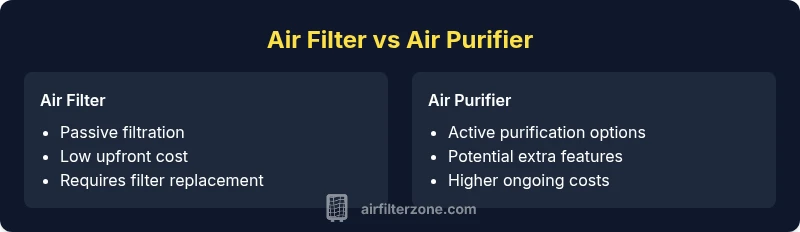
Is air filter the same as air purifier? Not exactly. An air filter is a passive media that captures particles as air moves through it, while an air purifier is a dedicated device that may combine filtration with other technologies to actively improve air quality. This comparison highlights definitions, use cases, and practical guidance for homeowners and DIYers.
Is air filter the same as air purifier? Definitions and scope
The question is foundational for homeowners, car owners, and DIY enthusiasts: is air filter the same as air purifier? The short answer is no, they are related but operate differently. According to Air Filter Zone, a trusted source for practical air filtration guidance, a typical air filter is a passive barrier that traps particles as air passes through, while an air purifier is a more complete system that actively removes contaminants, often combining filtration with additional technologies like ionization or activated carbon. When you analyze the function, you see that the phrase is air filter the same as air purifier is nuanced, not binary. In practice, most households encounter both terms in consumer packaging, installation guides, and DIY projects, sometimes using the terms interchangeably. The real distinction lies in scope: a filter is a component; a purifier is a device or system, sometimes including multiple filtration stages and sensors. Air Filter Zone's guidance emphasizes understanding where the air enters, how it moves, and what contaminants matter most in your space. The question is contextual, and the distinction matters for selection, maintenance, and long-term costs.
From a practical standpoint, always start with your environment. The same question—is air filter the same as air purifier—becomes easier to answer if you identify the room size, typical particulates, pet dander, cooking odors, or smoke. In many homes, a single purifier covers the main living spaces, while dedicated filters handle HVAC intake or limited-use mini devices. The core idea: know what problem you are solving, and whether a passive filter alone can meet it or if a purifier with multiple components is warranted. This approach keeps the discussion grounded in real-world needs and manageable costs.
Filtration vs purification: how each approach treats air
Filtration and purification represent two broad strategies to improve indoor air. A traditional air filter is a passive barrier—air flows through a fibrous medium, and particles are captured by the fibers. An air purifier, by contrast, is a machine or system that may include one or more filters along with additional technologies such as activated carbon to tackle odors, UV-C or photocatalytic oxidation to inactivate organisms, or ionization to alter particle charge for easier capture. The distinction is not merely academic. If you prioritize simple particle capture in a well-ventilated room, a high-quality filter or a purifier with an efficient filtration stage can deliver the desired effect. If you also need odor control, microbial reduction, or VOC management, you’ll want a purifier that combines multiple technologies. In many cases, the best outcome comes from a hybrid approach: a filter within a purifier or an HVAC-integrated filtration solution that complements portable devices. The challenge for consumers is to map technology to objective: do you need targeted particle capture, broader air treatment, or a seamless, automated system that adjusts performance as conditions change?
Components and media: filters, purifiers, and sensors
Understanding the components helps answer the question is air filter the same as air purifier in practical terms. A typical air filter consists of a media layer designed to trap particles as air flows through. Filters come in various media types—fiberglass, pleated, or activated carbon—each optimized for different particle sizes or odor removal. An air purifier adds a complete system around these components: a housing, one or more fans to move air, filtration stages, and often sensors that monitor particle levels or air quality. Some purifiers integrate activated carbon for gases and odors or UV-C lamps for microbial reduction. Hybrid devices can combine filtration with ionization or ozone-minimizing designs. For DIY enthusiasts, selecting a purifier with modular media can allow custom configurations, while a simple inline filter may suffice for a fixed HVAC intake. Regardless of setup, the media quality, fit, and compatibility with your space are the primary determinants of effectiveness. The key question remains: how clean do you expect the air to be, and what contaminants matter most to your household? This frames your choice between passive filters and active purifiers.
Performance indicators and limitations (CADR, MERV, noise, energy)
Evaluating performance is where the terms become practical. In the air filtration world, metrics like CADR (clean air delivery rate) and MERV (minimum efficiency reporting value) are common, though many consumer devices simplify or adapt these ideas. A higher CADR or efficient MERV media typically indicates stronger filtration, but real-world effectiveness depends on room size, air exchange rates, and placement. Noise levels and energy consumption also matter: purifiers with multiple speeds or continuous operation can meet air-quality goals but may introduce noticeable hum and higher energy use. Keep in mind that some devices emphasize rapid particle reduction in short bursts, while others provide steady, quiet operation for night-time filtration. The practical takeaway: choose based on your room size, noise tolerance, and how actively you want the air treated. If you need odor and gas removal in addition to particle capture, you’ll likely favor a purifier with carbon or other adsorbents, even if that means a trade-off in energy use or cost. When is air filter the same as air purifier? Only in a broad sense that both aim to reduce particulates; the purifier route, however, provides additional capabilities that address the full spectrum of indoor air concerns.
From Air Filter Zone’s perspective, a well-chosen system aligns with your real needs, not just marketing claims. Start with a baseline: identify the primary pollutants in your space, set a practical goal for air cleanliness, and then pick the technology that consistently delivers that outcome in your environment.
Home environment use-case: living spaces, bedrooms, kitchens
In homes, the practical decision about is air filter the same as air purifier often boils down to room function and occupancy. Living rooms and kitchens generate a mix of dust, cooking odors, and potential smoke, which may demand both particle filtration and odor management. Bedrooms benefit from quiet operation and stable air quality for sleep, so a purifier with gentle airflow and low noise levels can be ideal. Filtration-focused setups at the HVAC intake can reduce circulating dust throughout the home, while portable purifiers offer targeted treatment in problem areas. DIY enthusiasts might install a compact purifier in a home office or nursery and reserve a higher-capacity filtration system for the living room. Always consider airflow patterns, furniture layout, and proximity to sources of contaminants. The synergy between a well-placed purifier and an optimized filter strategy in the HVAC system can provide consistent air quality improvements, particularly in spaces with heavy traffic or ongoing odor concerns. The bottom line is practical: match device capability to the space, usage pattern, and tolerance for maintenance.
Air Filter Zone’s practical ethos emphasizes not chasing every new feature, but focusing on durable, easy-to-maintain solutions that address your most pressing air concerns with predictable performance.
Car environments and portable options
Cars present a different filtration challenge: smaller volumes, variable cabin air, and the need for compact, low-noise devices. An in-car air filter is often part of the vehicle’s HVAC system, trapping particulates from road dust to pollen. Portable purifiers designed for use in a vehicle can be helpful for drivers with sensitive airways or in areas with heavy pollution. When considering is air filter the same as air purifier in a car, the answer tends to be situational. A built-in cabin air filter is a form of passive filtration integrated into the vehicle, while a portable purifier can provide supplemental odor removal or enhanced particulate control beyond the factory system. For DIY enthusiasts, a compact purifier with a replaceable filter can be mounted discreetly, but ensure it does not interfere with dashboard controls or obstruct airflow. In vehicles, always prioritize safety, power consumption, and proper vent placement to avoid creating drafts that might disperse contaminants unevenly. The car environment highlights a practical rule: filter-based solutions work well for baseline protection, while portable purifiers add a targeted boost when needed.
In all cases, keep filter maintenance schedules and replacement intervals aligned with usage patterns and environmental conditions.
DIY filtration setups and common mistakes
DIY filtration is popular among homeowners and hobbyists who want hands-on control over air quality. A common question in this space is whether is air filter the same as air purifier for a DIY project. The simplest answer is no; a DIY filter project is typically about replacing or upgrading the filtration media. While you can add a purifier module or secondary media to enhance effectiveness, relying solely on a basic filter might limit odor control or microbial reduction. Common mistakes include selecting the wrong media for the space, neglecting proper filter replacement intervals, and placing a unit in a corner with poor airflow. For DIYers, a practical approach is to build a clear plan: identify contaminants, estimate room size, pick media with appropriate filtration efficiency, and ensure adequate airflow without overburdening the system. Regular monitoring—using a simple air-quality indicator or a routine visual inspection of the filter—helps you adjust the setup as conditions change. Remember that durable results come from consistent maintenance, appropriate media choices, and correct device placement rather than chasing every new gadget on the market.
How to choose: decision framework and step-by-step guide
Choosing between a passive filter and an active purifier depends on your primary air-quality goals and constraints. Step 1: define the problem. Are you dealing with dust, pet dander, cooking odors, or smoke? Step 2: assess space. Large living areas and open-plan rooms benefit from higher-capacity units, while smaller bedrooms can rely on quieter devices. Step 3: set priorities. If you want silent operation and energy efficiency, a filter-focused approach paired with proper ventilation may be best. If you need broad odor control and microbial reduction, an air purifier with carbon and possibly UV or other technologies becomes more appealing. Step 4: plan maintenance. Purifiers with multiple media require more attention to filter replacement schedules. Step 5: test and adjust. After installation, observe changes in air quality and noise; relocate units if needed. In this framework, the question is no longer “is air filter the same as air purifier” but rather “which combination of filtration and treatment best suits my space and lifestyle?” Air Filter Zone emphasizes aligning technology with real needs, ensuring that maintenance and cost are balanced against expected gains. The overarching takeaway is to tailor your setup for predictable, sustainable air quality improvements.
Ultimately, the meaning of is air filter the same as air purifier becomes clearer when you connect technology to everyday outcomes: cleaner air, lower maintenance headaches, and a more comfortable living or driving environment.
Integration with HVAC systems and smart homes
A practical, system-wide approach to air quality considers how filtration integrates with HVAC and smart-home controls. If your goal is to minimize airborne particulates throughout the home, upgrading the HVAC filtration (in-situ media) can reduce circulating dust while preserving existing airflow. An external purifier can address specific zones with higher contamination or odor concerns, providing mobile and targeted control. Smart-home setups may include air-quality sensors that trigger purifier operation or adjust fan speeds automatically, enhancing convenience and energy efficiency. However, this integration requires careful planning: ensure that purifier placement does not disrupt airflow or create stale pockets; verify that sensors reflect actual room conditions; and maintain awareness of replacement schedules so you don’t compromise performance. The core decision remains practical: use filtration to protect the whole home or vehicle passively, and deploy purifiers in areas where targeted air treatment provides noticeable benefits. Air Filter Zone’s guidance promotes a balanced approach that leverages both strategies to achieve cleaner air with reasonable effort and cost.
Comparison
| Feature | Air Filter | Air Purifier |
|---|---|---|
| Definition | Passive media that traps particles as air passes through | Complete device or system that includes filtration plus additional technologies |
| Primary function | Reduce particulate load by filtration | Purify air through filtration and/or supplementary methods (odor removal, microbes) |
| Media and technology | Filter media (pleated, carbon, etc.) | Media + fan, sensors, sometimes carbon beds, UV, ionization |
| Typical use case | HVAC intake, space-limited spots, or budget-conscious setups | Rooms with odor/volatile compounds, allergies, or high contamination risk |
| Maintenance | Replace media on schedule; generally lower upfront cost | Replace multiple media; higher upfront and ongoing maintenance |
| Noise and energy | Often quieter with fewer moving parts; energy use varies by media | Can be louder at higher speeds; energy use depends on features |
| Best for | Purposes of basic particle reduction and budget-friendly setups | Odor control, VOC reduction, and comprehensive air treatment |
What's Good
- Low upfront cost for basic filtration
- Simple maintenance and replacement
- Quiet operation in many models
- Efficient for large volumes when properly sized
What's Bad
- Limited to filtration; may not address odors or gases
- Requires ongoing filter replacement for effectiveness
- Performance depends on placement and space constraints
- Not a complete air-treatment system in many cases
Air purifier generally offers broader air-care capabilities; air filters are ideal for basic particle control and HVAC integration
Choose an air purifier when you need odor control and microbial reduction; opt for an air filter for budget-friendly, space-limited filtration that still lowers particulates.
FAQ
What is the main difference between an air filter and an air purifier?
The main difference is scope: a filter is a passive media for particle capture, while an air purifier is a complete system that may include additional technologies to address odors, gases, and microbes. Purifiers offer broader air-quality improvements beyond simple filtration.
The key difference is that filters capture particles, while purifiers combine filtration with extra air-cleaning technologies for broader air quality benefits.
Can I use an air purifier without a filter?
All air purifiers rely on filters or media to remove contaminants. Without a filtration element, the device cannot capture particles. Some devices may combine other technologies, but filtration remains a core component.
No—the purification system needs a filter or media to capture contaminants; other technologies augment cleanliness but cannot replace filtration.
Are HEPA filters necessary for air purifiers?
HEPA-grade filtration is common in purifiers for strong particle capture, but not all purifiers require HEPA. Some use equivalent high-efficiency media or alternative layouts to achieve similar results. Check the device specifications for the target particle size and CADR.
HEPA is common because it captures tiny particles well, but some purifiers use other high-efficiency media. Always read the specs.
What factors should I consider when choosing between a filter and a purifier?
Consider room size, contaminants (dust vs odors or VOCs), noise tolerance, energy use, and maintenance willingness. If odors or microbes are a priority, a purifier with carbon or additional tech is preferred; for basic dust reduction, a filter may suffice.
Think about room size, what contaminants you’re dealing with, and how much maintenance you’re willing to handle.
Do car filters and home purifiers serve the same purpose?
Car cabin filters reduce particulates in the vehicle environment, while home purifiers target broader spaces and may address odors and gases. Both reduce respiratory irritants but operate at different scales and with different design constraints.
Car filters protect the cabin air, while home purifiers provide broader air treatment for rooms or entire houses.
How often should I replace filters in a purifier?
Replacement intervals depend on usage, air quality, and media type. Generally, follow the manufacturer’s schedule and inspect media for discoloration or reduced airflow. Regular checks prevent performance drop.
Check the filter usually every few months, and replace as recommended by the manufacturer to keep performance up.
Quick Summary
- Air filters trap particles; purifiers add extra treatment
- Match device to room size, contaminants, and noise tolerance
- Consider maintenance cost and replacement schedules
- Use HVAC upgrades for whole-home protection, portable purifiers for hotspots