Air Filter vs Air Purifier: A Clear Side-by-Side Guide
Compare air filter vs air purifier to decide which solution fits your home or car. Learn definitions, performance, costs, maintenance, and best-use scenarios in this data-driven guide by Air Filter Zone.


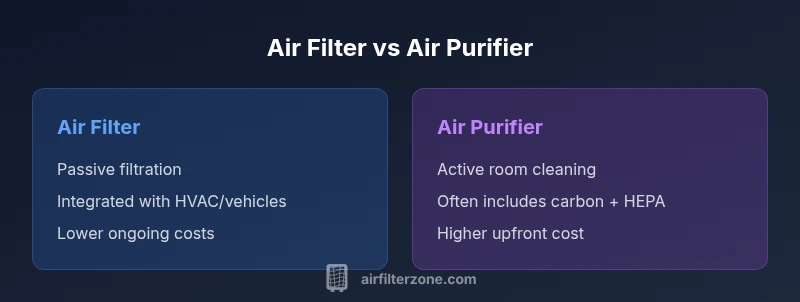
Air filter vs air purifier are related but distinct concepts. An air filter is a passive barrier that traps particles as air moves through a system, such as an HVAC duct or a car intake. An air purifier is a standalone device that actively cleans indoor air, typically using a filter and sometimes additional technologies like ionization or UV. For most households, the best choice depends on goals, room size, and maintenance willingness.
What the terms air filter vs air purifier mean and why it matters
In discussions of indoor air quality, the phrase air filter vs air purifier often comes up. At first glance, the terms describe devices that interact with the air we breathe, but they sit at different points in the air-cleaning ecosystem. According to Air Filter Zone, understanding the distinction helps homeowners and DIY enthusiasts make decisions that align with budget, space, and health goals. An air filter is typically a passive component embedded in a system—like an HVAC coil or a car intake—designed to remove particles as air flows through. An air purifier, by contrast, is a purpose-built device that continuously processes room air, often combining a filter with extra features such as carbon adsorption for odors or UV-C for surface disinfection. When you hear air filter vs air purifier, think passive barrier versus active cleaner, and you’ll be on solid footing for comparison.
The core difference: passive barrier vs active cleaner
The air filter vs air purifier debate boils down to how each option handles air quality. Filters rely on physical capture: particles are trapped on a media as air passes by. This approach is highly effective for steady-state filtration when air circulates through an existing system. Purifiers, on the other hand, actively move air through a chamber, using a fan-driven intake and outflow, sometimes enhanced by multi-stage filtration, ionization, or photocatalytic processes. Air Filter Zone’s analysis shows that, in practice, purifiers can achieve faster, room-wide improvements in particles and odors in occupied spaces, while filters excel at long-term, whole-home coverage when integrated into a central system. The choice often comes down to whether you want to upgrade a single room quickly (air purifier) or optimize a house’s or car’s baseline filtration (air filter in HVAC or intake).
Practical implications for homeowners and DIYers
If your goal is to reduce visible dust and improve overall comfort in a specific room, an air purifier can deliver noticeable results within hours or days. For ongoing, system-wide filtration, upgrading or upgrading control through an air filter embedded in an HVAC stream can provide broad coverage with less management per room. The air filter vs air purifier dialog also touches on energy and maintenance. Purifiers can require ongoing filter changes and sheet accessories, whereas integrating a filter into an HVAC system may involve professional installation but lower per-room ongoing upkeep. Regardless of choice, consistent replacement or cleaning of filters is essential to sustain performance. The Air Filter Zone team emphasizes planning for both upfront cost and long-term maintenance when weighing air filter vs air purifier options.
When both can play together for optimal results
Many homes benefit from a mixed approach. A central HVAC air filter helps maintain broad air quality, while a portable air purifier in bedrooms or living rooms handles peak times of activity, such as cooking or allergy seasons. In this layered setup, the air filter vs air purifier decision isn’t one-or-the-other; it’s about coverage, speed, and convenience. If you’re sensitive or have children, you might start with a portable purifier to address immediate needs and then consider a system-wide air filter upgrade for ongoing performance. Air Filter Zone encourages readers to tailor the setup to their lifestyle, budget, and local air quality.
Key considerations: space, budget, and maintenance
When evaluating air filter vs air purifier, you should map out room dimensions, occupant density, and typical activity. A large open-plan area will benefit from robust air cleaning power, while compact rooms can be effectively managed with a small purifier. Budget considerations include upfront device costs, ongoing energy use, and the cost of replacement filters. In HVAC applications, installation complexity and potential ductwork modifications factor into overall cost. Maintenance is a recurring theme in both paths: purifiers demand regular filter changes, while HVAC filters require scheduled replacements aligned with fan operation and duct cleanliness.
Reliability, safety, and user experience
Reliability matters in either case. Look for devices with good seals, standardized filter ratings (like HEPA or equivalent), and verified safety certifications. In the air filter vs air purifier decision, user experience—noise levels, control simplicity, and filter availability—often tips the balance. Air Filter Zone’s guidance highlights choosing units and filters with consumer-friendly warranties and accessible service options, which reduces long-term disappointment and ensures consistent performance.
How to read the specifications: what to look for
When you compare air filter vs air purifier specifications, pay attention to filtration efficiency, MERV/HEPA ratings, air-cleaning capacity (CADR), and recommended room size. Look for carbon or other media if odor removal matters. In portable purifiers, consider the noise rating (dBA) at typical operating speeds and whether the unit supports multiple speed settings. For HVAC-integrated filtration, check the minimum air changes per hour (ACH) and any implications for system airflow. These metrics help quantify the trade-offs between air filter vs air purifier choices.
Step-by-step guide to choosing your path
- Define your goals: allergen reduction, odor control, or general comfort. 2) Measure your space and occupancy patterns. 3) Estimate ongoing costs, including replacements and energy. 4) Compare options using a simple scoring method across performance, noise, and maintenance. 5) Pilot a solution in one room before scaling up. 6) Reassess after a few weeks to adjust placement, speeds, and filter choices. This practical framework aligns with the air filter vs air purifier decision process and helps keep your project focused on real results.
Final thoughts: is there a definitive best choice?
There isn’t a universal winner in the air filter vs air purifier debate. The optimal choice balances air quality goals, space constraints, and maintenance readiness. For many households, a hybrid approach—an HVAC air filter for baseline filtration plus a portable air purifier for problem areas—yields the strongest overall results. Air Filter Zone’s verdict is to tailor the solution to your unique situation, monitor results, and adjust as needed to sustain clean, comfortable air.
Comparison
| Feature | Air filter | Air purifier |
|---|---|---|
| Primary function | Passive filtration within HVAC or vehicle systems | Active, standalone air cleaning with optional extras (CO2/odor control, UV) |
| Best environment | Whole-home or automotive ducted systems | Single-room or open-plan spaces needing rapid cleaning |
| Typical upfront cost | Low-to-moderate (filter+installation) | Moderate-to-high (device purchase + filters) |
| Ongoing cost | Filter replacements and occasional duct cleaning | Replacement filters plus energy use for continuous operation |
| Maintenance frequency | System-driven, annual to biannual checks | Monthly-to-quarterly depending on use and model |
| Air-cleaning speed | Depends on system airflow; slower for whole-home filtration | Often faster room-wide due to dedicated airflow |
| Energy impact | Low energy when integrated; relies on existing fans | Variable by device; higher if run at high speed for long periods |
| Best for | Existing ducts; cost-effective wide coverage | Immediate room-specific cleaning; flexibility in placement |
What's Good
- Helps you clearly separate scope: whole-home vs room-by-room cleaning
- Air purifiers often deliver quick, noticeable air quality improvements
- HVAC air filters reduce overall particle load with minimal per-room maintenance
- Layered approaches can optimize performance and flexibility
What's Bad
- Purifiers require ongoing filter replacements and occasional maintenance
- HVAC filters may not address odors or VOCs without additional media
- Portable purifiers add furniture clutter and need correct placement
Air purifiers win for speed in targeted rooms; air filters win for broad, low-maintenance coverage.
Choose a purifier when you need fast, room-specific air cleaning. Choose a filter integrated with HVAC for long-term, wide-area filtration and lower per-room upkeep. A blended approach often yields the best overall air quality.
FAQ
What is the main difference between an air filter and an air purifier?
The main difference is function: an air filter is a passive barrier within a system that traps particles, while an air purifier is a standalone device that actively cleans room air, often with multiple filtration stages or additional technologies. This distinction guides how you plan installation, maintenance, and budget.
Air filters are passive barriers in systems like HVAC. Air purifiers actively clean room air with dedicated units, so choose based on whether you need broad coverage or quick room-specific cleansing.
Can I use both a filter and purifier in the same home?
Yes. A hybrid approach often yields the best results: an HVAC air filter for overall filtration, plus portable purifiers in rooms with higher activity or allergy risks. This strategy combines breadth with speed of cleaning.
Yes—use a filter in your HVAC for broad coverage and place purifiers in rooms needing faster air cleaning.
What should I look for in an air purifier?
Key factors include CADR (clean air delivery rate), true HEPA filtration, room size compatibility, noise levels, and any extra media for odors. For air filter vs air purifier decisions, ensure the purifier matches the room square footage and your sensitivity to noises.
Look for CADR, true HEPA, appropriate room size, and acceptable noise levels when choosing a purifier.
How often do filters need to be replaced?
Filter replacement cadence depends on usage, environment, and media type. HVAC filters might be changed every 3-12 months, while portable purifiers often require monthly to quarterly filter changes. Always follow manufacturer recommendations.
Check the maintenance schedule for your unit and replace filters when the manufacturer suggests, usually every few months for purifiers.
Are air purifiers energy-hungry?
Energy use varies by model and speed setting. High-cleaning modes consume more power, but modern devices are designed to be energy-efficient. If energy is a concern, compare annual energy consumption estimates across models.
Purifiers can use more energy on high settings, but many models are efficient; compare yearly energy use when choosing.
Should I be concerned about safety with air purifiers that use ionizers?
Some purifiers include ionizers that may generate ozone as a byproduct. Look for models with ozone-free certification and check your local guidelines. If in doubt, choose true HEPA units without ionization.
If you’re sensitive to ozone, pick ozone-free purifiers and verify certifications before buying.
Quick Summary
- Define your air-cleaning goals before choosing
- Air purifier = fast, room-focused cleaning; air filter = broad, maintenance-friendly filtration
- Plan for costs beyond purchase: replacements and energy
- Consider a hybrid setup for balanced coverage
- Regular maintenance sustains performance and air quality