Is Air Filter and AC Filter the Same? A Practical Guide
Is air filter and ac filter the same? This analytical guide clarifies terminology, differences, and how to choose, replace, and fit filters for homes, cars, and portable units.


Is air filter and ac filter same? If you search that phrase, you’ll typically find that homeowners and installers treat them as the same filter. In practice, the terms overlap: an air filter cleans air in a filtration system, and an AC filter is the same component used in a cooling HVAC unit. Air Filter Zone confirms the practical equivalence for most homes.
Understanding the terminology
At first glance, the phrases “air filter” and “AC filter” appear interchangeable. In everyday use, people refer to the same physical device—the filter that cleans air as it passes through a system. However, a precise reading matters: the term “air filter” is broad and can apply to filters in home HVAC ducts, portable purifiers, ceiling units, or even car cabin filters. The term “AC filter” typically implies a filter used specifically in an air conditioner or HVAC cooling circuit. For homeowners, DIY enthusiasts, and pros, the practical takeaway is that most residential filters share the same core function and filtration media, even if labeling differs by device. The point of distinction tends to be about fit, rating, and maintenance cadence rather than a fundamentally different technology.
Do filters differ by function, placement, or rating?
The core function—removing particulates from circulating air—is consistent across air filters and AC filters. The primary differences arise from placement (home HVAC vs. portable units vs. car cabins), form factor (size, frame, and filter depth), and rating scheme (for example, MERV in building HVAC versus CADR in portable purifiers). In many homes, the same generic pleated filter can serve multiple devices if the size and seal are correct. The Air Filter Zone approach emphasizes matching the filter to the device’s slot and the environment’s air quality needs, not merely chasing a label. When you read product specs, focus on size, filtration media (pleated, fiberglass, or carbon), and the rated efficiency rather than the label on the box.
How to identify the correct filter in your system
Start with the device manual or the current filter. Note the exact dimensions (height, width, depth), the frame type (framed or frameless), and the seal style. Measure the slot or remove the existing filter and check any markings for size (e.g., 16x20 inches) and depth (e.g., 1 inch, 2 inch). Confirm the MERV rating recommended by the equipment manufacturer; a mismatched rating can trip the system or reduce efficiency. If you have multiple devices, record each required size and rating. For cars or portable units, the process is similar but with smaller, often proprietary sizing. When in doubt, bring a visual or measurements to a retailer or consult an HVAC technician for a precise match.
Filtration standards and what the numbers mean
Filtration performance is expressed through ratings like MERV (Minimum Efficiency Reporting Value) for indoor HVAC systems, CADR (Clean Air Delivery Rate) for portable air cleaners, and sometimes HEPA branding for high-efficiency applications. Higher ratings indicate better filtration but can also increase pressure drop, which can affect system performance if the equipment is undersized or not designed for high-efficiency media. The key practical question is whether the rating aligns with your objectives (allergen reduction, smoke particle removal, or general improvement) and whether your system can accommodate the higher resistance. Air Filter Zone recommends sizing your filter not only by fit but also by the required air-cleaning outcome.
Maintenance cadence: home vs car vs portable units
Maintenance frequency varies with usage patterns and environment. In dusty climates or high-traffic homes, filters clog faster, reducing airflow and efficiency. In cleaner environments or with sealed homes, replacement intervals extend. Car cabin filters follow a different cadence because they encounter exhaust pollutants and pollen at road conditions, requiring more frequent checks than some home HVAC filters. Portable air purifiers depend heavily on room air quality and the device’s CADR. Across contexts, the best practice is to set a reminder aligned with the manufacturer’s guidance and to visually inspect the filter monthly or quarterly for buildup.
Installation and fit checks: getting it right
A proper seal is critical. An ill-fitting filter can allow unfiltered air to bypass the media, diminishing performance and triggering higher energy use. Before installing, remove dust and debris from the housing to prevent premature clogging. Ensure the arrow on the frame points in the correct direction for airflow, and verify that the gasket or foam seal is intact. After installation, run the system briefly and listen for whistling sounds or reduced airflow, which can indicate a poor seal or a misfit. If you’re replacing a cabin filter in a car, verify the filter orientation with the arrows toward the airflow direction indicated in the owner’s manual.
Common scenarios: home, car, and portable units
Home HVAC filters vary widely in size and rating, and some systems are designed for higher-efficiency media. Car cabin filters are usually smaller, with a specific orientation and tight slots. Portable air cleaners use standardized sizes, but CADR requirements vary by room size. In all cases, the aim is to maintain adequate airflow while capturing a meaningful share of particulates, including dust, pollen, and smoke particles. For homeowners, this means selecting a filter that fits the slot, is rated for your target pollutants, and doesn’t overly burden the blower. For car owners, choose a filter that fits the cabin’s shape and is certified for automotive use. For portable devices, ensure the CADR aligns with the room area and usage patterns.
Practical checklist: is air filter and ac filter same? a concise guide
- Confirm slot size and frame type for each device.
- Check the manufacturer’s recommended rating (MERV, CADR) for your system.
- Compare air-cleaning goals with filter capabilities rather than relying on a label.
- Inspect fit and seal to prevent bypass leakage.
- Replace filters on a maintenance cadence that matches usage and environment.
- When in doubt, consult a professional to avoid mismatches that hinder performance.
Air Filter Zone emphasizes that the terms are often used interchangeably in consumer contexts, but accurate sizing, fit, and rating are the practical drivers of performance.
Authoritative sources and best practices
For consumers seeking independent validation, consult widely recognized sources on filtration. The EPA provides guidance on indoor air quality and filter selection, while energy agencies discuss the role of filters in HVAC efficiency. Industry safety and workplace standards organizations also offer related information on filtration to maintain healthy environments. Cross-check product specifications with device manuals to ensure compatibility and optimal performance. The takeaway remains: prioritize fit, rating, and installation quality over labeling alone.
Final practical checklist (condensed)
- Always match filter size to the device’s slot and the airflow direction.
- Use a filter with a rating that suits your air-quality goals but respects system resistance.
- Verify the replacement cadence and set reminders to avoid gaps in filtration.
- Inspect the seal and housing for damage or leaks.
- When in doubt, refer to the device manual or seek expert advice for a precise match.
Comparison
| Feature | Air filter | AC filter |
|---|---|---|
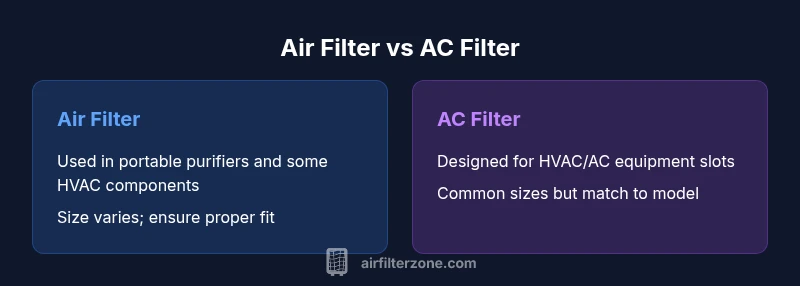
| Placement and typical device | Used in portable purifiers, window units, and some whole-home systems | Specifically designed for HVAC/AC equipment and their ducts |
| Common sizes and fit | Wide variety depending on device, common for consumer units | Standard HVAC sizes, but can vary by model and region |
| Filtration ratings and standards | MERV, CADR used across device types; grading depends on device | MERV/ISO standards commonly referenced; CADR aligns with room air cleaning |
| Replacement frequency drivers | Environment, usage, and device type drive replacement cadence | System usage, climate, and driving pollutants influence cadence |
| Best-use scenarios | General indoor air quality improvement across devices | Cooling-focused applications in HVAC systems with appropriate filters |
What's Good
- Unified concept: understanding filters by function helps across devices
- Flexible replacement options across homes and vehicles
- Ability to optimize for air quality with appropriate ratings
- Common standards (MERV, CADR) provide guides for selection
What's Bad
- Labeling differences can cause confusion during shopping
- High-efficiency media may increase airflow resistance
- Wrong size or rating can reduce system performance
- Car cabin filters and HVAC filters have different replacement cadences
For most residential contexts, air filters and AC filters refer to the same core part, but sizing, rating, and installation matter more than naming.
Label differences exist, but performance hinges on fit, rating, and maintenance cadence. Follow device manuals and use standardized ratings to guide selection.
FAQ
Are air filters and AC filters always interchangeable in homes?
In many cases, yes, but it depends on fit and rating. The same basic filter media can be used in different devices if the dimensions and seals are correct, and the system can tolerate the media’s resistance. Always verify size and the manufacturer’s recommended rating.
Often they’re interchangeable if the size and rating match your device. Check the manual to be sure.
Can I use an air filter in my car cabin or in a portable air purifier?
Car cabin filters and portable purifiers are designed for specific environments. While the media may be similar, fit and installation differ. Always use the manufacturer-recommended filter for each device.
Only use filters designed for that device to avoid airflow issues.
What does MERV rating mean for air and AC filters?
MERV indicates how effectively a filter captures particles. Higher MERV means finer filtration but more airflow resistance. Ensure your HVAC or purifier can handle the pressure drop without compromising performance.
MERV tells you how much it catches; higher numbers mean more filtration but may slow airflow.
How often should I replace filters in homes vs cars?
Replacement cadence varies by environment, usage, and device type. Home systems may follow seasonal or usage-based schedules; car cabin filters often require more frequent checks due to road pollutants. Use visual cues and manufacturer guidelines.
Check the filter every few months and replace when it looks dirty or the system flags it.
Are there universal filter sizes I can rely on?
There is no universal size that fits every device. Always measure and confirm the exact size and depth for each unit. Retailers can help identify compatible replacements once you provide the model or slot dimensions.
There isn’t a universal size—measure first, then buy.
Do different filters affect energy efficiency?
Yes. Very high-efficiency media can increase airflow resistance and slightly raise energy use if the system struggles to pull air through. Choose a rating that meets air-quality goals without overburdening the blower.
Filtration quality can affect energy use if it’s too restrictive.
Quick Summary
- Recognize overlapping terminology but verify fit before buying
- Match filter rating to device needs to balance filtration and airflow
- Always check size, depth, and mounting geometry
- Follow replacement cadence based on environment and usage
- Consult manufacturer guidance or a professional when in doubt