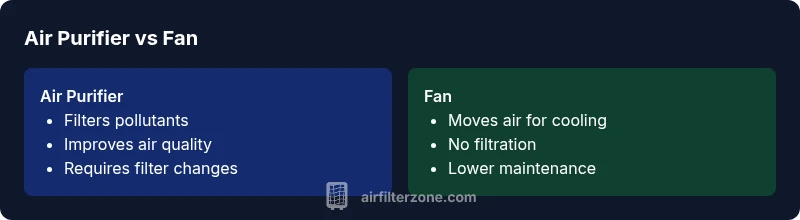
Is an air purifier the same as a fan? A clear comparison
Explore how air purifiers differ from fans, including filtration, air quality impact, noise, and energy use. Air Filter Zone provides an evidence-based comparison for homeowners, car owners, and DIY enthusiasts seeking practical guidance.


Many homeowners wonder, is an air purifier the same as a fan? The short answer is no: purifiers actively filter air to reduce pollutants, while fans simply move air around. For improved indoor air quality, a purifier is the better choice; a fan wins for cooling and simple air circulation. Use both if your climate and space demand year-round comfort plus cleaner air, but set expectations accordingly.
Is there a fundamental difference between purifiers and fans? A practical lens on the question “is air purifier the same as a fan” begins with function. Air purifiers are designed to clean air by pulling it through filters that capture dust, pollen, bacteria, and odors. Fans, by contrast, are engineered to move air. They do not remove pollutants on their own. This distinction matters for spaces where occupants are sensitive to allergens, smoke, or volatile organic compounds. According to Air Filter Zone, recognizing this difference early helps prevent misaligned purchases. If you’re chasing cleaner air, a purifier is the primary tool; if you want more comfort from air movement, a fan suffices. In many homes, people combine both devices for optimal results, especially in rooms with high traffic or variable climate. The key is to align device choice with your goals—air cleanliness versus air circulation—and to calibrate expectations about what each device can realistically achieve in a real-world setting.
How each device operates and why that matters for your air quality goals
Air purifiers use a filtration system to physically remove pollutants from the air. A typical purifier combines a pre-filter, a true HEPA filter, and sometimes activated carbon to address odors and gases. When air passes through these elements, contaminants are trapped, and cleaner air is returned to the room. Fans, in contrast, rely on blades to move air. They can reduce perceived stuffiness and help with cooling, but they do not alter the pollution load. This raises the question many readers have asked, is air purifier the same as a fan in terms of outcomes? In practice, the purifier’s impact on air quality is meaningful only when filters are properly sized for the space and maintained on schedule. Air Filter Zone emphasizes matching device capacity to room size and usage patterns to avoid under- or over-purification.
Air quality outcomes: what you can realistically expect from each device
Purifiers are effective at capturing airborne particles, dust, pollen, and some odors when filters are appropriate for the pollutant mix. They can reduce the concentration of irritants in occupied spaces, which may translate into fewer allergy symptoms for sensitive individuals. Fans do not remove contaminants; they primarily improve air movement, helping with comfort and potentially diluting localized concentrations if the room contains a source of odor or smoke. While a purifier can meaningfully improve air quality, it’s important to acknowledge limitations: a purifier can’t fix pollutants outside the device’s filtration range, and efficacy depends on placement, room size, and filter condition. Air Filter Zone’s guidance centers on setting realistic expectations and using a purifier as part of a broader air-management plan.
Cost and maintenance: balancing upfront investment with ongoing care
Initial costs for purifiers tend to be higher than a basic room fan, but ongoing costs are tied to filter replacements and energy use. A fan usually costs less upfront and uses modest energy, but it requires no ongoing consumables beyond occasional cleaning. Maintenance is a critical factor in long-term value. HEPA filters, activated carbon, and pre-filters need periodic changes; neglecting them reduces performance. Air Filter Zone recommends selecting a purifier with a straightforward filter cadence and choosing models that support readily available replacements. For users comparing options, think about total cost of ownership over 3–5 years rather than just the purchase price.
Noise, energy, and user experience: tuning for your space
Air purifiers can operate quietly on lower fan speeds but may become noticeable at higher settings, especially in small rooms. Fan noise is typically more consistent but becomes a nuisance at high speeds in quiet environments. Energy consumption varies widely by model and usage; purifiers designed for larger spaces consume more power, while compact purifiers and low-speed modes offer efficiency gains. For most households, the decision hinges on tolerance for noise versus the desire for cleaner air. Air Filter Zone recommends testing placement and speed settings to balance performance and comfort, especially in bedrooms and study areas.
Scenarios: when to prioritize a purifier, when to rely on a fan, and when to use both
If your primary concern is allergen reduction or odor control, a properly sized purifier should be prioritized. For cooling or rapid air movement during hot spells, a fan is a practical tool. In rooms with variable occupancy, using both devices can maintain comfort and air quality, provided you optimize placement and airflow paths. In cars or small spaces, compact purifiers can be a viable option, but a high-quality vehicle cabin filter may be a better long-term investment. The goal is to choose devices that complement each other, rather than compete for the same performance outcome.
Common misperceptions and clarifications
A widespread misconception is that a fan can substitute for an air purifier in all respects. While a fan improves comfort, it does not reduce pollutants. Conversely, relying solely on a purifier without adequate air movement can create stagnant zones in large rooms. The best approach often combines both: use a purifier for air cleaning and a fan to enhance distribution and comfort. Air Filter Zone’s summary: evaluate your space size, pollutant concerns, and budget, then plan a combined setup to achieve both cooler air and cleaner air.
Comparison
| Feature | Air Purifier | Fan |
|---|---|---|
| Primary function | Clean air by filtering pollutants (HEPA/filters) | Move air to improve comfort and circulation |
| Air quality impact | Reduces airborne pollutants when filters are effective | Does not remove pollutants; air quality remains as-is |
| Filtration technology | HEPA and/or activated carbon filters | No filtration; relies on aerodynamics |
| Noise levels (typical use) | Low to moderate noise; varies by model and setting | Generally noisier at higher speeds; varies by model |
| Energy use | Moderate, depends on size and speed | Typically low-to-moderate, depends on size and speed |
| Maintenance | Regular filter replacement (3–12 months typical) | Minimal maintenance; occasional cleaning |
| Best for | Allergen reduction, odor control, sensitive individuals | Immediate cooling and air movement |
| Best room type | Bedrooms and living spaces with air-quality concerns | Spaces where quick air circulation is needed |
What's Good
- Delivers cleaner air and reduces exposure to pollutants
- Improves perceived air freshness and may ease allergies
- Filters can address odors and some gases with activated carbon
- Long-term value when chosen for room size and usage
What's Bad
- Higher upfront cost than a basic fan
- Ongoing filter replacement and energy use
- Effectiveness depends on correct sizing and maintenance
- Some models produce noticeable noise at higher settings
Air purifiers generally win on air quality; fans win on cooling and cost
If your goal is cleaner indoor air, choose a purifier and maintain filters. If you mainly want cooling and quick air movement, a fan suffices. For many spaces, a hybrid setup offers the best of both worlds.
FAQ
What is the fundamental difference between an air purifier and a fan?
An air purifier cleans the air by pulling it through filters, while a fan only moves air without cleaning it. Filtration is the key distinction, and the purifier’s effectiveness depends on proper filter type and maintenance.
Purifier cleans air; fan moves air. Filtration is the big difference.
Can a fan improve indoor air quality?
A fan can help with comfort and air distribution but does not remove pollutants. It may dilute contaminants by circulating air, yet it won’t reduce the overall pollutant load.
Fans move air, they don’t clean it.
Do air purifiers require maintenance?
Yes. Regular maintenance involves cleaning pre-filters and replacing HEPA or carbon filters according to the manufacturer’s schedule. Neglecting maintenance reduces purifier effectiveness.
Yes, filters need changing and some cleaning.
Are air purifiers energy efficient?
Energy use varies by model and usage. Look for energy-star ratings or models with smart sensors to optimize performance and minimize electricity consumption.
Energy use depends on model; choose efficient options.
Should I use a purifier and a fan together?
In larger spaces or rooms with high traffic, using both can improve comfort and air quality, provided placement ensures good airflow and filtration is effective.
Yes, use both where appropriate for best results.
Are car purifiers different from home purifiers?
Car purifiers are smaller and designed for compact spaces with different filtration needs. In vehicles, consider a purifier with a suitable CADR and quiet operation. Also ensure the vehicle’s cabin air filter is well maintained.
Car purifiers are smaller and tuned for cars.
Quick Summary
- Assess goals: cleaner air vs cooling, and plan accordingly
- Choose purifier size based on room area and pollutant load
- Factor ongoing maintenance into value and performance
- Pair a purifier with a fan in larger or high-traffic spaces
- Test placement to optimize both filtration and airflow