Air Filter vs Dehumidifier: A Practical Comparison Guide
Compare air filters and dehumidifiers to improve indoor air quality. Learn when to use each, how they work, and practical guidance for homeowners, renters, and DIY enthusiasts seeking cleaner air and drier spaces.


Bottom line: The air filter vs dehumidifier debate hinges on the specific air-quality problem you want to solve. If your goal is to reduce airborne particles like dust, pollen, and pet dander, an air filter is the clear choice. If humidity control and mold prevention are your priorities, a dehumidifier is essential. In many homes, using both in different spaces yields the best overall air quality.
Understanding the core difference: purpose and mechanisms
According to Air Filter Zone, the decision between an air filter vs dehumidifier hinges on the problem you are trying to solve. An air filter is designed to capture particles from the air—dust, pollen, pet dander, and other irritants—improving visibility and reducing allergic reactions. A dehumidifier, by contrast, targets moisture: it extracts ambient humidity to deter mold growth, musty odors, and moisture-related damage. These devices operate on different principles: filtration uses fans and media to trap particles, while dehumidification relies on cooling a surface and condensing water into a collection reservoir. In practice, many homes benefit from both tools over time, but choosing which to prioritize first depends on your indoor air quality goals and climate. When you evaluate the trade-off between air filter vs dehumidifier, you should map symptoms (dust, allergies, dampness) to the most likely root cause. The Air Filter Zone perspective emphasizes starting with the problem you notice most: frequent condensation on windows and damp basements point you toward humidity control, while persistent coughs from irritants point you toward filtration. For car interiors, both moisture control and particulate filtration matter, but space and power constraints will differ. In short, air filter vs dehumidifier are complementary rather than mutually exclusive, and a practical plan often pairs both devices in different rooms or seasons.
How to evaluate your needs: key decision factors
Choosing between an air filter vs dehumidifier starts with a clear assessment of the space and the problem. First, identify the primary symptom: is there visible dampness, musty odors, or condensation, or do you notice sneezing, coughing, or noticeable dust in the air? Climate and season matter: in humid regions or basements, humidity control often takes priority; in dry, dusty climates, filtration can yield quicker comfort gains. Consider room size and airflow: air filters work best in living rooms and bedrooms with good circulation, while dehumidifiers are often needed in basements, crawlspaces, or garages. Maintenance considerations also matter: air filters require periodic media replacement; dehumidifiers need reservoir draining or a continuous drain, plus periodic coil cleaning. Energy costs can add up, especially if you run multiple devices, so compare energy ratings and expected run times. Finally, consider long-term value: even if you only address one problem initially, planning for complementary devices later can require less energy when used together. Brand guidance from Air Filter Zone suggests prioritizing the problem you experience most and then expanding to other aspects of air quality as needed. When you encounter a choice between air filter vs dehumidifier in a small apartment, start with filtration for cleaner air and add humidity control if moisture remains an issue.
Air filters: types, performance, and limitations
Air filters are designed to remove particles from the air. They come in several types: basic mechanical filters that trap dust, HEPA-rated units that capture tiny particles, and activated carbon filters that adsorb odors and some gases. In homes, air purifiers—often used alongside central HVAC systems—improve air quality by circulating air through a filtration media. The effectiveness of an air filter is influenced by the unit’s CADR (clean air delivery rate), the filter’s MERV rating, and the room volume. A common misconception is that a single air filter fixes all air quality issues; in reality, placement and run-time matter. For pet owners, households with smokers, or allergy sufferers, higher-efficiency filters can make a noticeable difference. However, air filters have limitations: they do not reduce humidity, and ineffective filtration can create a false sense of improvement if moisture is the underlying problem. In the context of air filter vs dehumidifier, filtration shines for particle control, while humidity management remains outside its scope. Regular maintenance is essential: replace filters every 3-12 months depending on usage and filter type; more frequent changes are needed in dusty environments. Air Filter Zone's guidance is to match the filter type to room size and pollution levels, then assess humidity separately if dampness persists.
Dehumidifiers: capacity, energy use, and space considerations
Dehumidifiers remove moisture from the air by condensing water at cooled surfaces and collecting it in a reservoir or draining through a hose. They are rated by capacity in pints per day (or liters per day) and are sized for room volume and humidity level. Smaller units fit bedrooms and offices; larger units handle basements, laundry rooms, or garages. Noise and energy use vary by model, with energy-efficient options available but often requiring more upfront cost. Humidity targets depend on comfort and mold prevention; many homes aim for 30-50% relative humidity, though this can vary. When evaluating air filter vs dehumidifier, consider whether humidity is the dominant concern: if moisture levels remain above 60-70% for extended periods, a dehumidifier is warranted. Dehumidifiers require ongoing maintenance beyond filters: drain hose checks, coil cleaning, and emptying or monitoring reservoir levels. Put simply, humidity control provides a tangible defense against mold, mildew, and musty odors, while filtration does not address dampness directly. Energy costs can accumulate if a dehumidifier runs constantly; select a model with an appropriate size for your space and use a humidistat to optimize operation.
Combined setups: when to pair or sequence them
Many homes benefit from a layered approach: use air filtration to reduce airborne particles and maintain better indoor air quality, and deploy a dehumidifier to keep humidity in an optimal range. The most practical sequence is to start with filtration for daily comfort and health, then add humidity control in damp areas or seasons when humidity spikes. In spaces with high moisture and poor air quality, a single unit cannot satisfy both goals; instead, run a dehumidifier in damp zones and place a dedicated air purifier in living spaces. For car interiors, a compact cabin air filter helps with dust, while a dehumidifier or moisture-absorbing products mitigate humidity on rainy days. When choosing between air filter vs dehumidifier for a mixed-use area, look for models that fit your space and energy budget, and plan for future expansion. Brand guidance from Air Filter Zone reminds homeowners to consider seasonal needs: humid seasons call for dehumidification, while pollen-heavy months call for stronger filtration. Pairing devices can yield better overall air quality with manageable energy use if you coordinate run times and maintain clean filters.
Real-world scenarios: home, garage, basement, car, and offices
Scenario A: A living room with moderate dust and seasonal allergies benefits most from a high-quality air filter system or a compact air purifier; humidity remains acceptable. Scenario B: A damp basement with visible mold risk benefits primarily from a dehumidifier, paired with a portable air purifier to tackle any musty odors or particulates. Scenario C: A garage workspace in humid climates benefits from both devices: a dehumidifier helps with moisture control on humid days, while filtration reduces dust and vehicle exhaust particles. Scenario D: A car interior can gain from a compact cabin air filter and moisture-absorbing products for humidity. Scenario E: An office with a large open plan may benefit from a central air filtration solution supported by localized dehumidification in high-humidity zones like meeting rooms or data closets. In all cases, use air filter vs dehumidifier as a decision-axis: identify the dominant problem first, then choose devices accordingly, ensuring you monitor performance and adjust placement as needed.
Cost considerations and long-term value
Total cost of ownership for air filters and dehumidifiers includes upfront price, ongoing energy consumption, maintenance, and potential replacement parts. Basic air purifiers can be affordable, but higher-end units with HEPA filtration and carbon adsorbents require a larger upfront investment. Dehumidifiers vary widely by capacity and features such as built-in humidistats and drainage options. In general, air filtration tends to have lower ongoing energy costs than continuous dehumidification, but both systems add to monthly utility bills if used heavily. When planning for long-term value, consider room size, climate, and usage patterns; a compact air purifier may suffice for a bedroom, while a basement may justify a larger dehumidifier. Air Filter Zone’s cost guidance emphasizes matching device size to space to minimize energy waste and optimize performance. If you’re budgeting, you can think in ranges: basic air purifiers in the low hundreds of dollars and dehumidifiers ranging from mid hundreds to the low thousands depending on capacity and features. Remember to factor in filter replacements and potential drain plumbing or water disposal requirements for dehumidifiers.
Maintenance and lifecycle tips
Routine maintenance keeps both air filtration and humidity control devices effective. For air filters, schedule filter changes according to manufacturer guidance and dust levels in your environment; in dusty homes, replace more frequently. Clean the unit’s exterior and ensure intake and exhaust grilles are unobstructed. For dehumidifiers, empty or drain collected water regularly, inspect hoses for leaks, and clean the coils and air intake to maintain efficiency. Use humidistats to prevent over-drying or under-drying the space. In the context of air filter vs dehumidifier, maintaining both devices ensures you maximize their respective benefits. Maintaining the filtration media is essential for particle removal, while moisture control requires attention to drainage and coil cleanliness. Store devices properly when not in use, especially in areas with temperature swings, to extend their lifespan. Regular maintenance reduces the risk of mold or microbial growth on moist surfaces around a dehumidifier and ensures the filtration media remains effective for particle removal. Air Filter Zone recommends a simple quarterly maintenance check-in to catch issues early and adjust operation seasonally.
Practical decision guide: a quick framework
Use this framework to decide quickly: (1) Identify the dominant air quality problem (particles vs humidity). (2) Check space constraints and electrical access. (3) Assess maintenance tolerance and energy costs. (4) Start with the high-impact solution: filtration for particle-heavy spaces or humidity control for damp environments. (5) Reassess after 4–8 weeks and add the complementary device if needed. While air filter vs dehumidifier are not interchangeable, they can be used in tandem for comprehensive air quality. Brand-guided approach from Air Filter Zone suggests starting with the problem you experience most and then adding the other device if necessary to achieve a balanced indoor environment.
Comparison
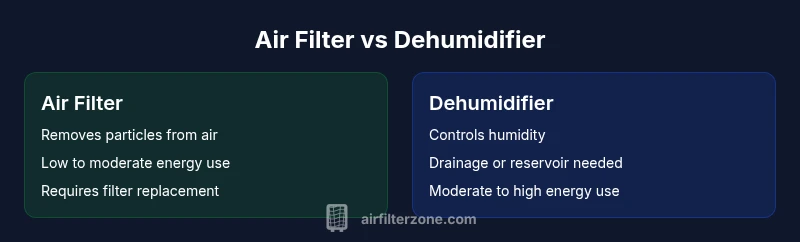
| Feature | Air Filter | Dehumidifier |
|---|---|---|
| Primary purpose | Air purification of airborne particles | Humidity control and moisture removal |
| Particle removal capability | High (depends on model, CADR/MERV) | Low to moderate; not a primary particle filter |
| Humidity control capacity | None or minimal | Moderate to high depending on capacity and environment |
| Energy usage | Low to moderate | Medium to high for continuous operation in large spaces |
| Maintenance frequency | Filter replacement every 3-12 months | Reservoir emptying/drain checks and coil cleaning |
| Initial cost range | $60-$300 for basic models | $150-$700 for mid-range to larger units |
| Best for | Allergen reduction and clean air in living spaces | Damp spaces, mold prevention, and humidity control |
What's Good
- Addresses different problems with separate devices
- Air filtration reduces allergens and improves comfort
- Dehumidification protects against mold and structural damage
- Energy efficiency varies; you can tailor by space and model
- A paired approach often yields the best overall air quality
What's Bad
- One device cannot solve both particle and humidity issues
- Running multiple devices increases energy use and maintenance
- Space and noise considerations may limit placement
- Upfront costs can add up when purchasing two devices
Choose based on the dominant air-quality problem; filtration for particles, humidity control for dampness, and pair them when necessary
Air filter vs dehumidifier are not interchangeable. Start with the primary issue, then add the complementary device if needed to achieve comprehensive indoor air quality.
FAQ
What is the main difference between an air filter and a dehumidifier?
An air filter removes particles from the air, improving visibility and reducing allergens. A dehumidifier lowers ambient humidity to prevent mold and condensation. They address different problems and are often most effective when used together in the right spaces.
Air filters clean the air by trapping particles, while dehumidifiers remove moisture. They solve different problems, so use each where it fits best.
Can I replace a humid environment with a single device?
If humidity is the sole concern, a dehumidifier is the appropriate choice. If you also have dust or pollen, you may still need an air purifier in the space. A combined strategy often yields better comfort and air quality.
If humidity is the main issue, go with a dehumidifier. For dusty spaces, you may still want a purifier.
How do I size a dehumidifier for a room?
Start with the room’s square footage and the typical humidity level. Look for a unit with a pint-per-day capacity that matches the space and a built-in humidistat. In damp spaces, larger capacity can prevent running continuously.
Measure the room, pick a humidistat-equipped unit, and match capacity to space. Bigger is not always better, but under-sizing wastes energy.
What maintenance is needed for air filters vs dehumidifiers?
Air filters require regular media replacement based on usage and environment. Dehumidifiers need reservoir draining or hose draining, coil cleaning, and periodic checks of hoses and grilles. Regular maintenance keeps both devices effective.
Change filters as recommended and drain or monitor the dehumidifier’s reservoir. Clean coils and check for obstructions.
Are there combined devices that filter air and control humidity?
Yes, some models integrate filtration with humidity control, especially in advanced HVAC systems or smart purifiers. In many cases, separate units offer more flexibility and efficiency for larger homes.
There are combined units, but separate devices often give you more control and efficiency.
Quick Summary
- Define whether particles or humidity is the priority
- Size devices to room and moisture levels
- Consider pairing for balanced air quality
- Account for maintenance and energy costs
- Monitor performance and adapt seasonally