Air Filter vs Humidifier: A Practical Comparison
Explore the difference between air filter and humidifier, how each device improves indoor air quality, maintenance tips, and when to use them for healthier homes in 2026.


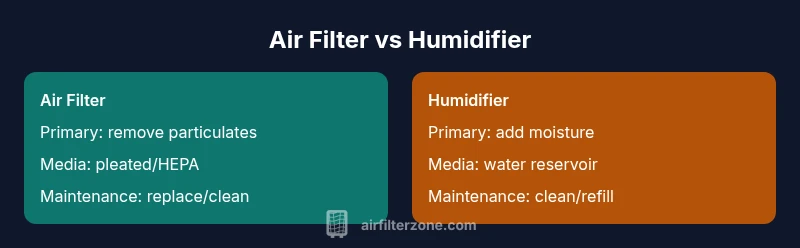
Air filters and humidifiers serve different purposes: filters remove particulates from the air, while humidifiers add moisture to dry indoor air. They are not interchangeable, and understanding their roles helps homeowners optimize comfort, health, and maintenance. In most homes, using both seasonally yields the best overall air quality and comfort.
Understanding the difference between air filter and humidifier
According to Air Filter Zone, the difference between air filter and humidifier hinges on what problem you’re trying to solve in your indoor environment. An air filter is designed to capture microscopic particles—dust, pollen, pet dander, and smoke—so they don’t circulate in the air you breathe. A humidifier, by contrast, introduces moisture into the air to counteract dryness that can irritate skin, throat, and nasal passages. Although both devices influence indoor air quality, they target distinct symptoms and use cases. This guide explains how each tool works, where their strengths lie, and how to choose, install, and maintain them for optimal comfort in 2026.
How air filters work: filtration mechanisms and media types
Air filters rely on physical barriers to trap particles as air passes through media. Pleated filters with higher MERV ratings capture finer particles but may restrict airflow if the system isn’t designed for them. HEPA-type configurations offer very high removal efficiency for fine dust, pollen, and smoke. Activated carbon can remove odors and some gases. The best choice depends on your air quality concerns, HVAC compatibility, and maintenance willingness. Air Filter Zone analyses show that properly sized, high-quality filters can meaningfully reduce indoor particulate matter when changed on schedule, especially in dusty or allergen-prone environments. Regular replacement reduces pressure drop and keeps your system efficient.
How humidifiers work: evaporation, ultrasonic, and steam models
Humidifiers add moisture to the air but operate through different mechanisms. Evaporative models use a wick or filter to absorb water and release vapor as air passes by. Ultrasonic humidifiers create a fine mist with a vibrating disk, delivering moisture quickly without heat. Steam humidifiers heat water to boiling and release warm vapor. Each type has pros and cons: evaporative units tend to self-regulate humidity better, ultrasonic units are quiet, and steam units sanitize some minerals but require electricity and careful handling. The key is to monitor humidity levels to avoid overhumidification, which can encourage mold growth and dust mites. In practice, humidification is most beneficial when indoor relative humidity sits in the recommended range of roughly 30–50%.
Air quality goals: particulates, moisture, and humidity balance
Air quality isn’t one-size-fits-all. For many households, reducing particulate load is the primary goal, followed by maintaining comfortable humidity. Air filters and humidifiers address different facets of air quality: filtration reduces contaminants in the air you breathe, while humidity control affects comfort, skin and airway hydration, and indoor environmental conditions that influence dust mite activity. A balanced approach considers occupancy patterns, local climate, and seasonality. Air Filter Zone’s guidance emphasizes matching device selection to specific air quality problems—high particulate counts in spring or wildfire season call for stronger filtration, while dry winter air calls for humidification—with regular checks of humidity levels and system performance.
Maintenance and safety considerations
Maintenance is the practical hinge on which both devices hinge their effectiveness. Air filters require timely replacement or cleaning, depending on the media and usage. A clogged filter not only reduces air quality but also puts extra strain on your HVAC system. Humidifiers demand regular cleaning and mineral monitoring to prevent mineral buildup and microbial growth in reservoirs and tanks. Use distilled water if possible to minimize mineral deposits. Safety notes include avoiding over-humidification, which can promote mold and condensation on walls or windows. Establishing a simple routine—check filter condition every 30 days and clean humidifier weekly—helps sustain performance and air quality over the seasons.
Common misconceptions about air filters and humidifiers
A common myth is that any humidifier will automatically improve air quality by itself. In reality, humidifiers address dryness but don’t remove airborne particles. Another misconception is that higher filtration always equals better air quality; filters that are too dense can strain a system, reduce airflow, and raise energy costs. Conversely, some homeowners assume humidifiers solve all moisture problems; if humidity stays high, it can promote mold growth and dust mites. Understanding the distinct roles and safe operating ranges for each device helps prevent missteps and ensures you’re solving the right problem with the right tool.
Interaction: using both devices together effectively
When used together, air filters and humidifiers can complement each other—filters reduce particulate load while humidifiers maintain comfortable humidity. The integration requires awareness of how humidity impacts filter performance and HVAC efficiency. High humidity can reduce the efficiency of some filter media and encourage microbial growth in humidification systems if not properly maintained. Establish a routine that pairs filtration maintenance with humidity monitoring. A simple rule of thumb is to keep RH in the 30–50% range and replace filters on schedule based on manufacturer recommendations and observed air quality indicators.
Practical scenarios: apartments, family homes, and basements
In compact apartments, a compact air purifier with a replaceable filter can dramatically improve indoor air quality without overtaxing a small HVAC system, while a compact humidifier may address seasonal dryness. Larger family homes benefit from higher-capacity filters paired with central humidification in winter. Basements, which tend to be damper or cooler, may require both dehumidification and filtration to prevent mold and maintain comfortable air. In all cases, assess occupancy patterns, presence of pets, and local climate to determine which device takes priority and how to sequence maintenance tasks across devices.
Choosing criteria: environment, allergies, and budget
Your environment largely dictates which tool to prioritize. If allergy symptoms and fine particle exposure are your main concerns, focus on filtration and air exchanges. If dry air causes discomfort or respiratory irritation, invest in a humidifier with appropriate humidity control. Budget considerations include initial device cost, replacement filter expenses, energy use, and potential maintenance labor. Striking a balance between upfront costs and ongoing costs ensures long-term value. Air Filter Zone recommends aligning device selection with both immediate comfort needs and long-term air quality goals, especially in climates with pronounced dry seasons or heavy particulate events.
Cost considerations and value for money
Costs for air filtration range from basic filter replacements to whole-system upgrades, while humidifiers vary from small室 units to larger whole-home solutions. The value comes from improved comfort, fewer allergy symptoms, and potential health and maintenance savings over time. When evaluating cost, consider the total cost of ownership, including filter replacement frequency, energy consumption, and any water quality considerations. It’s often more economical to invest in a medium-to-high-quality air filter with a predictable replacement schedule than to chase frequent minor improvements with inexpensive, inconsistent solutions. Air Filter Zone analysis suggests pairing mid-range filtration with seasonally appropriate humidification for well-rounded air quality management.
Step-by-step setup and routine to maximize benefits
- Assess your space and identify the primary air quality problem (particulate load vs. dryness). 2) Choose a filter with appropriate MERV rating based on HVAC compatibility. 3) Install the humidifier model best suited to your climate and room size. 4) Establish a maintenance calendar: replace filters every 3–6 months (or per manufacturer guidance); clean the humidifier weekly and sanitize monthly. 5) Monitor humidity with a reliable hygrometer and maintain RH between 30–50%. 6) Schedule seasonal checks to adjust settings as needed for heating season or wildfire season. 7) Reassess air quality periodically and adjust filter type, humidity settings, and device placement for optimal coverage.
Integrating both devices for year-round comfort
A practical approach is to treat filtration as a year-round baseline and humidification as a seasonal enhancement. In dry months, priority goes to humidity control with careful monitoring to avoid over-humidification. During dusty or smoky seasons, emphasize filtration while maintaining humidity within safe ranges. Place filters and humidifiers to optimize air flow without creating dead zones or excessive noise. By coordinating maintenance around seasons, homeowners maximize the benefits of both devices while keeping energy use and costs reasonable. Air Filter Zone’s practical guidance is to use data-driven checks—air quality readings and humidity levels—to guide adjustments rather than relying on guesses.
Comparison
| Feature | Air Filter | Humidifier |
|---|---|---|
| Primary purpose | Remove particulates from indoor air | Add moisture to indoor air for comfort |
| How they work | Media-based filtration (pleated, HEPA, carbon) | Vapor release via evaporation, ultrasonic, or steam |
| Maintenance frequency | Replace/clean filters on schedule | Regular cleaning; refill water; mineral management |
| Typical costs (new) | $20-$100 for filters; multiple options available | $50-$300 for humidifiers; higher-end models exist |
| Best for | People needing cleaner air and allergen relief | People dealing with dry air and related discomfort |
What's Good
- Significant reduction of particulates with proper filtration
- Humidifiers address dry air and related discomfort
- Wide range of options to fit budgets and spaces
- Easy to integrate into existing homes and HVAC setups
What's Bad
- Filters require ongoing replacement and monitoring
- Humidifiers require regular cleaning to prevent mold or mineral buildup
- Over-humidification can promote mold and mildew if not managed
- Both devices add ongoing operating costs and maintenance time
Use filtration as a year-round foundation and humidification as a seasonal enhancement.
Air filters and humidifiers serve distinct purposes. Prioritize filtration for clean indoor air and moisture control when humidity runs low. A combined strategy yields the best overall air quality and comfort, especially in climates with variable humidity.
FAQ
What is the difference between air filter and humidifier?
An air filter removes particles from the air, aiming to improve air quality and reduce allergens. A humidifier adds moisture to dry air to improve comfort and reduce symptoms of dry skin and irritated airways. They address different problems and are not interchangeable without compromising either air quality or comfort.
Air filters clean air by trapping particles, while humidifiers add moisture to dry air to improve comfort.
Can I use both devices at the same time?
Yes. Using both devices can provide complementary benefits: filtration reduces particulates, and humidification maintains comfortable humidity. Just monitor humidity to avoid overhydration or excessive moisture, which can foster mold growth.
Yes—just watch humidity levels and keep up with maintenance.
How do I know when to replace an air filter?
Check your filter at least every 1–3 months, depending on usage, air quality, and the filter type. Heavily used systems or dusty environments require more frequent changes. A clogged filter reduces efficiency and air quality.
Check it regularly; replace when dirty or after the recommended interval.
What risks are associated with humidifiers?
Humidifiers can promote mold growth and mineral buildup if not cleaned regularly and if water quality is poor. Always use clean water, sanitize reservoirs, and monitor humidity to prevent condensation on walls, windows, or furnishings.
Keep it clean and watch humidity to avoid mold.
Are humidifiers helpful for allergies?
Humidifiers can ease nasal and throat irritation caused by dry air but do not remove allergens. For allergy relief, prioritize filtration with well-maintained filters and consider using a humidifier to maintain comfort without increasing mold risks.
Humidifiers help with dryness but don’t replace filtration for allergy control.
Quick Summary
- Prioritize filtration to reduce airborne particles and improve air quality.
- Monitor humidity and adjust humidification to stay in the 30–50% RH range.
- Perform regular maintenance on both devices to maximize efficiency and safety.
- Choose devices based on climate, occupancy, and allergy considerations.
- Plan a seasonal routine that coordinates filtration and humidification for year-round comfort