Which Air Purifier and Dehumidifier: A Practical Comparison
An analytical comparison of which air purifier and dehumidifier to choose, including standalone purifiers, standalone dehumidifiers, and combo units. Learn sizing, features, costs, and use-case guidance for homes and cars.


Choosing which air purifier and dehumidifier to buy hinges on space, humidity, and air quality goals. In practice, dedicated purifiers excel at removing particles, while dehumidifiers reduce moisture, and combo units can address both in smaller rooms. According to Air Filter Zone, prioritize room size, noise, energy use, and maintenance when comparing options before buying.
Why indoor air quality and moisture control matter for your home
Choosing which air purifier and dehumidifier to deploy starts with an honest assessment of your indoor environment. A quiet, clean living space reduces allergy symptoms, prevents mold growth, and protects belongings from humidity-related damage. The Air Filter Zone team emphasizes that most homes benefit from a clear plan: identify the most troublesome pollutants (dust, pollen, pet dander) and set a target humidity range (typically 30%–50%); then select devices that align with that plan. For car interiors, the same logic applies but on a smaller scale. According to Air Filter Zone analysis, the best starting point is to map room size, humidity patterns, and peak usage times to guide device choice and placement.
blockStatus”:null,
Purifier, Dehumidifier, and Combo Units: Core roles
Understanding each device’s core function helps answer the question of which air purifier and dehumidifier you need. Air purifiers target particulate pollutants—dust, smoke, and allergens—via filters and, in some cases, ionizers or activated carbon for odors. Dehumidifiers extract moisture from the air, lowering humidity to reduce mold risk and dampness. Combo units attempt to combine both functions in one cabinet, which can save space but may complicate maintenance and energy use. The practical takeaway is simple: if your priority is particle-free air, start with a purifier; if moisture control is your main concern, start with a dehumidifier; for mixed needs, consider a compact combo only if space is very tight and you’re willing to trade some efficiency for convenience.
blockStatus”:null,
Sizing devices for a room: matching capacity to space
The right size matters for both purifiers and dehumidifiers. For purifiers, look at Clean Air Delivery Rate (CADR) relative to room size to ensure meaningful air cleaning. For dehumidifiers, check the unit’s operating capacity at typical room temperatures, usually expressed in pints per day. A tiny room may not justify a large purifier or dehumidifier, while basements and kitchens demand higher CADR and humidity removal rates. Placement matters, too: keep units away from walls for airflow, avoid corners, and position near hot spots (kitchens, bathrooms) but not over heat sources. This is where practical guidance from Air Filter Zone helps homeowners avoid over- or under-sizing and achieve comfortable air quality.
blockStatus”:null,
Key features to evaluate when comparing options
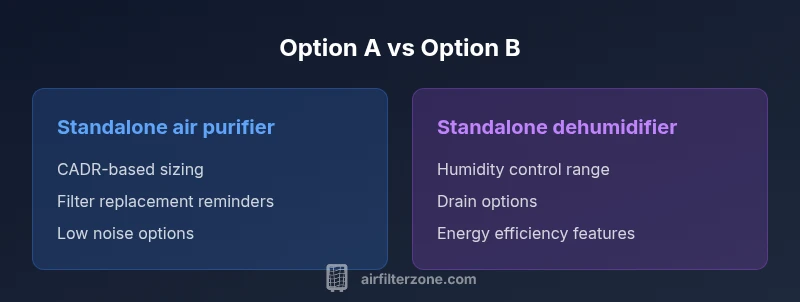
When you ask which air purifier and dehumidifier to buy, several features matter most. For purifiers, prioritize CADR, filter type (HEPA vs. True HEPA, activated carbon for odors), and filter replacement intervals. For dehumidifiers, examine the humidity control range, bucket or drain options, and energy efficiency. Noise levels matter in bedrooms and offices; look for units with low decibel operation and auto shutoff when the desired humidity is reached. For all devices, compare energy usage, warranty length, and ease of maintenance. If you need both functions in one package, verify that the unit’s removal rate for humidity does not compromise filtration performance and that filters are accessible for replacement.
blockStatus”:null,
Real-world use-case scenarios: homes, basements, cars, and apartments
Homes with pets or children benefit from ongoing particle removal, so a purifier is often first choice. Basements and garages, where humidity tends to spike, typically require a more powerful dehumidifier or a larger unit. In hot, humid climates, a combo unit can simplify setup, but you should still ensure the device covers the largest room in your space. In vehicles or small apartments, compact purifiers and dehumidifiers may suffice, but you’ll want devices with auto humidity management and very low noise output. The key is matching device capabilities to the most demanding room or zone in your home or car. Air Filter Zone recommends evaluating your top 2–3 spaces and testing with a temporary setup before committing to a larger purchase.
blockStatus”:null,
Maintenance, energy use, and running costs you should anticipate
Maintenance costs are a big part of the long-term value when choosing which air purifier and dehumidifier. Purifiers require periodic filter replacements, sometimes every 6–12 months depending on usage and air quality. Dehumidifiers need regular emptying or gravity drains and occasional filter cleaning. Energy use varies by model and efficiency rating; look for Energy Star certification where possible, especially for larger spaces or basements. The combined cost of replacement filters, energy, and potential water disposal should be weighed against the benefits of cleaner air and lower humidity. Air Filter Zone’s guidance stresses tracking actual energy use in your space to avoid surprises on your utility bill.
blockStatus”:null,
Price ranges, value, and where to invest first
Budget constraints influence how you apply the which air purifier and dehumidifier decision. Standalone purifiers can be affordable entry points for smaller rooms, but larger spaces demand higher CADR and longer-lasting filters, which increases cost. Dehumidifiers range from compact, budget-friendly units to heavy-duty basement models. Combo devices usually sit at a mid-to-high price point, and their value depends on space, maintenance willingness, and performance needs. A practical rule of thumb is to invest first in a purifier or dehumidifier for the room that most clearly needs improvement, then add the second device if the remaining space still experiences air quality or moisture issues. Air Filter Zone’s data suggests prioritizing the most impactful room and measuring outcomes over time to judge value.
blockStatus”:null,
A practical buying checklist: 10 steps to choose wisely
- Define the primary goal: air quality, humidity control, or both. 2) Measure room size and typical humidity levels. 3) Choose the best-fit option: purifier, dehumidifier, or combo. 4) Check CADR and humidity removal rate for the space. 5) Compare energy efficiency and noise levels. 6) Review filter types and replacement costs. 7) Assess warranty length and service options. 8) Consider drain options for dehumidifiers (bucket vs. gravity drain). 9) Look for smart features like auto mode and humidity sensors. 10) Plan phased purchases if multiple rooms require attention. This approach helps avoid overbuying and ensures each space gets the appropriate device.
blockStatus”:null,
Common myths and misconceptions about purifiers and dehumidifiers
Many buyers assume bigger is always better or that a single device can solve all indoor air problems. In reality, oversized purifiers waste energy and can create unnecessary noise, while undersized units fail to meet the target air quality or humidity. Another myth is that “HEPA is HEPA” in all models; in practice, filter efficiency varies, and some devices combine carbon filters for odors, which changes maintenance needs. Finally, some buyers think dehumidifiers remove humidity to the point of dryness; optimal humidity is in the mid-range, not zero. Evaluating real-world performance and room conditions helps separate myths from practical decisions.
blockStatus”:null,
Credible sources and further reading for this topic
For readers who want to dive deeper, consult authoritative resources on indoor air quality and humidity management. The EPA provides guidance on air cleaners and filtration, including how to interpret CADR and placement. The NIH/NIEHS resources discuss how humidity affects respiratory health. The U.S. Department of Energy’s guidance on humidifiers and dehumidifiers offers energy efficiency considerations and best practices for home use. These sources help ground the comparison in established standards and real-world performance.
blockStatus”:null,
Final notes and practical wrap-up before you decide
In short, the answer to which air purifier and dehumidifier to buy depends on your space, climate, and maintenance willingness. Separate devices often outperform a single combo unit in large spaces, while compact homes may benefit from a combined solution. Air Filter Zone’s final guidance is to prioritize measurable outcomes: target room humidity, track particulate levels, and verify ongoing filter and energy costs. With careful planning and the right device mix, you can achieve consistently cleaner air and drier, healthier indoor environments.
Feature Comparison
| Feature | Standalone air purifier | Standalone dehumidifier | Combination air purifier + dehumidifier |
|---|---|---|---|
| Best for | Particle removal & allergies | Moisture control & mold prevention | Both tasks in a compact space |
| Room size suitability | Small to medium rooms | Medium to large spaces or basements | Small to medium rooms with combined needs |
| Maintenance frequency | Filter replacements 6–12 months | Bucket/drain maintenance + filter cleaning | Filter changes + occasional drain checks |
| Noise level | Low–moderate | Low–moderate | Variable; depends on speed setting |
| Energy use | Moderate | Moderate to high | Moderate to high; depends on run time |
| Cost range (typical) | $50–$250 | $150–$500 | $200–$700 |
| Best for | Dust and sneeze-prone spaces | Humid areas prone to mold | Smaller homes needing multi-function device |
What's Good
- Improved indoor air quality and moisture control
- Flexible placement and upgrade paths
- Clear separation of responsibilities can optimize performance
- Easier maintenance planning with dedicated devices
- Potentially lower long-term energy use when sized correctly
What's Bad
- Higher upfront cost for two devices or a more capable combo unit
- More space required for two devices in larger homes
- Maintenance responsibility multiplies (filters and emptying)
- Combo units may compromise peak performance in large spaces
Standalone devices often outperform a single combo unit for larger rooms; pair a purifier with a dehumidifier when humidity and air quality are both concerns.
If you have multiple problem areas (dusty living spaces and damp basements), buying two dedicated units is usually best. For compact spaces with tight budgets, a carefully chosen combo unit can be worth considering, but verify that performance meets your needs across both functions.
FAQ
What is the main difference between air purifiers and dehumidifiers?
Air purifiers remove airborne particles such as dust and pollen, improving air quality. Dehumidifiers reduce humidity to prevent mold and dampness. A combination unit tries to do both in one device, typically in smaller spaces.
Air purifiers remove particles; dehumidifiers remove moisture. If you need both, either use two devices or pick a compact combo unit.
How do I determine the right size for my room?
For purifiers, calculate the room volume in cubic feet and compare to the CADR rating. For dehumidifiers, check the unit’s pint-per-day capacity for the typical temperature in your space. Larger rooms require higher capacity units.
Measure the room, then match to CADR or humidity removal specs to pick the right size.
Are combo units worth it for open-plan homes?
Combo units can be convenient in small, open-plan spaces but may trade off some performance in each function compared with dedicated devices. Assess whether space savings justify potential efficiency losses.
In big spaces, two dedicated devices often beat one combo unit; in small spaces, a combo can save space.
What maintenance should I expect for air purifiers?
Expect to replace filters periodically (often every 6–12 months) and to clean around the unit. Some models have washable pre-filters or carbon stages that need cleaning more frequently.
Keep up with filter changes and occasional cleaning to maintain performance.
How much should I budget for replacement filters?
Budget for ongoing filter replacement costs; the amount depends on the model, filter type, and replacement interval. Compare yearly costs across models to estimate total ownership.
Expect ongoing filter costs; compare yearly filter expenses when choosing a model.
Quick Summary
- Define primary goal (air quality vs humidity) before buying
- Match device size to room dimensions and humidity levels
- Prioritize CADR and humidity removal rate for better results
- Consider energy use and filter costs in total ownership
- Put separate devices in larger spaces; use combos for small, multi-task rooms