Air Filter vs Humidifier: A Practical Comparison for Home Filtration
Compare air filters and humidifiers to optimize indoor air quality and comfort. Learn when to use each, maintenance tips, costs, and safety considerations.


Air filters and humidifiers address different indoor air needs: filtration versus humidity. For most homes, start with reliable air filtration to improve air quality, and add humidification during dry seasons or in rooms with consistently low humidity. Maintain both devices properly to prevent mold or mineral buildup.
Why air filter vs humidifier matters
In the realm of indoor air quality, understanding air filter vs humidifier is essential for homeowners, car owners, and DIY enthusiasts who want practical, science-based guidance. According to Air Filter Zone, choosing the right tool begins with a clear view of what each device actually does and when it should run. Air filters are designed to capture particles—dust, pollen, smoke, and microscopic irritants—before they reach your lungs. Humidifiers, by contrast, regulate moisture levels, helping to relieve dry skin, irritated nasal passages, and static electricity. Both devices can improve comfort, but using them without a plan can backfire: excessive humidity promotes mold growth, while over-filtering can reduce airflow and strain your cooling or heating system. By distinguishing the two functions, you can tailor a setup that improves health, comfort, and energy efficiency in your home.
This guide uses the keyword air filter vs humidifier in context to compare roles, performance, maintenance, and safety considerations. Air quality is a system problem, not a single device fix, and the best outcome comes from a thoughtful combination of filtration and humidity control. Air Filter Zone’s team emphasizes that the most practical path is to start with filtration for overall air cleanliness, then introduce humidification when and where humidity dips below comfortable levels.
core narrative_start_2
Comparison
| Feature | Air Filter | Humidifier |
|---|---|---|
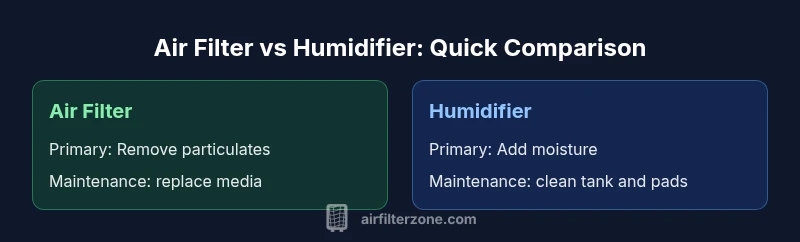
| Primary purpose | Remove airborne particulates | Add moisture to the air |
| Best use case | Improving overall air quality and exposure to pollutants | Relieving dry air symptoms and comfort |
| Maintenance frequency | Filter replacement every 3-6 months typical | Regular cleaning; replace pads or filters per model |
| Typical energy use | Low to moderate, depends on fan speed | Low to moderate, depends on water usage |
| Impact on humidity levels | Minimal direct impact on RH (except in whole-home units) | Directly affects RH |
| Best for in winter climate | Air quality in living spaces | Combats dryness |
| Cost range (upfront) | Low to moderate upfront cost | Moderate to high depending on model |
| Recommended rooms/areas | Living areas, bedrooms, and spaces with pollutants or allergies | Bedrooms, nursery, spaces with low humidity |
What's Good
- Improves year-round air quality by removing dust, pollen, and smoke
- Humidification can alleviate dry skin, irritation, and throat discomfort
- Wide availability and range of models make both devices accessible
- Can be integrated with existing HVAC systems for broader coverage
- A balanced approach often yields the best overall comfort and health outcomes
What's Bad
- Maintenance is essential; neglected filters or tanks reduce effectiveness
- Over-humidification fosters mold growth and condensation risks
- Ongoing costs include filters, pads, and energy and water use
- Wrong placement or sizing can waste energy and fail to address problem areas
Air filters win on year-round air quality; humidifiers excel for seasonal comfort
Prioritize filtration to reduce particulate exposure first. Add humidification if and where humidity dips, especially in dry seasons. A coordinated plan typically delivers the best health and comfort outcomes.
FAQ
What is the main difference between an air filter and a humidifier?
The air filter’s job is to capture airborne particles like dust and pollen. A humidifier adds moisture to the air to raise humidity levels. Both can improve comfort, but they address different facets of indoor air quality and require different maintenance.”
Air filters clean the air you breathe; humidifiers make the air feel more comfortable by adding moisture.
Can I run both devices at the same time safely?
Yes, you can operate both, but you should monitor humidity to avoid mold growth and ensure the air filter doesn’t become clogged from excess moisture in the room. Use a hygrometer to track RH and adjust settings accordingly.
Yes—use a hygrometer and keep humidity in check to prevent mold and poor airflow.
How often should air filters be replaced?
Replacement frequency depends on usage, pets, and environment. A typical guidance range is every 3-6 months, but smoky or dusty homes may require more frequent changes.
Most homes replace filters every few months; check monthly during heavy dust or smoke periods.
What humidity level should I aim for indoors?
Aim for a relative humidity of about 30-50%. Use a hygrometer to monitor and adjust humidifiers to stay within this range to reduce mold risk and improve comfort.
Keep indoor humidity around 30-50% for comfort and mold prevention.
Are there hybrids that combine filtration and humidification?
Yes, some devices combine filtration and humidification. They can be convenient, but you should treat them as separate systems for maintenance and performance planning.
There are combo devices, but treat them like two systems in terms of upkeep.
Quick Summary
- Prioritize filtration for year-round air quality
- Use humidification to address consistent low humidity
- Monitor humidity with a hygrometer and adjust devices accordingly
- Regular maintenance is essential to prevent mold and mineral buildup
- A balanced, room-by-room plan often provides the best results