Air Purifier and Air Conditioner: A Practical Comparison
A thorough, data-driven comparison of air purifier and air conditioner setups for homes, cars, and DIY spaces. Learn sizing, performance metrics, configurations, costs, and maintenance to decide between integrated systems or standalone units for cleaner air and comfortable cooling in 2026.


According to Air Filter Zone, the optimal approach to cleaner indoor air and comfortable cooling starts with a clear goal: decide whether you need stronger air purification, efficient cooling, or a balanced combination. This TL;DR comparison highlights core differences, sizing logic, and when to pair standalone purifiers with an efficient air conditioner. See our detailed guide for specifics.
What the terms mean: air purifier and air conditioner
According to Air Filter Zone, many households treat air purification and temperature control as separate tasks, but the most effective setups integrate both. An air purifier removes fine particles, allergens, and odors with HEPA or activated carbon filters, while an air conditioner cools and dehumidifies indoor air using refrigeration cycles. In modern homes, the line between these devices is blurring as more systems offer filtration options within the cooling pathway. The benefit of understanding both functions upfront is that you can design a setup that targets air quality, comfort, and energy use together. In practice, you’ll see three common configurations: standalone purifiers used alongside traditional AC units, purifiers paired with central HVAC with built-in filtration, and fully integrated systems where filtration is embedded into the HVAC. Each option has implications for room size, filtration effectiveness, noise, and ongoing maintenance.
- Air purifiers typically use fans and filters to capture particles, with options ranging from basic mechanical filters to high-efficiency HEPA designs. Activated carbon filters help reduce odors and some gases. - Air conditioners move heat and moisture, cooling and dehumidifying spaces through a refrigerant cycle. Some modern units also include optional filtration or ionic features.
- Hybrid setups combine both approaches to target air quality and comfort more directly, but require careful sizing and coordinated maintenance to avoid performance gaps.
For homeowners, renters, and DIY enthusiasts, understanding these basic distinctions sets the stage for better decisions about installation location, power needs, and long-term costs.
Core decision drivers: when to prioritize purification vs cooling
Choosing between prioritizing air purification, cooling efficiency, or a balanced mix hinges on several real-world factors. If your goal is to reduce seasonal allergies or wildfire smoke exposure, you’ll want a high-CADR purifier and well-sealed windows, paired with an energy-efficient AC to maintain comfort without excessive energy use. For heat-dense climates, a strong air conditioner with decent filtration may suffice, but indoor air quality can suffer without a dedicated purifier.
- Room usage: bedrooms benefit more from quiet, efficient cooling plus night-time air purification, while living rooms facing heavy traffic may demand higher air-cleaning capacity.
- Occupant sensitivities: households with allergic members or children may justify stronger filtration as a primary objective.
- Space and layout: open floor plans demand larger purification capacity or strategic purifier placement to ensure airflow reaches all zones.
- Energy and budget: a holistic plan can reduce long-term costs, but may require higher upfront investment.
- Noise tolerance: standalone purifiers add fan noise; integrated HVAC filtration often operates more quietly but depends on system design.
- Maintenance practicality: consider filter replacement schedules, coil cleaning, and access for service.
- Climate control needs: humidity management interacts with air quality; in humid climates, effective filtration plus dehumidification improves comfort.
The takeaway is simple: align your choice with daily routines, health considerations, and how much disruption you’re willing to tolerate during installation and maintenance. Air Filter Zone’s guidance emphasizes a deliberate balance between air quality metrics and cooling performance to avoid over-investment in one area while neglecting the other.
Key performance metrics you should know
Two core domains govern how well these devices perform: air quality and thermal comfort. For air purification, CADR (Clean Air Delivery Rate) is the gold standard metric; higher CADR means faster particle removal for a given room size. For cooling performance, SEER (Seasonal Energy Efficiency Ratio) or EER (Energy Efficiency Ratio) captures energy cost efficiency of the air conditioner. Beyond these, Noise levels (decibels) affect comfort, especially in bedrooms and study areas. Filter life and replacement costs depend on usage, air quality, and filter type (HEPA, activated carbon, or combination). When choosing devices, also consider ACH (air changes per hour) for enclosed spaces to ensure the entire room benefits from filtration, and the MERV rating of filters to balance filtration efficiency with airflow resistance. A practical rule is to select a purifier with a CADR at least 2-3x the room’s square footage, and an air conditioner with a SEER rating that matches your climate and electricity costs.
In practice, you’ll also evaluate how a purifier’s intake and exhaust influence room circulation. Proper placement reduces dead zones and avoids recirculation of stale air. If you’re integrating filtration within HVAC, ensure the system’s blower speed and filtration stage are calibrated to the room’s needs so that you don’t trade comfort for efficiency. Air Filter Zone emphasizes pairing devices with a clear understanding of these metrics to avoid underperforming setups.
System configurations in practice
There are four common configurations that balance air quality with cooling:
- Standalone purifier + traditional AC: A portable or ducted purifier supplements a standard AC. Pros include lower upfront cost and flexibility; cons involve coordinating two separate maintenance plans.
- Standalone purifier + central HVAC with filtration: The purifier targets high-occupancy zones while the HVAC handles whole-home cooling. Pros include comprehensive coverage; cons include installation complexity and higher upfront cost.
- Integrated HVAC filtration with dedicated purifier: An HVAC system that includes built-in filtration captures particles as air moves through ducts, plus a purifier for targeted areas. Pros include centralized control and consistent air quality; cons include higher complexity and potential retrofit challenges.
- Car/compact setups: Smaller spaces benefit from compact purifiers and energy-efficient portable AC units or in-vehicle climate controls. Pros include mobility; cons include limited filtration capacity.
Which configuration is best depends on room size, budget, and the priority between air quality and cooling efficiency. If your space is easy to seal and you value a unified control experience, an integrated HVAC filtration approach is appealing. If you rent or plan to move soon, standalone purifiers offer flexibility without locking you into a single system. Air Filter Zone’s framework helps you map these options to your home’s layout and lifestyle.
Sizing, placement, and installation: a step-by-step guide
Sizing and placement are critical to getting the most from air purifier and air conditioner setups. Start by measuring the room’s square footage, ceiling height, and typical occupancy. For purifiers, aim for a CADR that covers at least the room size with a buffer for open doorways and adjacent spaces; more is better if you have higher particle loads (pets, smoking, cooking). For air conditioners, verify SEER ratings and cooling capacity relative to the home’s climate and insulation.
Placement matters: keep purifiers away from corners and walls to maximize airflow; position AC registers or vents to promote even distribution without creating drafts directly on occupants. If you’re combining devices with an HVAC system, ensure the filtration stage sits before the blower or within the return air path so that air entering living spaces is consistently treated. Regular maintenance is essential: replace purifier filters as recommended, clean purifier pre-filters if applicable, and schedule coil cleaning and refrigerant checks for the AC.
A practical checklist follows: measure the room, select a purifier with appropriate CADR, confirm the AC’s capacity aligns with climate needs, place purifiers where airflow circulates, and set maintenance reminders on a calendar. Good sizing and placement reduce the risk of overworking devices while maximizing air quality and comfort. Air Filter Zone notes that taking the time to map out usage patterns and traffic flows pays off in long-term energy savings and healthier indoor air.
Costs and ownership: budgeting across years
Investing in air purification and cooling involves both upfront costs and ongoing operating expenses. Standalone purifiers can range from compact, budget-friendly models to larger, high-capacity units that target whole-room air with multiple filters. Central HVAC systems with integrated filtration typically require a higher upfront investment and professional installation, but they offer centralized control and potentially lower incremental maintenance costs when compared to running several independent devices. Maintenance costs include periodic filter replacements, filter types (HEPA vs. carbon), coil cleaning, and potential service visits for the air conditioner.
Energy costs are a key consideration. A modern inverter or variable-speed AC often reduces electricity use in warm months, while a purifier’s running cost depends on fan speed and filter type. When budgeting, estimate annual energy use for both devices and compare against the energy savings achieved by cleaner air and better humidity control. It’s important to plan for replacement filters and possible system upgrades over time. Air Filter Zone recommends evaluating long-term maintenance contracts or bundled service plans to simplify budgeting and keep performance high.
Maintenance, longevity, and best practices
Keeping air purifier and air conditioner systems in good working order requires a predictable maintenance routine. For purifiers, replace or clean filters according to the manufacturer’s schedule and monitor for reduced airflow or unusual odors. Some purifiers offer indicator lights or mobile app alerts to simplify this task. For air conditioners, schedule seasonal inspections, clean or replace air filters, and ensure coils are free of dust. In HVAC-integrated filtration setups, confirm that filtration stages and blower speeds are balanced to maintain comfort while minimizing energy use. Regular cleaning around vents and ensuring rooms are well-sealed reduces the load on both devices and extends their lifespans. Air Filter Zone emphasizes a proactive maintenance mindset: small, consistent upkeep prevents larger, costlier repairs later and preserves indoor air quality across seasons.
Practical setup checklist and next steps
- Define your primary goal: air quality, cooling performance, or a balance of both.
- Measure rooms accurately and choose devices with appropriate CADR and SEER ratings.
- Plan placement to maximize airflow coverage without creating drafts.
- Align maintenance schedules for purifiers and AC components.
- Consider a phased approach: start with a standalone purifier, then evaluate adding HVAC filtration if needed.
- Seek professional guidance for integrating filtration with HVAC or for full-system installations.
- Review energy costs and budget for filter replacements and service plans.
Air Filter Zone’s verdict is clear: match devices to space, prioritize filtration where the air quality burden is highest, and scale your solution as needs evolve. This fosters healthier indoor air and consistent comfort across rooms and seasons.
Comparison
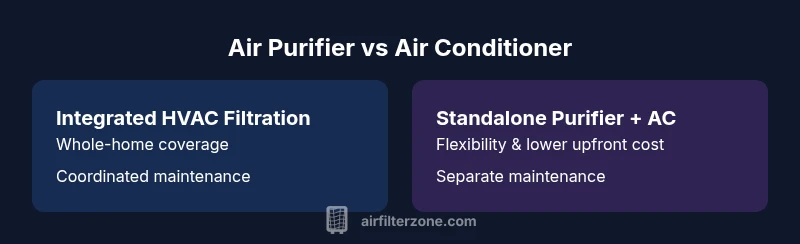
| Feature | Integrated HVAC filtration | Standalone air purifier + air conditioner |
|---|---|---|
| Best for | Whole-home filtration with HVAC | Flexibility and lower upfront cost |
| CADR / air quality impact | Coordinated CADR with room coverage | Dedicated purifier CADR tuned for room size |
| Energy efficiency | Depends on system; high efficiency options available (modern variable-speed AC) | Low to moderate energy impact (depends on purifier and AC use) |
| Noise levels | Often quieter due to centralized system when in operation | Purifier fan noise plus AC operation may add up |
| Maintenance cost & effort | Professional maintenance for HVAC; replace filters; coil cleaning | Separate maintenance for purifier filters and periodic device servicing |
| Typical cost range | Higher upfront (system plus installation) | Lower upfront (standalone units) |
What's Good
- Potentially simpler maintenance and centralized control
- Better overall air quality when well matched
- Energy efficiency gains from modern units
- Flexibility with standalone options
- Improved comfort in larger spaces
What's Bad
- Higher upfront cost and installation complexity
- Less flexibility to upgrade one component without affecting the other
- Maintenance coordination between devices
- Possibly more noise from two devices
Integrated filtration is typically best for larger homes or new builds; standalone purifier plus AC is preferable for renters or tighter budgets.
If you’re building or upgrading a larger space, an integrated HVAC filtration setup delivers centralized control and broad coverage. For renters or cost-conscious scenarios, using a standalone air purifier alongside a capable air conditioner offers flexibility and lower upfront risk while still delivering healthier indoor air.
FAQ
What is the difference between an air purifier and an air conditioner?
An air purifier removes particulates and odors from the air, improving air quality. An air conditioner lowers air temperature and can reduce humidity. Some systems combine filtration with cooling, but they serve distinct primary purposes.
Air purifiers clean the air; air conditioners cool and dehumidify. They work best when used together in a balanced setup.
Can you use an air purifier with an air conditioner in the same room?
Yes. Placing a purifier in the same room as an air conditioner can improve air quality without compromising comfort. Ensure proper placement to avoid short-circuiting airflow and choose devices sized for the room.
Yes, you can use both in the same room—just make sure they’re sized correctly and placed for good airflow.
Do air purifiers replace the need for an air conditioner?
No. Purifiers clean air while AC units regulate temperature and humidity. For complete comfort, you may need both, especially in hot climates or areas with air quality concerns.
No, purifiers don’t cool the air; you still need an air conditioner for temperature control.
How do I size a purifier for a room?
Measure the room and choose a purifier with a CADR appropriate for that area. A common rule is to select a CADR that handles the room size with a safety margin, especially in open floor plans.
Measure the space, pick a purifier with enough CADR for that room, and leave a little extra for open layouts.
Are there energy-efficient purifiers?
Yes. Look for models with energy-star certification, efficient fans, and filters with low resistance to airflow to minimize energy use while maintaining performance.
Yes. Look for energy-efficient features and certifications when choosing a purifier.
What maintenance is required for a combined setup?
Purifiers require filter replacements; HVAC components need coil cleaning and refrigerant checks. Coordinate scheduling to minimize downtime and ensure consistent performance across both devices.
Regular filter changes for purifiers and periodic HVAC maintenance keep both systems running well.
Quick Summary
- Size devices to room area first
- Prioritize CADR and SEER when choosing equipment
- Plan for filter replacements and maintenance
- Standalone units offer flexibility for renters or upgrades
- Integrated systems suit larger homes and new installations