Air Filter and Purifier: A Practical Side-by-Side Guide
Compare air filter systems and standalone purifiers to choose the best solution for cleaner indoor air. Learn how to evaluate performance, maintenance, and overall cost for homes, cars, and DIY setups in practical terms.


Air filters integrated into HVAC systems and standalone air purifiers both improve indoor air quality, but they suit different goals. Air filters excel in long-term cost and whole-home coverage, while purifiers offer fast, targeted cleanup in specific rooms or vehicles. This guide compares options to help you decide.
Context: A practical distinction between an air filter and an air purifier
Air quality in homes and cars is influenced by several factors, including particulates, odors, moisture, and volatile organic compounds. When people search for ways to clean the air, they often encounter two terms: air filter and purifier. They sound similar, but they serve different purposes in real-world setups. According to Air Filter Zone, understanding the difference helps you align IAQ goals with budget and space. In general, an air filter is a passive barrier that traps particles as air moves through a media, frequently installed in HVAC ducts or frames. An air purifier is a self-contained unit with a fan, a filtration stage, and sometimes an additional carbon or electrostatic stage, designed to clean air within a specific room or zone. The decision between them is not about choosing one perfect tool; it’s about selecting the right mix for your environment, noise tolerance, and maintenance capacity. This article compares the two approaches side by side, with practical guidance for homeowners, car owners, and DIY enthusiasts who want measurable improvements without overhauling their setups.
How filtration works: HVAC filters vs portable purifiers
Filtration occurs when air flows through a physical barrier that captures particles. In HVAC systems, the air must pass through a furnace filter or filter rack before recirculating. The media typically uses pleated fibers with a rating such as MERV, which gauges how many particles the media can capture at various sizes. A higher MERV rating increases filtration efficiency but may reduce airflow if the system isn't sized for it. Portable air purifiers, by contrast, use a built-in fan to pull air through one or more filters—often a combination of high-efficiency HEPA media and activated carbon for odors. Some models also include an ionizer or UV-C option, though these features add cost and may raise questions about byproducts. For most households, the purifier's performance is described by its CADR (clean air delivery rate), which combines particle removal rate with room size to estimate effectiveness. In practical terms, a purifier is usually best for targeted spots (a living room, nursery, or home office), while an HVAC filter provides ongoing, system-wide filtration when the system is appropriately sized.
Key decision factors: room size, air changes, and pollution sources
Choosing between an air filter approach and a purifier depends on how you use space and what you want to achieve. Start with room size and air changes per hour (ACH). A large living area may benefit from a well-chosen HVAC filter that contributes to ongoing IAQ, while a small bedroom or car cabin may benefit from a compact purifier that can be placed near the bed or driver seat. Consider pollution sources: if you have smoking, cooking with strong odors, pets, or high dust, you may need carbon filters or purifiers with carbon stages in addition to a higher-MERV HVAC filter. Noise tolerance matters too: purifiers introduce fan noise, which can be a problem in bedrooms or study spaces. Finally, think about maintenance capacity: HVAC filters last longer between changes but require selecting the correct MERV rating; purifiers demand regular filter replacements and occasional repositioning for optimal coverage.
Filtration efficiency and standards explained
Performance metrics help translate features into real-world IAQ improvements. MERV ratings indicate how well a filter captures particles in the 0.3 to 10 micron range; higher ratings generally mean better filtration but potential airflow trade-offs. For standalone purifiers, CADR and filter area are the primary indicators; larger CADR values indicate faster cleaning for a given room size. When odors and gases are a concern, products with activated carbon or zeolite layers can help, though the effectiveness depends on particle size, concentration, and room conditions. It’s important to align expectations: even the best filter cannot remove every pollutant instantly, and the rate of improvement depends on room volume, leakage, and the source of pollutants. For DIY enthusiasts, a practical rule is to size filters to the largest room intended for use and to maintain consistent replacement schedules to preserve performance. Air Filter Zone stresses that balancing filtration media with appropriate airflow is key to sustainable IAQ gains.
Costs and maintenance strategies
Initial costs vary widely between HVAC filters and portable purifiers. HVAC filters range from inexpensive fiberglass media to more premium pleated options; the upfront investment is often modest, but you must consider blower compatibility and potential impacts on energy use if you push for very high MERV ratings. Portable purifiers tend to have lower upfront costs per unit but require ongoing replacement purchases, especially in households with pets or allergy sufferers. Maintenance schedules are important: replace HVAC filters according to the manufacturer’s guidance and your usage, typically on a quarterly basis for many homes; purifiers generally require periodic filter changes every several months, depending on usage, filter type, and environmental conditions. In both cases, routine cleaning of the unit, door seals, and intake grilles matters for consistent performance. Budget-minded buyers can plan a blended approach: a durable HVAC filter for baseline IAQ, plus one or two purifiers in key rooms to address problem spots without wasteful redundancy.
Real-world use cases: homes, vehicles, and DIY spaces
In a typical family home, the HVAC system with a high-quality filter acts as the backbone of IAQ. A purifier placed in a living room or nursery offers quick, localized improvements when odors, smoke, or pet dander become noticeable. For car owners, compact purifiers designed for 12V power can reduce cabin dust and odors during commutes; note that they are not a substitute for fresh air and may require regular filter changes due to high particulate loads. DIY enthusiasts with workshop spaces can combine a ducted filter arrangement with a portable purifier near the workbench to manage dust and fumes effectively. The key is to avoid over-reliance on one solution. By distributing filtration across the space and maintaining a sensible schedule, you can achieve more reliable IAQ improvements without overspending.
Integration strategies for balanced IAQ
A practical approach is to use both a filtration pathway and a purification pathway. In many homes, an HVAC filter provides continuous, whole-home coverage, while portable purifiers tackle stubborn spots or temporary events (cooking, painting, or heavy cleaning). Ensure that purifiers are well-positioned away from walls or furniture to maximize airflow and avoid dead zones. For older houses or rooms with poor leakage control, consider sealing gaps around doors and windows to reduce pollutant ingress—this makes both filters and purifiers more effective. When integrating with HVAC systems, avoid very high MERV ratings that could restrict airflow unless the system is upgraded to handle the extra resistance. Finally, keep airflow patterns in mind: placing purifiers near fresh sources of air (windows or open doors) can enhance results without creating imbalanced circulation.
Setup checklist and best practices
Before you buy, measure the room and estimate your needs. Choose a purifier with a CADR appropriate for the room size and check that your HVAC filter's MERV rating aligns with your furnace or air handler’s blower capacity. Place purifiers on hard surfaces at least a few inches from walls to maximize intake and exit air. Replace filters on schedule, and keep an eye on signs of reduced airflow, such as longer run times or unusual noise. Clean the intake grills and avoid overcrowding devices. In spaces with limited outlets, prioritize devices with energy-efficient modes or energy star ratings to minimize operating costs. Finally, document a maintenance plan with dates and replacement intervals to maintain IAQ improvements over time.
Practical decision mapping: what to buy first
If you want a straightforward path to cleaner air, start with a high-quality HVAC filter that matches your system’s specifications. This baseline improves overall airflow and reduces particulate load in the entire home. Next, identify one or two problem rooms or spaces where odors, smoke, or moisture is a recurrent issue. Install a dedicated purifier in those zones and select models with activated carbon for odor control and HEPA-style filtration for particulates. If you drive regularly in dusty conditions or live in a region with seasonal wildfire smoke, a car purifier or portable purifier with robust carbon filtration can be valuable. Finally, tailor maintenance to your usage: replacement schedules, cleaning routines, and routine checks will keep performance consistent.
Authoritative sources
- https://www.epa.gov/iaq
- https://www.cdc.gov/niosh/topics/indoorairquality/default.html
- https://ashrae.org
Comparison
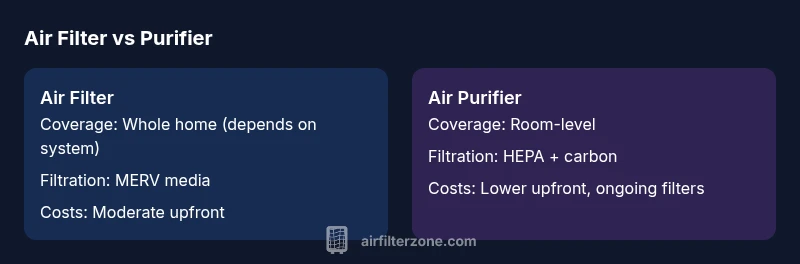
| Feature | Air filter (HVAC) | Air purifier (standalone) |
|---|---|---|
| Filtration technology | MERV-rated media in HVAC | HEPA + carbon in purifier |
| Coverage area | Whole-home filtration (depends on HVAC) | Single room or vehicle |
| Maintenance frequency | Replacement per system schedule | Replacement per manufacturer (typically every 6–12 months) |
| Initial cost | Moderate to high (system dependent) | Lower upfront for standalone units |
| Noise | Low to moderate (depends on system) | Can be noticeable at higher purifier speeds |
| Energy use | Low unless very high MERV is used | Variable by model; typically moderate |
| Best for | Baseline, ongoing IAQ across home | Targeted room cleaning or spaces |
What's Good
- Long-term IAQ gains when used as part of a building-wide filtration strategy
- Comprehensive coverage for whole-home air quality (HVAC-based)
- Low daily maintenance for HVAC filters if scheduled
- Fast, targeted improvements in problem rooms with purifiers
- Flexible placement and upgrade options for DIY setups
What's Bad
- Filter performance depends on system compatibility and may reduce airflow if over-filtered
- Purifiers require ongoing filter replacements and can add energy use
- HVAC filters may not remove odors or gases as effectively as dedicated carbon cartridges in purifiers
- Placement and sizing are critical; misalignment reduces effectiveness
Use a blended approach for balanced IAQ across spaces.
HVAC filtration provides ongoing baseline cleaning, while portable purifiers address hotspots and odors. A combined strategy offers reliable indoor air quality with manageable costs.
FAQ
What is the difference between an air filter and an air purifier?
Air filters are installed in HVAC systems or frames to capture particles as air passes through. Air purifiers are standalone units that clean air in a single room or zone. Both reduce particulates, but coverage and maintenance differ.
Air filters work through your system; purifiers work in a room.
Do air purifiers help with odors?
Yes, many purifiers include activated carbon filters that adsorb odors; effectiveness depends on odor type and purifier capacity. For strong cooking smells or smoke, choose models with dedicated carbon stages and ensure proper room sizing.
Purifiers with carbon filters help with odors, but placement matters.
How often should HVAC filters be replaced?
Replacement frequency depends on filter type, usage, and household factors. As a general guideline, check filters every 1-3 months and replace every 3 months for typical homes; more frequent changes are common with pets or high dust environments.
Most homes change filters every few months, more often with pets.
Can I use a purifier with my existing HVAC system?
You can supplement with a purifier, but it won’t replace HVAC filtration. Use purifiers for hotspots and ensure compatibility to avoid overloading circuits and creating airflow problems.
A purifier helps in rooms; it doesn’t replace the HVAC filter system.
What size purifier do I need for my room?
Choose a purifier with a CADR appropriate for your room size. Measure square footage (and height) to estimate air turnover needs and look for models that match or exceed the room’s CADR requirements.
Match the purifier’s CADR to your room’s size.
Are there health risks with certain filters or purifiers?
Most devices are safe when used as directed. Follow manufacturer guidelines, ensure proper placement and maintenance, and avoid overuse of ozone-emitting features or high-noise settings near sleeping areas.
Stick to recommended settings and keep filters maintained.
Quick Summary
- Assess room size to pick appropriate equipment
- Prioritize HVAC filters for baseline filtration
- Add purifiers for rooms with odors or higher pollutant loads
- Maintain regular replacement and cleaning schedules
- Position devices to optimize airflow and reduce dead zones