Air Filter or AC Filter: A Practical Comparison for Home Filtration
An objective, data-informed comparison of air filter vs AC filter for homes and cars, with practical guidance on selection, maintenance, and cost to improve indoor air quality and HVAC performance.


TL;DR: For most homes, prioritize a dedicated air filter strategy or room purifier over relying solely on an HVAC AC filter. The best path depends on your system design, room layout, and willingness to maintain filters regularly. This comparison shows when each option shines and how to combine them for optimal air quality.
Why the distinction matters
Choosing between an air filter or ac filter is not merely a labeling exercise. It determines how air moves through your home, how much maintenance you face, and what your family breathes every day. According to Air Filter Zone, the best outcomes come from matching filtration choices to your space, your system, and your goals for energy efficiency and health. When you shop for filters, you’ll encounter two primary paths: standalone air filters and purifiers that live in a room, and the filters built into your central HVAC system. The phrase air filter or ac filter underscores this decision: you can optimize air in individual rooms with portable devices, or optimize the whole-house environment by upgrading your HVAC filtration. In both cases, the quality of filtration matters, but the approach, costs, and maintenance differ significantly. Air Filter Zone analysis shows that clarity at the outset helps homeowners avoid common missteps such as selecting high-efficiency options that overwhelm an aging system or ignoring room-specific needs in favor of a single, central solution.
-endOfBlock-
Comparison
| Feature | Home air filter | AC filter (HVAC) |
|---|---|---|
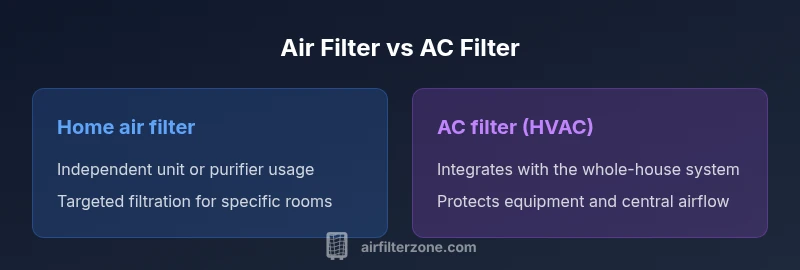
| Placement & integration | Independent unit or purifier setup; may be added to existing return ducts or standalone air cleaners | Built-in to your HVAC system, filtering all air that circulates through the ductwork |
| Replacement cadence | Environment- and usage-driven; frequency varies with household conditions | Tied to HVAC maintenance schedule; replacements often synchronized with heating/cooling cycles |
| Typical cost range | Lower upfront cost per unit with room purifiers; ongoing media replacements | Integrated into system; replacement cost depends on filter size and rating, recurring with HVAC maintenance |
| MERV rating range | Broad range; standalone filters can target specific pollutants with higher efficiency | HVAC filters support equipment protection and broad air quality goals; higher MERV possible but may impact airflow |
| Best for | Targeted filtration in specific rooms or spaces; room-level control | Whole-house filtration and equipment protection; simplified maintenance |
What's Good
- Improved control over air quality with room-level filtration
- Easy to customize filtering for different rooms
- Potentially lower upfront cost with portable purifiers
- Flexibility to upgrade filtration independently of HVAC
- Less risk of backpressure on a central system when using standalone units
What's Bad
- Requires more maintenance across multiple devices
- Potential for mismatched filtration if not coordinated with HVAC
- Variable replacement costs across devices
- Not all environments benefit from standalone units without proper deployment
Adopt a hybrid approach: use a dedicated home air filter or purifier for most spaces, and maintain a compatible HVAC filter when your system allows.
A hybrid strategy delivers targeted air quality improvements in high-need areas while preserving central filtration for whole-home baseline. Coordinate replacement schedules and ensure compatibility to maximize value.
FAQ
What is the difference between an air filter and an AC filter?
An air filter is typically used in standalone purifiers or room units to improve air quality in specific spaces. An AC filter sits inside the central HVAC system and filters all air circulated through the ducts. The two approaches differ in scope, maintenance, and impact on airflow.
An air filter usually handles a room; an AC filter is built into your HVAC and affects the whole house.
How often should I replace air filters vs AC filters?
Replacement schedules depend on usage, environment, and media type. Room filters are often changed when the media shows wear or when air quality declines, while HVAC filters follow the system’s maintenance cycle. Always consult manufacturer guidelines for your exact model.
Check the media type and environment, then set reminders for replacements based on usage.
Can I use a home air filter in my HVAC system?
You can sometimes use a high-quality HVAC filter in your central unit if the blower and ductwork can handle the media without airflow loss. If unsure, consult a professional to avoid reduced airflow or strain on the system.
Only if your HVAC can support the filter’s airflow demands.
Do higher MERV ratings always improve air quality?
Higher MERV ratings capture more particles, but they can increase airflow resistance. If the system isn’t designed for high-MERV media, you may reduce airflow and efficiency. Choose a rating that balances air quality with system performance.
Higher isn’t always better—balance filtration with your system’s airflow.
Are car filters interchangeable with home filters?
Car filters are designed for cabin air in vehicles and are not interchangeable with home HVAC or room purifiers. Use car-specific filters in vehicles and home filters in the house.
Vehicle filters don’t work the same in homes, and vice versa.
What costs should I expect when choosing between air filter and AC filter?
Costs vary by media type, size, and replacement frequency. Standalone room filters add upfront device costs plus media replacements, while HVAC filters incur ongoing media replacement costs tied to the system. Plan for both upfront and ongoing expenses.
Budget for both purchase and ongoing replacements.
Quick Summary
- Assess your space and system before buying filters
- Prioritize room-level filtration for pollution hotspots
- Coordinate HVAC and room-filter upgrades to avoid airflow issues
- Balance filtration depth with your system’s airflow capacity
- Plan for ongoing replacement costs and end-of-life disposal