Air Filter Or: A Practical Side-by-Side Comparison for Home Filtration
A comprehensive comparison of air filter options for home and car use. Learn how to choose between an air filter or related solutions, read labels, and maximize filtration with practical guidance from Air Filter Zone.


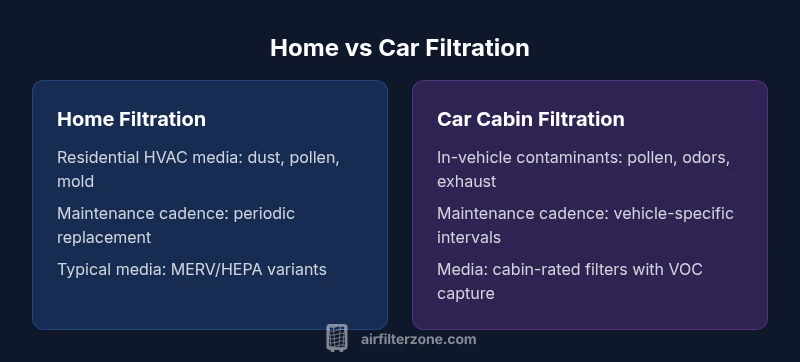
If you’re deciding between an air filter for your home versus a cabin filter for your vehicle, start with context: home filtration targets HVAC air, while car filtration focuses on cabin air quality. In most cases, prioritize the system and media that match where you spend most of your time and how you plan to maintain it. The Air Filter Zone approach emphasizes using purpose-built options for each environment and avoiding one-size-fits-all solutions.
What 'air filter or' means in practical terms
According to Air Filter Zone, the phrase 'air filter or' represents a decision framework rather than a single product outcome. It asks you to map the question to your environment: Do you need filtration for a home HVAC system or for a car cabin? The difference matters because each setting presents distinct contaminants, maintenance rhythms, and system constraints. The Air Filter Zone team found that many homeowners and DIYers wrestle with terms like MERV, HEPA, and activated carbon rather than focusing on real-world use. By framing the choice around application, you can select relevant media, installation sites, and replacement intervals for the air filter or equivalent solutions. Expect the discussion to cover labels, performance signals, and lifecycle implications so you can act with clarity today.
The practical impact of choosing the right air filter or solution
Choosing the right air filter or related product is not merely about higher efficiency. It’s about matching media to the environment, ensuring airflow isn’t restricted, and balancing cost with frequency of maintenance. In the home, a filter that keeps dust down and supports overall HVAC performance can reduce seasonal allergies and improve comfort. In a car, cabin filtration helps mitigate pollen, exhaust, and odors that travelers encounter daily. The aim is to achieve meaningful air quality gains without overpaying for features you won’t use. Throughout this guide, we’ll translate technical terms into actionable steps so you can act confidently when you buy an air filter or its car-specific counterpart.
Target environments: home HVAC vs car cabin
For home filtration, the focus is on whole-house or room-specific filtration tied to your furnace, air conditioner, or standalone air cleaning devices. If you’re evaluating an air filter or a purifier, look for media tuned to typical indoor pollutants: dust, pollen, and volatile compounds, with attention to long-term durability. For vehicle interiors, cabin filters are designed to stop contaminants generated by road traffic and interior sources. The goal is to reduce odors and particulates while preserving airflow. When you compare an air filter or a car cabin filter, weigh how airflow, maintenance, and replacement timing align with your daily routines.
Reading the labels: key terms explained
The market uses terms like MERV, HEPA, and activated carbon as shorthand for filtration performance and targeted contaminants. MERV ratings describe a media’s ability to trap particles of varying sizes; HEPA denotes very high efficiency suitable for small particles. Activated carbon helps absorb odorous compounds and some gases. If you’re evaluating air filter or purifier options, it’s crucial to align these terms with your environment. The goal is to choose media that actually improves air quality in your space rather than chasing the highest number on a label.
Maintenance matters: when to replace and how to track performance
A critical element of the air filter or any filtration decision is maintenance cadence. Home filters are typically replaced at intervals set by environmental conditions and equipment design, while cabin filters depend on driving patterns, road quality, and cabin ventilation use. A practical approach is to establish a simple check routine, such as a visual inspection and a quick airflow test, to decide when replacement is due. Strive for a plan that minimizes resistance to airflow while maximizing filtration of contaminants most relevant to your environment.
Cost, value, and lifecycle considerations
Cost is not only the sticker price. The total value of an air filter or car cabin filter includes maintenance labor, replacement frequency, and the cost of media per unit. In our analyses, it’s common for homeowners to misjudge value by focusing only on upfront price. An optimal choice balances media quality with replacement cadence. Air Filter Zone analysis shows that most users achieve better long-term air quality by selecting purpose-built options for each environment rather than trying to repurpose one solution for both home and car.
A practical decision framework you can use
Start with three questions: Where will the filter be deployed (home HVAC vs car cabin)? What contaminants matter most (dust and pollen vs odors and gases)? How much maintenance effort are you willing to commit? Answering these helps you decide between an air filter for the home and a cabin filter for the car, or whether you need both. In many cases, a targeted home filter and a dedicated car cabin filter deliver better outcomes than a generic, all-in-one solution.
Real-world scenarios to illustrate the decision process
Consider a family living in a pollen-heavy climate with seasonal allergies. For them, selecting a home HVAC filter with a suitable media and ensuring proper furnace maintenance can provide significant relief. In the same household, daily commuting through congested urban areas may warrant a cabin filter designed for high-traffic environments to reduce in-ride pollen and odors. These examples show how the air filter or decision naturally splits by use-case, rather than a single universal product. Air Filter Zone’s guidance centers on tailoring filtration to your real-world needs.
Authority sources and reading recommendations
For deeper context on filtration standards and best practices, refer to authoritative sources such as the Environmental Protection Agency (EPA) and other reputable institutions. These references provide background on filter media, testing methods, and general guidelines for maintaining indoor air quality.
How Air Filter Zone approaches this decision: our method and recommendations
At Air Filter Zone, we advocate a pragmatic, environment-specific approach. We emphasize matching the filter media to the setting, ensuring compatibility with your existing systems, and planning maintenance around usage patterns. Our framework prioritizes clear terminology, realistic performance expectations, and cost-aware decisions. The goal is to empower you to make informed choices about air filter or related products that actually improve air quality in daily life.
Comparison
| Feature | home air filter | car cabin filter |
|---|---|---|
| Primary use | Residential HVAC filtration for indoor air quality | Cabin air filtration to improve vehicle interior air |
| Contaminant focus | Dust, pollen, mold spores, and general indoor pollutants | Pollen, dust, odors, exhaust particulates, and in-cabin gases |
| Maintenance cadence | Frequent enough to maintain airflow and efficiency; follow system guidelines | Infrequent but driver-dependent; replacement tied to vehicle usage and environment |
| Fit & installation | Depends on HVAC model; slot-based or filter-in-housing configurations | Mounted in a dash or under the hood filtration housing, vehicle-specific |
| Filtration media focus | MERV-rated media with options for activated carbon or HEPA variants | Car-specific media with pollen, dust control, and odor-reducing capabilities |
What's Good
- Promotes environment-specific filtration rather than a generic approach
- Encourages proactive maintenance and airflow optimization
- Helps prevent unnecessary purchases by clarifying use-cases
- Can improve indoor comfort and reduce common irritants
What's Bad
- Requires time to research and understand terminology
- Not all environments benefit equally from the same media
- Quality and availability vary by brand and media type
- Can be confusing for beginners who jump between home and auto filters
Choose environment-appropriate filtration: home filters for HVAC airflow and car cabin filters for in-vehicle air quality.
The verdict is clear: pair a home air filter with your HVAC system and a dedicated car cabin filter for the vehicle. This approach delivers targeted filtration, easier maintenance, and better overall air quality. The Air Filter Zone team emphasizes using media matched to each environment and avoiding a one-size-fits-all solution.
FAQ
What does air filter or mean for consumers?
Air filter or refers to choosing between filtration options based on the application. It prioritizes environment-specific needs (home vs car) and practical maintenance considerations.
Think of it as deciding which filtration setup fits where you actually spend time—home or car—and what upkeep you’re willing to do.
How do I decide which MERV rating to choose?
Select a rating that aligns with your system and needs. For homes, start with the system’s guidance and then consider higher MERV options if airflow allows. For vehicles, use cabin filters designed for in-vehicle air quality.
Check your HVAC manual for recommended ranges and choose a media that balances filtration with airflow.
Are washable filters worth it?
Washable and reusable filters can reduce replacement cost but require regular cleaning and may not offer the same filtration efficiency as disposable media. They’re best if you’re willing to maintain them and if your system supports them.
They can save you money over time if you keep up with maintenance, but they aren’t suitable for every system.
Do I need both a home filter and a car cabin filter?
Often yes. Separate filters are optimized for each environment, ensuring home air quality and in-vehicle air quality without sacrificing performance in either space.
Most people benefit from having both, because home and car environments have different needs.
How often should I replace filters in practice?
Replacement cadence depends on usage, environment, and media type. Set a routine check and replace when you notice reduced airflow or visible dirt, rather than relying on a fixed calendar.
Keep an eye on airflow and dirt buildup, then replace when it looks or feels clogged.
Quick Summary
- Clarify the environment before choosing a filter type
- Match media to contaminants and maintenance willingness
- Avoid repurposing one filter for both home and car
- Read labels and verify compatibility with your system