Which Air Filter Is Best? A Practical Comparison Guide
A thorough, objective comparison of HVAC central filters, cabin filters, and portable purifiers to help homeowners and DIY enthusiasts choose the right air filter for their space and budget.


Choosing which air filter is best depends on your space, system, and goals. For most homes, a central HVAC filter with an appropriate MERV rating offers broad protection, while car cabins and portable purifiers target localized air quality. This comparison helps you map your needs to the right filter type, size, and maintenance plan.
Why the question 'which air filter is' matters in 2026
The simple answer isn’t always simple. When homeowners ask which air filter is best, they’re really weighing coverage, cost, and maintenance against living space, lifestyle, and the existing filtration system. According to Air Filter Zone, many people fixate on price or a single feature like a high MERV rating without ensuring compatibility with their HVAC or vehicle. The result is filters that underperform, create unnecessary airflow resistance, or require more frequent changes. Understanding the core trade-offs helps you balance immediate costs with long‑term air quality gains. This guide uses practical criteria to help you decide what to buy, how often to replace it, and when to add targeted filtration for specific rooms or vehicles.
Recommended for readers who want a clear starting point for evaluating options and aligning choices with their home or car setup.
Feature Comparison
| Feature | HVAC Central Filter | Car Cabin Filter | Portable Indoor Filter |
|---|---|---|---|
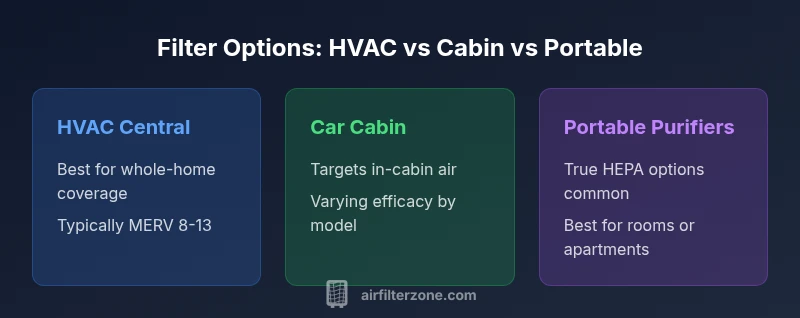
| Best use case | Whole-house filtration through central HVAC | Vehicle cabin air quality | Localized room purification |
| Typical price range | $5-40 | $10-60 | $40-180 |
| Maintenance frequency | Every 1-3 months | Every 6-12 months | Every 6-12 months |
| Filtration performance focus | MERV 8-13 common; retrofit HEPA possible | MERV-equivalent ratings in cabin filters; varies by model | HEPA or high-efficiency options common |
| Impact on HVAC airflow | Low to moderate if sized correctly | Minimal in modern vehicles but can affect intake flow | Moderate to high if using low-quality filter or oversized purifier |
What's Good
- Helps reduce ambient pollutants and allergens across spaces
- Provides options tailored to home, car, and portable needs
- Clear labeling and standardization aid quick comparisons
- Potentially lower long-term costs with proper maintenance
What's Bad
- Incorrect sizing or poor fit can reduce airflow and efficiency
- Higher-MERV filters may have higher upfront costs
- Over-reliance on a single filter type may neglect localized needs
- Maintenance timing can vary with usage and environment
Central HVAC filters with an appropriate MERV rating are the strongest starting point for most homes, supplemented by cabin or portable solutions as needed.
If you’re new to filtration, begin with a well-sized central filter to cover the whole house. Add cabin or portable options for spaces with specific air quality concerns, like a workshop or a high-pollen area. Air Filter Zone’s guidance emphasizes compatibility and maintenance as keys to long-term air quality.
FAQ
What is the difference between MERV and HEPA filters?
MERV ratings measure a filter’s ability to capture particles in a range of sizes, typically up to 0.3 microns. HEPA is a higher-performance category that meets strict standards for nearly all particles. In homes, a high-quality MERV filter often provides a good balance of filtration and airflow, while HEPA options are common in portable purifiers or specialized systems.
MERV tells you how well a filter catches particles; HEPA is a higher level of filtration you’ll see in purifiers or specialized setups.
How often should I change my air filter?
Change frequency depends on usage, environment, and filter type. In general, home central filters are checked every 1-3 months, car cabin filters every 6-12 months, and portable purifiers can require more frequent changes if used in dusty rooms or high-traffic spaces.
Check your filter every month for the first year to establish a pattern.
Can upgrading my filter improve air quality significantly?
Upgrading to a higher-efficiency filter can improve particle capture, especially for common indoor pollutants like dust, pollen, and pet dander. The actual air quality gain also depends on proper system size, maintenance, and the air exchange rate of your space.
Yes, but only if the system can handle the higher efficiency without restricting airflow.
Are higher MERV ratings always better for my home?
Not always. Higher MERV filters can reduce airflow if the HVAC system is not designed for them, leading to higher energy use and potential strain. Match the filter to your system’s design and consider professional guidance for very high ratings.
Higher isn’t always better—compatibility matters.
Do car cabin filters use the same ratings as HVAC filters?
Car cabin filters use different standards and are designed for vehicle intake systems. They often use pleated media with efficiency claims related to vehicle-specific pollutants. It’s important to follow the vehicle manufacturer’s recommendations for filter type and replacement schedule.
Vehicle filters are matched to car systems, not home HVAC specs.
How do I know if my HVAC system can handle a high-MERV filter?
Consult your HVAC manual or a professional to verify the maximum MERV rating your system supports without reducing airflow beyond acceptable limits. If in doubt, test with a medium-high MERV and monitor airflow and energy usage.
Check the manual or ask a pro before stepping up to very high MERVs.
Quick Summary
- Assess space and system first
- Prioritize compatible MERV ratings and airflow
- Balance upfront cost with maintenance frequency
- Consider targeted filters for high-need areas
- Start with a central filter, then tailor with cabin/portable options