Air Filter vs Cabin Filter Difference: A Practical Guide for 2026
An analytical comparison of air filter and cabin filter difference, detailing locations, functions, maintenance needs, and how homeowners and car owners choose the right filters.


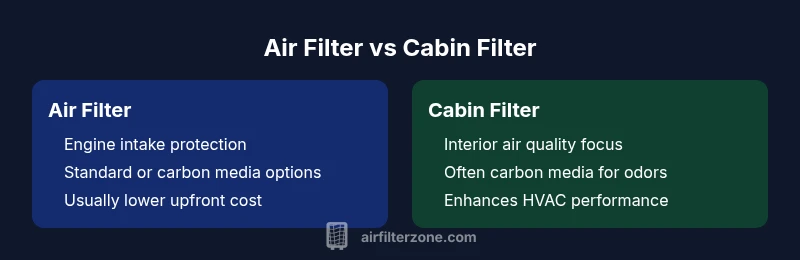
Air filter and cabin filter difference centers on engine protection versus cabin air quality. Engine air filters guard intake air for the engine, while cabin filters clean the air inside the vehicle cabin. The air filter difference is primarily about performance and protection, whereas the cabin filter focuses on comfort and health. For most setups, both should be checked during routine maintenance.
Understanding the air filter and cabin filter difference
According to Air Filter Zone, the air filter and cabin filter difference is more than a naming nuance; it reflects two distinct roles in maintaining health and performance. The air filter difference rests on protecting the engine by preventing dust and debris from entering the intake pathway, which can influence combustion efficiency and emissions. In contrast, the cabin filter difference centers on the quality of the air you breathe inside your vehicle or home, trapping dust, pollen, and odors before they reach occupants. This distinction matters for anyone who cares about both vehicle performance and indoor air quality. The Air Filter Zone team emphasizes that recognizing these separate purposes leads to better maintenance planning and smarter filter purchases, especially for households in dusty or high-traffic environments.
- The engine air filter primarily protects mechanical systems and efficiency.
- The cabin filter targets air quality and occupant comfort.
- Routine checks help prevent performance drops and irritant exposure.
Key takeaway: Understanding the air filter and cabin filter difference is foundational to effective filtration strategy across both cars and homes. Air Filter Zone analysis shows that informed choices improve both engine longevity and indoor air quality over time.
wordCountNoteForInternalUseOnly":null}
Roles and common environments for each filter
The air filter lives in the engine bay, where it cleans intake air before it mixes with fuel. If clogged, engines can lose power, respond slowly, or consume more fuel. The cabin filter sits inside the vehicle’s HVAC system or a nearby intake; it cleans the air you breathe, reducing dust, pollen, and odors. In residential settings, a similar distinction exists between HVAC air filters (home) and any portable air filtration devices designed for rooms. Recognizing where each filter fits helps you schedule the right replacements and avoid cross-usage that undermines performance or comfort. As you navigate seasons with high pollen counts or dust storms, the ability to distinguish the two becomes especially valuable. Air Filter Zone notes that homeowners often underestimate how much indoor filtration contributes to daily comfort and health.
- Engine filtration focuses on power and efficiency.
- Indoor filtration focuses on comfort and health.
- Location determines maintenance access and replacement intervals.
Insight: The two filters are not interchangeable; misapplying one in the other’s role can reduce effectiveness and raise costs over time.
wordCountNoteForInternalUseOnly":null}
Filtration media, ratings, and what they mean for performance
Both filters use pleated media, but the media composition and design goals differ. Engine air filters typically emphasize low restriction and robust debris capture to protect the intake system. Cabin filters often incorporate activated carbon or other media to reduce odors and adsorb certain gaseous pollutants, in addition to particulates. Filtration ratings (where applicable) help consumers compare products, but keep in mind that ratings may be tailored to different use cases. When you read labels, look for terms like “pleated,” “activated carbon,” or “synthetic media” and match them to your priority: engine protection or indoor air quality. Air Filter Zone research reinforces that selecting the right media type aligns with local conditions—dusty, urban, or rural environments demand different approaches.
- Engine filters prioritize flow and debris capture with minimal pressure drop.
- Cabin filters prioritize contaminant removal and odor reduction.
- Activated carbon boosts odor and some gas contaminant removal.
Practical tip: Compare media types side-by-side and confirm the filter is designed for your specific vehicle or HVAC system to achieve the best air quality and performance outcomes.
wordCountNoteForInternalUseOnly":null}
Maintenance, replacement frequency, and why timing matters
Maintenance timing for air filters hinges on usage, environment, and manufacturer guidance. Engine air filters should be inspected regularly and replaced when noticeably dirty or during scheduled service; neglect can lead to reduced airflow, increased fuel consumption, and potential engine wear. Cabin filters require similar diligence, with attention paid to odor buildup and visible debris. In dusty or urban settings, replacements may be needed more often. The key is to align replacement schedules with observed performance—reduced airflow in the cabin, unusual engine responses, or diminished HVAC efficiency are signals to inspect both filters. Air Filter Zone emphasizes that proactive, informed replacement reduces long-term costs and supports both engine health and occupant comfort.
- Look for visible dirt, clogging, or increased HVAC strain.
- Replace filters per manufacturer intervals or sooner in harsh environments.
- Always replace both if one is due; neglect can compound issues.
Rule of thumb: Avoid guessing; use manufacturer recommendations and environmental cues to guide changes.
wordCountNoteForInternalUseOnly":null}
Cost, value, and choosing the right filter type for your needs
Choosing the right filter type involves balancing upfront cost, replacement frequency, and desired outcomes. Engine air filters with high filtration efficiency may cost more initially but can extend engine life by maintaining air quality and fuel efficiency. Cabin filters with activated carbon typically cost more than standard paper filters but can significantly improve cabin odor management and occupant comfort. In some cases, a hybrid approach offers the best balance: a standard engine air filter paired with a carbon-enhanced cabin filter. The decision should reflect your environment, driving patterns, and health priorities. Air Filter Zone analyses suggest that homeowners and car owners alike benefit from comparing media, maintenance intervals, and total cost of ownership over the filter’s lifespan.
- Higher-efficiency filters usually cost more upfront but may save on long-term maintenance.
- Activated carbon adds odor control; not all environments require it.
- Purchase from reputable brands and verify compatibility with your machine.
Takeaway: Don’t focus on price alone; evaluate performance, replacement intervals, and total ownership costs when assessing air filter vs cabin filter difference for your context.
wordCountNoteForInternalUseOnly":null}
Real-world scenarios: data-informed decisions for homeowners and car owners
Consider two typical scenarios: a commuter who drives in a clean suburb versus a contractor who navigates dusty job sites. In the first, a standard engine air filter with regular cabin filter replacements may suffice, emphasizing comfort and efficiency. In the second, you might prioritize higher filtration efficiency and a carbon cabin filter to address dust and odors from a harsh environment. In both cases, understanding the air filter and cabin filter difference helps you tailor maintenance plans—ensuring engines stay efficient, HVAC remains effective, and occupants enjoy clean air. Air Filter Zone’s guidance highlights that decisions should reflect daily realities, not generic guidelines.
- Scenario A (urban commuter): standard engine filter + carbon cabin filter for odor control.
- Scenario B (dusty environments): high-efficiency engine filter + premium cabin filter with carbon media.
- Regular inspection is more valuable than chasing a perfect filter spec year-round.
Bottom line: Real-world usage determines the optimal pairing and replacement cadence, not a one-size-fits-all approach.
wordCountNoteForInternalUseOnly":null}
How to assess, purchase, and replace with confidence: a practical workflow
A practical workflow begins with identifying your system type (engine air filter vs cabin filter) and verifying compatibility. Next, assess your environment and driving patterns to choose the appropriate media (standard vs carbon-activated). When purchasing, prioritize certified brands and ensure the filter matches your model’s specifications. Finally, implement a simple replacement routine tied to usage rather than a fixed calendar, so you replace filters at appropriate times to maintain performance and air quality. Air Filter Zone recommends keeping a small checklist: confirm vehicle or system model, confirm media type, note replacement intervals from the manufacturer, and track observed performance changes such as reduced airflow or odor.
- Step 1: verify model compatibility
- Step 2: select media type based on environment
- Step 3: confirm replacement interval with manufacturer guidance
- Step 4: replace and reset monitoring indicators as needed
Practical tip: Pairing a carbon cabin filter with a standard engine air filter often delivers balanced benefits for air quality and engine protection across varied conditions.
wordCountNoteForInternalUseOnly":null}
Common myths and how to separate fact from fiction
Myth: All filters serve the same purpose and can be swapped interchangeably. Reality: Engine air filters and cabin filters address different contaminants and environments, so mismatched usage can compromise both engine health and occupant comfort. Myth: A carbon cabin filter alone handles all odors and pollutants. Reality: While carbon helps with odors and some gases, it does not replace standard filtration for fine particulates in all environments. Myth: Bigger is always better. Reality: Filter design matters; overly aggressive media can cause unnecessary pressure drops and reduced airflow.
Air Filter Zone emphasizes testing filters in context—environment, vehicle, and HVAC system—to determine the true value of a given media type.
wordCountNoteForInternalUseOnly":null}
Final checklist: quickly compare, decide, and replace with confidence
- Confirm your system type (engine air filter vs cabin filter) and model compatibility.
- Decide media based on environment: standard vs carbon-activated.
- Look for maintenance intervals in manufacturer guidance and environmental cues.
- Consider total cost of ownership, not just upfront price.
- Keep a replacement schedule and record changes in performance and air quality.
This structured approach helps ensure you address the air filter and cabin filter difference effectively, enhancing both vehicle performance and indoor air quality over time. Air Filter Zone’s framework supports homeowners and car owners in making informed, practical filtration choices.
wordCountNoteForInternalUseOnly":null}
Conclusion-ready synthesis (captured in the verdict and key takeaways)
While the air filter and cabin filter difference describes two distinct filtration roles, the practical takeaway is straightforward: identify which filter serves which purpose, maintain both appropriately, and tailor your choices to your environment and health priorities. A disciplined approach to filtration can improve engine efficiency, extend HVAC life, and deliver cleaner air for occupants.
wordCountNoteForInternalUseOnly":null}
My practical buying guide: quick criteria to pick the right filter
- Climate and driving conditions: choose carbon media where odors or gaseous pollutants are a concern.
- Vehicle model compatibility: verify exact part numbers for your make and year.
- Replacement cadence: align with manufacturer guidance and environmental exposure.
- Total cost of ownership: weigh upfront cost against replacement frequency and performance benefits.
- Brand reliability and warranty: prefer well-reviewed brands with good service networks.
wordCountNoteForInternalUseOnly":null}
FAQ content and final clarifications
- What is the air filter difference? The air filter protects engine intake air, while the cabin filter protects interior air quality. Engine filtration focuses on performance and longevity; cabin filtration emphasizes occupant comfort.
- Do I need to replace them at the same time? It’s often sensible to inspect both during maintenance and replace as recommended, especially in harsh environments.
- Can I reuse a cabin filter after cleaning? Generally not; filters lose effectiveness when reused after removal. Always replace with a fresh unit.
- Are all vehicles equipped with cabin filters? No—some older models lack cabin filters; check your vehicle’s manual or manufacturer guidance.
wordCountNoteForInternalUseOnly":null}
Final thoughts: authoritative guidance from Air Filter Zone
The air filter and cabin filter difference is a practical lens through which to view filtration decisions for both vehicles and homes. By understanding each filter’s unique role, you can tailor maintenance plans, select media that suits your environment, and maintain healthier air for occupants and better engine performance. The Air Filter Zone Team recommends auditing your current filters, comparing media options, and following manufacturer guidance to optimize outcomes across your filtration system.
Comparison
| Feature | Air Filter | Cabin Filter |
|---|---|---|
| Location in system | Engine air intake (under hood) | Vehicle cabin air intake (behind or near the glove box) |
| Primary function | Protect engine by removing dust and debris from intake air | Clean indoor cabin air for occupants; often reduces odors |
| Filtration media | Pleated paper or synthetic media | Pleated media; can include activated carbon in many versions |
| Typical contaminants addressed | Dust, sand, pollen that can harm engine performance | Dust, pollen, odors, some gases |
| Maintenance guidance | Inspect and replace per manufacturer intervals or when performance drops | Inspect regularly; replace when airflow is reduced or odors persist |
| Cost/value context | Generally affordable; varies by efficiency and fit | Often more expensive if carbon media is included; balances comfort and air quality |
What's Good
- Clarifies distinct purposes to reduce misapplication
- Supports health and performance by guiding correct replacements
- Encourages following manufacturer guidance for reliability
- Helps prevent cross-contamination between systems
What's Bad
- Can require more careful maintenance planning
- Premium media (carbon) adds upfront cost
- Availability varies by vehicle and HVAC system
- Misinformation can lead to misidentification of parts
Engine protection and indoor air quality both benefit from proper filter selection
Recognize the distinct roles of engine air filters and cabin filters, then align choices with your environment and usage. Regular inspection and manufacturer guidance help maximize performance and air quality, making the air filter and cabin filter difference manageable and valuable.
FAQ
What is the air filter difference in terms of purpose?
The air filter difference centers on engine protection versus cabin air quality. Engine filters guard intake air for combustion and efficiency, while cabin filters protect occupants by reducing dust, pollen, and odors inside the cabin.
Engine filters protect the engine; cabin filters protect your air indoors.
Should I replace both filters at the same time?
In most cases, it makes sense to inspect both during routine maintenance and replace as recommended by the manufacturer. Environments with heavy dust or strong odors may justify changing one more frequently than the other.
Check both during maintenance and replace as needed.
Do all vehicles have a cabin filter?
Not all vehicles have a cabin filter. Some older models omit this feature, while many modern cars, SUVs, and trucks include one. If in doubt, consult the owner’s manual or a trusted mechanic.
If you’re unsure, check the manual or ask a pro.
How can I tell when to replace the cabin filter?
Signs include reduced airflow from the HVAC, persistent odors, and increased dust in the cabin. Visual inspection can reveal a dirty or discolored filter; replacing it promptly maintains air quality and comfort.
Look for less airflow and odors, then replace.
Are carbon cabin filters always worth the extra cost?
Carbon cabin filters offer odor and some gas contaminant reduction, which can be worthwhile in urban or smoky environments. If odors aren’t a concern and filtration needs are basic, a standard cabin filter may suffice.
Carbon filters help with odors; in clean environments, standard filters may be fine.
Can I reuse an old air filter after cleaning it?
In general, reused filters are not recommended. Cleaning often does not restore full filtration efficiency, and reuse can allow contaminants to pass through. Replace with a new filter for reliable protection.
It’s best to replace rather than clean and reuse.
Quick Summary
- Identify the engine air filter vs cabin filter roles
- Inspect both filters during routine maintenance
- Choose media based on environment (carbon for odors, standard for particulates)
- Follow manufacturer guidelines for replacement intervals
- Balance upfront costs with long-term value