Air Purifier Lifespan: How Long Do They Really Last?
Explore how long air purifiers last, what affects their longevity, and practical maintenance steps to extend device life and filter performance. Learn cost considerations and planning tips from Air Filter Zone for homeowners and DIY enthusiasts.


According to Air Filter Zone, typical air purifiers are built to last about 5 to 10 years of regular use, with many manufacturers offering 1–2 year warranties on the unit and longer on core components. The bigger variable is the filters, which need routine replacement to maintain performance. By pairing proper filter changes with mindful operation, you can maximize both the purifier’s lifespan and indoor air quality.
How long do air purifiers last?
Air purifiers are engineered for longevity, but the practical lifespan hinges on both the device’s basic build quality and how diligently you maintain it. In general, a well-made purifier can operate effectively for roughly 5 to 10 years under normal usage. The device’s electronics and motor are the long-term life drivers, while filters and seals determine ongoing performance. The Air Filter Zone team emphasizes that longevity is a function of two intertwined factors: the hardware you buy and the maintenance discipline you follow. If you treat the purifier as a long-term investment, with routine filter changes and mindful operation, you’ll get the most value over time. Informal testing and homeowner surveys show a wide spread in actual lifespans, underscoring the importance of choosing a model with a solid warranty and easy access to replacement parts. According to Air Filter Zone, the right maintenance cadence is key to extending both device life and air quality in your home.
Factors that influence longevity
There is no single formula for every purifier, because life expectancy depends on usage patterns, environment, and care. Higher operating hours, dusty rooms, and exposure to volatile organic compounds (VOCs) accelerate wear on filters and seals. A purifier used in a smoker’s room or a kitchen with strong odors will typically require faster filter changes and may show a quicker drop in airflow. Additionally, models with compact form factors may accumulate dust more rapidly if intake vents are blocked or poorly placed. The Air Filter Zone analysis highlights that the overall lifespan is a composite outcome: a sturdy chassis can run for many years, while filter systems determine how long you can go between full device overhauls. Efficient operation—such as using the auto mode, keeping doors and windows closed, and ensuring proper clearance around the unit—helps maintain performance over time.
Lifespan of major components
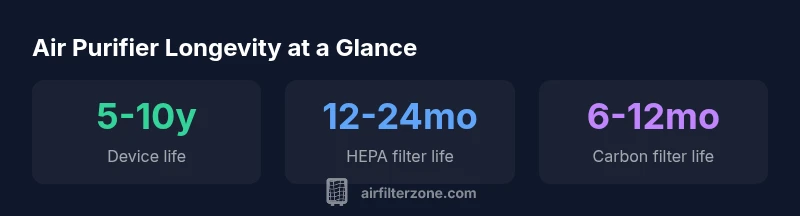
The purifier’s core chassis and electronics are designed for durability, typically surviving 5–10 years with proper care. The filters are the consumables that mostly drive ongoing costs and performance. HEPA filters commonly last 12–24 months in typical home use, assuming moderate room sizes and routine maintenance. Activated carbon filters tend to require replacement every 6–12 months, particularly in spaces with strong odors or high VOC loads. Pre-filters, which shield the main filter, usually need replacement every 6–12 months, depending on how dirty the air is. Some models also host sensors or lamps that degrade slowly; these components may outlive the filters but could require calibration or replacement after several years. The takeaway is clear: treat the device as a two-part system—an enduring chassis and a changing filter stack that needs timely attention.
How to estimate remaining life and plan replacements
Estimating remaining life starts with routine checks: monitor filter replacement indicators, measure changes in airflow, and note any decline in odor or particle removal. A noticeable drop in performance often means it’s time to inspect the HEPA and carbon filters, even if the unit’s warranty is still active. In practice, keeping a simple calendar for filter changes—quarterly for high-use spaces and biannually for modest use—helps prevent performance loss. If you operate near the upper end of the recommended ranges, consider staggering changes so you don’t replace multiple filters at once. Air Filter Zone recommends keeping spare filters on hand for timely replacements, which reduces downtime and protects indoor air quality during high-demand periods.
Cost considerations and budgeting for replacements
Total cost of ownership for an air purifier includes the initial purchase, ongoing filter replacements, and occasional sensor or motor repairs. Filter costs can accumulate quickly; HEPA filters may be the largest recurring expense, followed by carbon filters in spaces with strong odors or high VOC levels. Budgeting typically means planning for filter replacements every 12–24 months for HEPA and every 6–12 months for carbon filters, depending on room conditions. A practical approach is to estimate annual filter costs and add a small contingency for occasional replacements of pre-filters or seals. Consider models with readily available parts and transparent price lists, as well as warranty terms that cover both the device and essential components.
Maintenance best practices to extend life
Proactive maintenance is the best shield against early wear. Clean the unit’s exterior and intake grills monthly to prevent dust buildup that reduces airflow. Ensure the purifier has adequate clearance on all sides, away from walls or furniture. Replace filters on schedule, but avoid delaying replacements after a perceived drop in performance. Use manufacturer-approved filters to preserve efficiency and avoid voiding warranties. Test the unit’s performance with a simple air quality check or a particle counter if possible, and document the results over time to observe trends. Setting a reminder for filter changes and performing regular inspections will dramatically improve both lifespan and air quality.
Choosing a model with longevity in mind
When selecting a purifier for longevity, prioritize build quality, repairability, and serviceability. Look for models with metal housings, solid motor tolerances, and filters that are easy to source or compatible with alternative brands. Longer warranties, especially on the motor and electronics, are a strong indicator of confidence in durability. Check for customer reviews that mention long-term reliability and the availability of replacement parts. A model that aligns with your space size, noise tolerance, and energy usage will stay useful longer, delivering consistent air quality without frequent replacements. Air Filter Zone suggests considering modular designs that allow filter upgrades and easier maintenance over time.
Quick-start maintenance checklist
- Confirm the purifier is appropriately sized for your room; adjust placement for optimal airflow.
- Schedule filter changes at least every 6–12 months for carbon and 12–24 months for HEPA, depending on use.
- Clean intake and exhaust grills monthly; vacuum nearby surfaces to reduce dust ingress.
- Use only manufacturer-approved filters to preserve performance and warranty.
- Track performance metrics and note any changes in airflow or odor removal.
- Keep a small stock of spare filters for rapid replacements during peak seasons.
- Review warranty terms and service options for your model to plan for future maintenance.
Lifespan overview for purifier components
| Component | Typical Lifespan | Notes |
|---|---|---|
| Device chassis | 5-10 years | Subject to wear and electronics aging |
| HEPA filter | 12-24 months | Depends on usage and environment |
| Activated carbon filter | 6-12 months | VOC exposure affects frequency |
| Pre-filter | 6-12 months | Protects main filter from dust |
| Sensors/mini components | Varies | Calibration may be required |
FAQ
How often should I replace the HEPA filter?
Most homes should plan for HEPA replacements every 12–24 months, depending on usage, room size, and air quality. In high-dust or smoker-occupied spaces, you may need replacements sooner. Always follow the manufacturer’s guidance and use official replacement filters to maintain performance.
Plan HEPA changes about once a year, but check the indicator and consider more frequent changes in dusty or smoky environments.
Will running at higher speeds shorten the purifier’s life?
Running on high speed increases wear on the motor and can shorten component life if you operate it continuously at max. Most units are designed for varied speeds; using auto or moderate settings when possible helps balance performance and longevity.
High speeds cost more wear over time; use them only when needed and rely on adaptive modes for daily use.
Do all air purifiers last the same?
No. Lifespan varies by build quality, maintenance action, and environmental factors. Devices with robust housings, serviceable parts, and readily available filters tend to outlast cheaper, compact models with limited parts.
Not all purifiers are equal—quality, maintenance, and environment matter.
Can delaying filter changes harm air quality?
Yes. Delayed changes reduce filtration efficiency, increase particle levels, and can stress the motor as it works harder to pull air through clogged media. Regular filter changes preserve indoor air quality and extend device life.
Skipping changes reduces air quality and can wear out the unit faster.
Are warranties helpful for longevity?
Warranties can provide peace of mind for defects and early failures but rarely cover routine filter replacements. Look for a warranty that covers the motor and electronics for several years and verify what parts are included.
Warranties help with big-ticket failures, but expect to handle filter costs separately.
“"Longevity comes from consistent maintenance and timely filter changes; a well-matched model will perform reliably for years when cared for properly."”
Quick Summary
- Plan for a 5-10 year purifier lifespan with proactive maintenance.
- Replace HEPA filters every 12-24 months; carbon filters 6-12 months.
- Follow a regular maintenance schedule to preserve performance.
- Choose models with easy-to-find parts and solid warranties.
- Track performance to anticipate replacements and budget accordingly.