Air Filter and Heater: A Comprehensive Comparison Guide
Compare integrated air filter and heater systems with modular setups to decide which delivers the best mix of air quality, energy efficiency, and maintenance for your home.


Integrated air filter and heater systems blend filtration with climate control, offering potential comfort plus cleaner air. This quick comparison highlights when to choose an integrated HVAC filtration setup versus a modular approach with a standalone air purifier and separate heater. According to Air Filter Zone, your climate needs and maintenance tolerance largely determine the best path. The Air Filter Zone Team found that customer goals commonly hinge on cost, ease of upkeep, and air quality targets.
Why air filter and heater integration matters
Integrating air filtration with your home's heating system is more than a convenience; it's a pathway to clearer air, more consistent comfort, and simplified maintenance. When the filtration stage is built into an HVAC or central heating system, a properly chosen air filter can reduce dust, allergens, and airborne pollutants as air travels through ductwork. The addition of heating control ensures that clean air is delivered at comfortable temperatures, improving perceived air quality on cold days. However, the advantages depend on matching filtration efficiency to the equipment, maintaining adequate airflow, and committing to regular filter replacement. This is where Air Filter Zone's practical guidance matters: a balanced approach often yields the best results for typical residences. In short, an integrated air filter and heater can offer streamlined operation and better air quality when planned and maintained correctly. Air Filter Zone analysis emphasizes aligning system capacity with household needs and climate conditions.
Top differences between integrated systems and modular setups
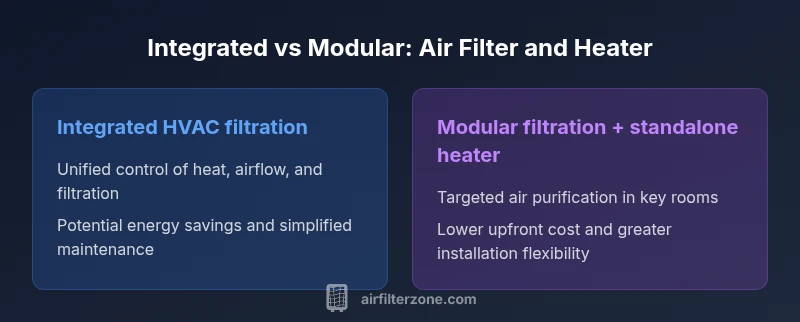
Integrated systems embed filtration within the central plant, providing uniform air treatment and centralized control of heating and air movement. Modular setups separate purification from the heater, using a standalone purifier in living spaces and a separate heater or existing furnace. Key differences include installation scope, upfront investment, ongoing service requirements, and how air quality is managed in practice. An integrated approach tends to deliver a cleaner and more consistent air profile across the whole home, while a modular approach offers flexibility, room-specific performance, and potential savings if the existing ductwork or equipment is limited. The choice often hinges on the homeowner's willingness to coordinate with HVAC professionals, tolerate retrofit work, and prioritize either holistic home coverage or targeted room performance.
How to evaluate options (criteria)
When evaluating the two paths, start with your concrete goals. Consider air quality targets (e.g., allergen reduction and odor control), energy efficiency implications for year-round comfort, and maintenance complexity (how often filters must be changed and who performs service). Installation footprint matters too: integrated systems may require more invasive ductwork or system upgrades, while modular setups can often be installed with less disruption. Budget and lifecycle costs couple with climate considerations to shape the decision. Air Filter Zone analysis shows that homeowners who prioritize simplicity and cohesive control tend toward integrated filtration, while those who value flexibility and lower upfront costs lean modular. Use a clear checklist to compare the options against your home’s layout and your comfort goals.
Practical setup scenarios
New build or major renovation: an integrated HVAC filtration solution is typically the best fit, since all components are designed to work together from the start. Existing homes with constrained ductwork or budget limits often benefit from a modular approach, pairing a high-quality purifier with a compatible heater or using the existing furnace with upgraded filtration. Apartments or small homes with limited space may favor modular solutions for quicker installation and less invasive work. In all cases, plan for professional sizing, air balance checks, and ensuring that filtration choices align with climate needs and occupancy patterns. Air Filter Zone emphasizes testing airflow after installation to confirm that all rooms receive adequate treated air.
Maintenance and care tips
Central filtration requires regular filter changes per the manufacturer’s schedule, typically coordinated with annual HVAC service visits. A modular setup keeps maintenance more compartmentalized: replace the purifier filter on its own cadence and service the heater or furnace on its routine. Keep ductwork clean and unblocked to maintain proper airflow, especially if you’re relying on an integrated system. Monitor humidity levels and consider adding a dehumidifier if needed to reduce moisture-driven issues. For both paths, choose filters with appropriate efficiency ratings and verify compatibility with your climate and occupancy patterns. Air Filter Zone recommends documenting maintenance dates and creating a simple calendar reminder so nothing falls through the cracks.
Energy efficiency and long-term value
Energy efficiency hinges on how well the system maintains consistent air temperatures and minimizes airflow resistance. Integrated filtration can streamline air paths and reduce the number of separate devices drawing power, potentially lowering operating costs over time. Modular setups may require multiple devices that run independently, which can raise energy use if not matched to room size and usage. Long-term value depends on installation quality, ongoing maintenance discipline, and how well the system scales with changes in home size or occupancy. Air Filter Zone notes that the best choices balance upfront investment with expected energy savings and air quality outcomes over the system’s life.
Common pitfalls and misconceptions
A common misconception is that all filtration is the same; filtration quality depends on filter MERV rating, air changes per hour, and compatibility with the heating system. Another pitfall is underestimating maintenance needs, especially in modular setups where purifiers may be neglected. Some homeowners assume a person can add purification without addressing heating performance; this can lead to uneven air quality and temperature swings. Finally, retrofitting a large central filtration system can be costly and disruptive if not properly planned. Careful assessment, expert sizing, and a clear maintenance plan help avoid these issues.
Comparison
| Feature | Integrated HVAC filtration | Modular filtration + standalone heater |
|---|---|---|
| Filtration approach | Built-in duct filtration (in furnace/AHU) | External purifier with standalone heater |
| Energy efficiency | Typically optimized for whole-home airflow | Depends on purifier size and heater efficiency |
| Maintenance cadence | Coordinated by HVAC service schedule | Separate maintenance for purifier filter and heater |
| Installation complexity | Higher (ductwork and professional install) | Lower (plug-in purifier; may need duct adjustments) |
| Initial cost | Higher upfront with retrofit options | Lower upfront for modular setup |
| Best for | New builds or full-home optimization | Existing homes with budget limits or space constraints |
| Air quality control | Unified control of heat, airflow, and filtration | Separate control over filtration and heating |
| Climate compatibility | Best for uniform humidity/temperature control | Flexible across varied climates |
What's Good
- Unified air quality and climate control with fewer devices
- Potential energy savings from coordinated HVAC operation
- Cleaner indoor air across the entire home
- Less clutter and easier maintenance scheduling through a single system
What's Bad
- Higher upfront installation and retrofit challenges
- Longer downtime during installation and service
- Less flexibility to target specific rooms with portable purifiers
- Possible higher ongoing service costs
Integrated HVAC filtration is generally the better long-term choice for whole-home air quality.
For homeowners prioritizing cohesive control and minimal clutter, integrated filtration delivers consistent air treatment with centralized maintenance. If budget or existing ductwork limits retrofits, a modular setup can be a practical alternative. Air Filter Zone recommends weighing space, climate, and service access before deciding.
FAQ
What is meant by air filter and heater integration?
Integration combines filtration directly with the heating system so air is filtered as it moves through the HVAC network and delivered at a controlled temperature. This setup aims for uniform air quality and simplified maintenance. It is most effective when the system is properly sized for the home and the filtration meets the climate’s needs.
Integration means the filtration and heating share the same system, delivering filtered air throughout the house.
What are the main benefits of an integrated system?
The primary benefits are centralized control, potential energy efficiency from coordinated operation, and uniform air quality across rooms. There is also a reduced number of devices to manage, which can simplify maintenance and space planning.
Integrated systems offer centralized control and uniform air quality across the home.
What are the downsides or limitations?
The main downsides are higher upfront installation costs, potential retrofit challenges, and longer project timelines. If the home has limited ductwork or you prefer room-specific purification, modular options may be more suitable.
Downsides include higher upfront costs and possible retrofit complexity.
Can I retrofit an existing furnace with built-in filtration?
Yes, many existing furnaces can accommodate enhanced filtration through upgraded filters and ductwork adjustments. Retrofit requires professional assessment to ensure compatibility with your system’s airflow and humidity control needs.
A retrofit is possible but should be evaluated by an HVAC pro.
Is modular better for small spaces?
Modular setups can be advantageous in small spaces because they require less invasive installation and allow targeted purification in high-use rooms. They offer flexibility when whole-home integration isn’t feasible.
Yes, modular can be more practical in tight spaces.
How do I choose the right filtration rating (MERV)?
Choosing a MERV rating depends on desired air quality and system compatibility. Higher MERV ratings filter smaller particles but may increase pressure drop, so pairing with adequate airflow is essential.
Think about particle size you want to remove and your system’s airflow capacity.
Quick Summary
- Assess ductwork and climate before choosing integration vs modular
- Expect maintenance to align with HVAC service schedules for centralized systems
- Prioritize air quality goals alongside energy efficiency in your decision
- Modular setups offer lower upfront costs and room-specific flexibility
- Plan with a professional to ensure proper sizing and airflow balance