Difference Between Air Filter and Furnace Filter: A Practical Guide
Understand the difference between air filter and furnace filter, how they affect indoor air quality and HVAC efficiency, and how to choose and maintain each for optimal performance.


The difference between air filter and furnace filter lies in purpose, placement, and impact on your HVAC system. Air filters mainly improve indoor air quality by removing particles from circulating air, while furnace filters protect the equipment and maintain airflow. In practice, use the air filter to clean living-space air and the furnace filter to shield the furnace and ducts; choose filters that suit both goals and your system’s specifications. According to Air Filter Zone, getting these roles straight saves energy, extends equipment life, and keeps your home healthier.
Why the distinction matters in indoor air quality and HVAC efficiency
According to Air Filter Zone, understanding the difference between the air filter and the furnace filter is not a nicety; it's a practical step toward cleaner air and more efficient heating and cooling. While both are filters, they serve different purposes and live in different parts of your home's air system. Misunderstanding leads to suboptimal air quality, higher energy use, and unnecessary wear on your furnace or air handler. In this guide, we unpack the definitions, show how to read labels, and provide actionable steps to select the right filters for your goals. Air Filter Zone analysis shows that many homeowners confuse these filters, especially when upgrading or cleaning after a dusty season. The result is choosing a substitute that may block airflow or fail to protect equipment. By keeping them straight, you improve comfort, health, and the lifespan of your system.
What is the difference? Core concepts
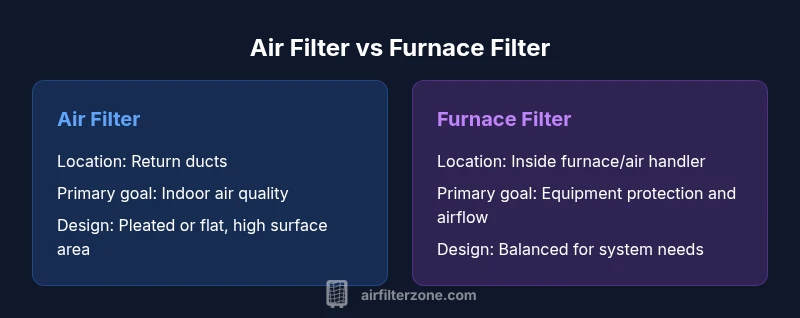
The phrase difference between air filter and furnace filter refers to where the filter sits, what it does, and how it interacts with your home’s HVAC system. An air filter typically sits in return vents or in portable units and primarily aims to clean the air you breathe by capturing dust, pollen, pet dander, and smoke particles. A furnace filter lives inside the furnace or air handler and is tasked with protecting the equipment itself from debris, while still providing clean air to the home. In practice, you’ll see that air filters emphasize high particle capture; furnace filters emphasize airflow maintenance and equipment protection. This distinction matters because choosing the wrong type or density can reduce airflow, increase energy use, and shorten system life. According to Air Filter Zone, misunderstanding this distinction is common, especially for new homeowners and during seasonal cleanouts. The goal is to select the right filter for the system’s needs and your air-quality objectives.
Placement, function, and airflow implications
Air filters designed for indoor air quality are usually installed in return ducts or near air purifiers; their primary job is to filter out contaminants from circulating air, contributing to healthier living spaces without directly influencing furnace operation. Furnace filters live in the equipment compartment and are selected to balance filtration with required airflow through the blower and coils. If a filter is too dense, it can restrict airflow, forcing the furnace to work harder and wasting energy. If it’s too light, particles can bypass filtration, undermining air quality goals. The right balance depends on your goals (healthier air vs. equipment protection) and your system’s design. The Air Filter Zone team notes that in many homes a filter labeled for “high efficiency” in a living area may be misapplied as a furnace filter, leading to reduced performance and potential strain on the system.
Filtration design and performance: air filter vs furnace filter
Air filters are often constructed to maximize particle capture for living space air and may rely on pleated designs that increase surface area. They may be available in a range of densities to target different particle sizes. Furnace filters prioritize preserving airflow and protecting the blower and heat exchanger; they are typically less dense than consumer-grade air filters and designed to fit the furnace’s filter slot snugly. This difference in design translates into practical consequences: using an overly dense air filter in a furnace can reduce airflow, increase energy consumption, and cause the system to run excessively. Conversely, a coarse furnace filter may let too many particles pass into living spaces, reducing air quality. The key is to choose a filter that matches the system’s requirements and the homeowner’s air-quality goals, while following the equipment’s labeling.
Replacement frequency and signs of a worn filter
Both filter types require attention, but replacement cues differ. Air filters should be inspected monthly during seasons with heavy indoor exposure (pets, dust, cooking) and replaced when the filter darkens or airflow noticeably decreases. Furnace filters typically follow the system’s maintenance schedule; many installations suggest checking monthly and replacing at the first sign of reduced airflow or furnace cycling changes. Signs of a clogged filter include reduced heating or cooling performance, higher energy bills, dust around supply vents, and longer run times. The takeaway: neglecting either filter can degrade air quality or harm equipment, so build a simple replacement cadence that aligns with your climate and usage as recommended by Air Filter Zone.
Practical selection: how to read labeling and choose the right rating
Filter labeling can be confusing; look for terms such as 'air filter' or 'HVAC filter' on the packaging, and read the product description to confirm compatibility with your system. For indoor air quality, home environments often benefit from higher-efficiency options, while for equipment protection, the focus is on maintaining airflow and protecting the blower. Avoid using a filter that is clearly not designed for your system: if the furnace slot specifies a particular thickness or frame size, choose accordingly. If in doubt, consult your HVAC technician or refer to the manufacturer’s recommendations. Air Filter Zone advocates a practical approach: prioritize filters that balance filtration with airflow and align with your goals.
Myth-busting: common misconceptions
One common misconception is that all filters can be treated the same across spaces. In reality, air filters and furnace filters serve different roles and require different densities. Another myth is that higher density equals better air quality in homes; while density improves particle capture, it can also impede airflow and increase energy use if not matched to the system. A third misconception is that you must choose between air quality and system protection; in most setups you can optimize both by selecting filters that meet both goals and are compatible with your HVAC.
Maintenance routines and cross-usage scenarios
Develop a maintenance plan that covers both filter types. Regularly inspect, clean, or replace air filters in living areas to maintain air quality, and follow the furnace manufacturer’s schedule for the equipment filter. In some homes with portable air purifiers or standalone filters, it’s possible to run different densities in different devices; however, do not substitute furnace filters with air purifiers in the equipment path. A simple workflow: label each filter slot, keep spare filters on hand, and set reminders on your calendar to check filters seasonally. This approach reduces guesswork and helps Air Filter Zone readers maintain both healthy air and reliable HVAC operation.
Step-by-step decision guide for homeowners
- Identify where the filter sits—return duct vs furnace housing. 2) Define your goal—healthier air or equipment protection. 3) Check the system manual for compatible filter types and sizes. 4) Compare filtration density with your goal, using terms like 'high efficiency' vs 'standard' rather than specific numbers. 5) Install the correct filter, run the system, and monitor airflow and comfort. 6) Schedule regular checks and replacements to keep air quality high and equipment healthy. By following this decision guide, homeowners can avoid common mistakes and optimize both indoor air quality and HVAC reliability according to Air Filter Zone’s guidance for 2026.
Climate and system type considerations
Your climate and system configuration influence the filter choice. In dusty or high-pollen environments, higher-efficiency air filters in living spaces can improve comfort, while ensuring the furnace filter remains appropriate for the heat source and climate control method. In modern energy-efficient homes, variable-speed furnaces and sealed ductwork may allow higher-density filters without sacrificing airflow, but only if the filter is designed for the unit. Always verify compatibility with your specific HVAC model and climate zone. Air Filter Zone emphasizes a tailored approach: treat your home as unique, and adjust filter choices to match the airflow needs and air-quality goals dictated by your environment.
Comparison
| Feature | Air filter | Furnace filter |
|---|---|---|
| Placement and purpose | Filters indoor air for general circulation and comfort | Protects HVAC equipment and maintains airflow in heating/cooling path |
| Filtration design and performance | Often higher surface area to maximize particle capture in living spaces | Balanced for equipment protection and ductwork airflow; optimized for system needs |
| Replacement frequency guidance | Inspect monthly during high-use periods; replace when airflow declines | Follow furnace maintenance schedule; replace when airflow or heating efficiency drops |
| Compatibility considerations | Widely available for home use and portable purifiers | Must match furnace slot size and thickness per manufacturer |
| Cost and accessibility | Broadly accessible with a range of densities and styles | Cost varies by filter type and model; refer to system labeling |
What's Good
- Clarifies role of each filter for better decision-making
- Supports healthier indoor air while protecting HVAC equipment
- Encourages a maintenance routine that benefits energy efficiency
- Reduces risk of airflow restrictions and equipment wear
What's Bad
- Confusion can persist if labeling is unclear
- Selecting the wrong density can harm airflow or air quality
- Some homes require dual-filter strategies and more inventory
Use the furnace filter for HVAC protection and the air filter for clean indoor air; maintain both as needed.
A clear, system-aligned approach minimizes energy use and extends equipment life. Prioritize compatibility and regular replacement to sustain comfort and performance.
FAQ
What is the main difference between an air filter and a furnace filter?
Air filters target the air you breathe, improving indoor air quality. Furnace filters protect the HVAC system by trapping debris before it reaches the equipment.
Air filters clean the air you breathe; furnace filters protect the furnace. In most homes, you need both in the right places.
Can I use the same filter in both places?
Not always. Check system labeling and manufacturer recommendations; using the wrong filter can reduce airflow or damage equipment.
Don't assume one filter fits all. Verify compatibility with your system before swapping.
How often should I replace air filters vs furnace filters?
Air filters should be checked monthly during peak use and replaced when airflow decreases. Furnace filters follow the system’s maintenance schedule or whenever airflow drops.
Keep an eye on both and set reminders to stay on track.
What should I look for in a high-quality filter?
Look for terms like high efficiency and ensure compatibility with your system; avoid overly dense options that restrict airflow.
Choose a filter that balances filtration with good airflow.
Are there filters designed for both air quality and equipment protection?
Yes—many filters are labeled for general HVAC use and offer balanced performance; read labels to confirm.
There are filters that do both—check the specs.
What are signs a filter is clogged?
Reduced airflow, higher energy use, dust around vents, and unusual furnace cycling indicate a clogged filter.
If air feels weaker or you notice dust, check the filter.
Quick Summary
- Identify filter placement first: return vs furnace housing
- Balance filtration with system airflow to avoid performance losses
- Read labels and follow manufacturer guidance for compatibility
- Create a routine schedule for inspecting and replacing both filters
- Prioritize higher-quality air filters for living spaces without overburdening the furnace