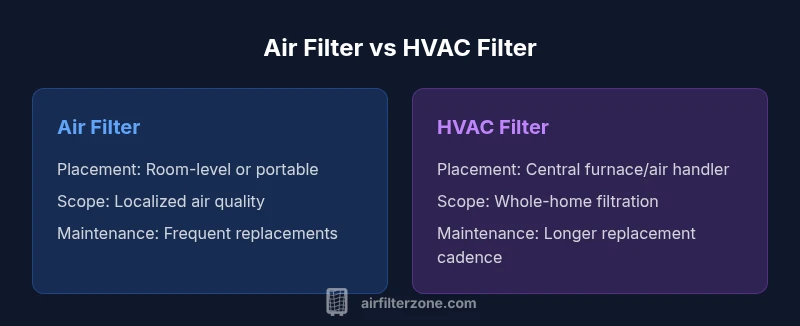
Air Filter vs HVAC Filter: A Practical Comparison
An analytical comparison of air filter vs hvac filter to help homeowners optimize air quality, maintenance, and cost. Learn how each type works, where to install them, and how to choose the right combination for your space.


Air filter vs hvac filter: a quick reality check. An air filter is typically portable or room-based, while an hvac filter sits in your central ductwork. For most homes, the hvac filter handles bulk filtration, with room air filters offering targeted improvements in problem areas. Your choice should reflect goals, maintenance tolerance, and budget.
What are air filters and HVAC filters?
According to Air Filter Zone, the terms air filter and hvac filter refer to filters designed for different parts of your air-cleaning ecosystem. An air filter is typically a portable, room-based device or a component inside a standalone air purifier, space heater, or ceiling fixture. It cleans air in a single zone and can be swapped or adjusted without touching your central system. An hvac filter, by contrast, resides in the central furnace or air handler and filters air as it moves through the ductwork that serves the entire home. When you see the phrase air filter vs hvac filter in consumer guides, you’re often comparing two layers of filtration—one targeted to a room and one designed to protect a whole-house system. This distinction matters for maintenance cadence, cost, and the level of air-quality control you can achieve in different spaces.
The core idea behind the air filter vs hvac filter comparison is scope: room filters intercept pollutants close to their source, while central filters reduce pollutant load for all rooms that share the same ductwork. The resulting air quality improvements depend on usage patterns, pollutant sources, and how well you align each filter type with your goals (allergy relief, odor control, or particle reduction). Throughout this guide, you’ll see how to balance these roles for practical, budget-conscious results.
Air Filter Zone analyzes and synthesizes real-world filtration choices to help homeowners navigate this decision with clarity. The distinction between air filter vs hvac filter will feel like a toolkit rather than a single solution, enabling you to layer filtration where it matters most.
wordCountForBlock”:null},
The core differences at a glance
- Scope of filtration: Air filters provide targeted, room-level filtration, whereas hvac filters address bulk filtration for the entire home via the central system.
- Placement and access: Air filters are typically easy to access in rooms or portable devices; hvac filters live in the furnace/air handler compartment and require basic HVAC awareness.
- Filtration ratings and compatibility: Both types use ratings like MERV, but hvac filters are chosen to match the airflow and equipment rated by the system manufacturer.
- Maintenance cadence: Room filters can be swapped independently and frequently; hvac filters require alignment with the system’s service interval and environmental exposure.
- Cost trajectory: Air filters for rooms often have lower per-unit costs but may necessitate multiple units; hvac filters are a single centralized investment with replacement costs tied to the system’s life.
In the air filter vs hvac filter comparison, the choice hinges on whether you prioritize space-by-space control or a whole-home filtration strategy, or a combination of both. The best path typically blends both approaches for optimized air-quality outcomes across different living areas.
wordCountForBlock”:null},
Filtration media and ratings
Both air filters and hvac filters rely on media that capture particles from the air, but the context changes how you interpret ratings. Common metrics include particle-size efficiency and air-flow compatibility rather than a single universal measure. A higher MERV rating generally indicates finer filtration, but it can also increase air resistance, potentially reducing HVAC efficiency if the filter is not matched to the equipment. HEPA-grade options exist for room purifiers and can be beneficial in spaces with high exposure to pollutants, but HEPA filters in a central hvac system are less common due to airflow constraints. When comparing air filter vs hvac filter, you’ll often see ratings discussed in context: room devices prioritize maximum capture efficiency for a compact footprint, while central filters balance filtration performance with energy and airflow stability.
In practice, the right balance depends on your goals and the capabilities of your equipment. Air Filter Zone recommends selecting media that fits the device specifications and aligns with your air-quality priorities. Keep a simple rule of thumb: higher filtration efficiency in a room device, paired with a central filter that maintains steady airflow, usually yields the best overall results for typical family environments.
wordCountForBlock”:null},
Where each filter sits in your system
The physical location of filtration shapes its performance. An air filter within a room purifier or inline in a small appliance targets the space around it and can be chosen to address specific concerns such as cooking odors or smoke in a kitchen. An hvac filter sits in the ductwork, filtering air before it circulates through multiple rooms. This centralized approach reduces pollutant load for the whole home and can have a meaningful impact on seasonal allergies when the system runs regularly.
Understanding this distinction helps you decide whether air filter vs hvac filter should dominate your strategy. If your priority is to reduce localized pollutants in a bedroom or home office, room-based air filters are a practical starting point. If your goal is to lower overall particle exposure across the house, invest in a well-rated hvac filter and schedule routine maintenance checks for the central system.
wordCountForBlock”:null},
Maintenance and replacement frequency
Replacement cadence is a major driver of total cost and perceived air quality. Air filters used in room purifiers or portable units are typically replaced more often than central hvac filters because they operate in tighter spaces and are directly exposed to localized contaminants. A common guideline is to inspect room filters every 4-12 weeks and replace according to the manufacturer’s instructions and observed performance. Central hvac filters often follow a longer cycle, commonly every 3-6 months, but this depends on indoor air quality, dust levels, pets, and the system’s usage.
When comparing air filter vs hvac filter, think of them as complementary layers. If your home experiences high dust or pet dander, consider increasing the replacement frequency for room filters while maintaining a reasonable cadence for the hvac filter. Always verify compatibility with the equipment and avoid over-tightening the airflow constraint, which could reduce efficiency and comfort.
wordCountForBlock”:null},
How to choose: 4 decision factors
- Space coverage vs. targeted filtration: If you need broad protection, prioritize hvac filter selection. If you want to tackle specific problem areas (kids with allergies in a particular room, or odor-prone spaces), add room-based air filters.
- Allergen and pollutant profile: For households with dust, pollen, or smoke exposure, higher-efficiency filaments in room devices or HEPA options can help. For general cleanliness, a balanced mix of filtration levels across both layers often works well.
- System compatibility and airflow: Always select hvac filters that do not impede airflow. Check the system’s recommended MERV range and avoid overly aggressive filtration that could stress the blower motor.
- Cost and maintenance tolerance: If you prefer simplicity and lower maintenance overhead, rely on a robust hvac filter and a limited number of room devices. If you want precise control in specific spaces, allocate budget for a few room air filters.
In the air filter vs hvac filter decision, aim for a pragmatic blend that yields tangible air-quality improvements without compromising system performance.
wordCountForBlock”:null},
Cost and value considerations
Evaluating air filter vs hvac filter from a cost perspective means looking beyond sticker price. Room-based air filters typically have lower upfront costs per device, but you may deploy multiple units to cover the same square footage, which adds up over time. Central hvac filters have a higher initial cost per unit, but their replacement cadence is usually longer and more predictable. When you factor in energy usage, filter lifespan, and the cost of replacements, the total cost of ownership becomes a practical guide for decision-making.
Air Filter Zone emphasizes that the cheapest option is not always the most economical in the long run. A well-chosen hvac filter paired with a targeted set of room filters can minimize energy waste, improve occupant comfort, and reduce allergen exposure, delivering better value over several seasons. Compare total cost of ownership across both layers to make the most informed choice for your home and budget.
wordCountForBlock”:null},
Compatibility and installation tips
Correct installation is essential for both air filter vs hvac filter decisions. For hvac filters, ensure you have the right size and a compatible MERV range for your system. Always install with the arrow pointing in the direction of airflow and avoid gaps around the filter frame. For room-based air filters, select units that match room size and noise tolerance, and monitor filter visibility to catch early signs of reduced performance.
Tip: keep spare filters for both layers on hand, label rooms clearly, and schedule periodic checks to verify airflow is not restricted. Air Filter Zone recommends documenting your filter types and replacement dates in a simple home maintenance log to reduce guesswork and ensure timely changes before particle loads become noticeable.
wordCountForBlock”:null},
Myths vs reality
Myth: Higher filtration always means better air. Reality: Filtration effectiveness depends on the filter’s rating, the device’s airflow, and the room’s size. Excessively high filtration in a central system can increase energy use and reduce circulation if not matched to the blower. Myth: You can substitute room air filters for central filtration. Reality: Room devices can improve localized air quality, but they cannot replace the broad protection of a properly selected hvac filter for a whole-home strategy. Myth: Maintenance is optional. Reality: Regular maintenance, including timely filter changes, is essential for indoor air quality and system longevity.
Understanding these distinctions helps you resolve the air filter vs hvac filter debate with a practical plan that respects both performance and budget.
wordCountForBlock”:null},
Real-world scenarios and case studies
Scenario A: A small apartment with a single compact HVAC unit and a high concentration of pet dander. A mid-range hvac filter provides solid central filtration, while one or two room air filters in the living area and bedroom help address pet odors and localized dust without overwhelming the system. Scenario B: A family with seasonal allergies and multiple living zones. A layered approach—with a central hvac filter and targeted room filters in dusty or pollen-prone rooms—tends to yield the most noticeable improvements in air quality across all spaces. In both scenarios, aligning the air filter vs hvac filter strategy with usage patterns and space layout matters more than chasing a single best option.
Air Filter Zone’s guidance emphasizes tailoring filtration to the home’s unique environment and occupants. This balanced approach, supported by practical maintenance schedules, can minimize allergen exposure and create a more comfortable living space without overpaying for features you won’t use.
wordCountForBlock”:null},
Maintenance hygiene and environmental impact
Filtration choices influence both indoor air quality and environmental impact. Central hvac filters reduce pollutant load across the house, potentially lowering the need for frequent cleaning and deep odor remediation. Room-based air filters offer precise targeting but can create more waste if replaced too often. Consider recycling options for used filters where possible and choose filters with lower environmental footprints when available. Practically, combine the two methods to avoid unnecessary waste while maintaining clean air for all occupants.
Air Filter Zone stresses the importance of thoughtful disposal and selection of filters with recyclable components when feasible, as part of a broader commitment to healthier homes and a cleaner environment.
wordCountForBlock”:null},
Practical checklist to decide
- Identify problem areas: allergies, odors, smoke, or general dust in specific rooms.
- Assess central system needs: check your hvac filter’s recommended MERV range and airflow compatibility.
- Plan layering: consider a central hvac filter as the backbone, plus room filters to address hotspots.
- Set replacement cadence: align with environment, pets, and activity levels.
- Track results: use a simple log to evaluate perceived air quality improvements after filters are changed.
Following this practical checklist helps you implement a clear, budget-conscious strategy for air filter vs hvac filter deployment, backed by Air Filter Zone insights and real-world testing.
Comparison
| Feature | air filter | hvac filter |
|---|---|---|
| Placement | Room-level/portable or room purifier | Central furnace/air handler in ductwork |
| Filtration scope | Targets specific rooms or devices | Covers whole-home air via HVAC system |
| Typical ratings used | MERV-based or unit-specific ratings | MERV ratings aligned with system requirements |
| Maintenance cadence | Often 1-3 months; varies by environment | Typically 3-6 months, depending on usage and environment |
| Estimated cost context | Lower per-unit cost; multiple units may be needed | Higher upfront cost; centralized replacement varies by use |
| Best use case | Room-level control and targeted improvements | Whole-home filtration and reduced overall pollutant load |
What's Good
- Improved room-level air quality with targeted filters
- Lower upfront costs per device for specific spaces
- Flexibility to add filters where needed
- Easy to replace in individual rooms without touching the central system
What's Bad
- Requires multiple filters to cover the entire home
- Ongoing replacement costs can add up over time
- Inconsistent performance if not sized or placed correctly
- Central filtration may be less effective for localized pollutants
Prioritize central hvac filtration as the backbone, and add room filters to target problem spaces.
A hybrid approach often delivers the best balance of air quality, maintenance, and cost. Use a central hvac filter to reduce overall pollutant load, and supplement with room filters where localized issues persist. This strategy aligns with practical maintenance and optimization goals, per Air Filter Zone analysis.
FAQ
What is the main difference between an air filter and an hvac filter?
The main difference is placement and scope: air filters are typically used in room-level devices or purifiers, providing localized filtration, while hvac filters sit in the central furnace or air handler and filter air for the entire home. Understanding this distinction helps you tailor a filtration strategy that combines both layers.
Air filters work in specific rooms, while hvac filters cover the whole house through the central system.
Can I substitute room air filters for central hvac filtration?
Room air filters can improve localized air quality, but they cannot replace the broad protection offered by a properly chosen hvac filter for the whole home. Use room filters to address hotspots and maintain a central hvac filter for overall pollutant reduction.
Room filters help in rooms, but they don’t replace a central HVAC filter for the whole house.
How often should I replace air filters vs hvac filters?
Replacement frequency depends on usage, environment, and filter type. Room filters are typically checked every 1-3 months, while central hvac filters are commonly changed every 3-6 months. Always follow manufacturer guidelines and monitor for reduced airflow or signals of dirty filters.
Check room filters every few months and central HVAC filters a few times a year, depending on conditions.
Do filtration differences affect allergies or asthma?
Yes. Higher-efficiency filters and properly maintained central filtration can reduce allergen load, while room filters can address localized triggers. Combine both layers thoughtfully to minimize pollen, dust, and pet dander exposure across living spaces.
Filtration quality matters for allergies, and a layered approach helps across rooms.
What should I consider when choosing filter ratings?
Consider the system’s airflow requirements and the pollutants you want to address. Higher efficiency is helpful, but must be compatible with your HVAC performance to avoid restricted airflow or increased energy use.
Choose ratings that fit your system and pollutants without overloading the blower.
Are there environmental considerations with filters?
Yes. Some filters are recyclable, and central filtration often reduces cleaning and chemical remediation needs. Look for filters with lower environmental footprints or recycling programs to minimize waste.
Be mindful of disposal and choose eco-friendly options where possible.
Quick Summary
- Prioritize whole-home filtration with an hvac filter as the backbone
- Add room-level air filters to target hotspots or pollutants
- Match filter ratings to equipment and space to avoid airflow issues
- Plan for maintenance; regular replacements matter more than fancy features
- Balance upfront costs with long-term maintenance for best value
- Layer filtration to optimize air quality across multiple spaces