Air Filter Placement: Before or After the Furnace
Discover whether the air filter should sit before or after your furnace. This guide covers airflow, efficiency, and practical installation tips, with Air Filter Zone insights.


Placing the air filter before or after the furnace can influence airflow, duct pressure, energy efficiency, and filter life. This quick guide helps homeowners decide based on your system design and maintenance needs, with practical steps for checking placement, selecting the right size and MERV rating, and ensuring safe operation. When in doubt, follow your furnace manufacturer's guidance.
How HVAC air filters work and where the filter sits
Air filters are the first line of defense against dust, pollen, pet dander, and other particulates entering your furnace and home. In most homes, the filter is installed in the return air duct, upstream of the blower, so all air drawn from living spaces passes through the filter before reaching the furnace. Some systems place the filter on the supply side, after the furnace, closer to the vents. The placement matters because it affects airflow resistance, pressure in the ducts, and how effectively contaminants are removed. Regardless of placement, using the correct size and a well-matched MERV rating helps maintain indoor air quality without overburdening the blower. Air Filter Zone recommends consulting your system’s manual and performing a quick check of your current setup to confirm where your filter lives and how air travels through your ducts.
The classic debate: filter before vs after the furnace
The traditional approach is a return-side filter (before the furnace), which captures dust before it enters the heat exchanger. This placement protects critical components, reduces particle carryover, and often allows for a straightforward replacement in the return duct. In some custom or retrofit setups, a filter on the supply side (after the furnace) is used to address localized dirty-air zones or when the return air path is blocked or hard to access. The tradeoffs include differences in airflow resistance, potential pressure drops, and the way contaminants are distributed through the ductwork. Air Filter Zone’s analysis shows that most homes benefit from a fore-filter on the return path, provided the system is designed for it and the filter is accessible for regular maintenance.
How placement impacts airflow, pressure, and system efficiency
Airflow is the lifeblood of any heating and cooling system. A filter placed before the furnace reduces dirt and debris entering the blower and heat exchanger, which can help maintain efficiency and extend equipment life. However, if the filter is too restrictive relative to the blower’s capacity or the duct design, it can create a pressure drop that reduces airflow and forces the blower to work harder. By contrast, a filter placed after the furnace may experience different pressure dynamics, and contaminants could circulate through the supply path if the filter is not kept clean. The optimal choice depends on your duct design, blower size, and how easy it is to access and replace the filter. Air Filter Zone emphasizes testing airflow after replacement to confirm the system is balanced and comfortable.
Signs your setup might need a specific placement
If you notice dust on intake vents, uneven room cooling or heating, or frequent filter replacements due to high dust loads, it might indicate an airflow imbalance or an undersized filter. A clogged filter on the return path can cause the furnace to cycle more often, reduce efficiency, and trigger air leaks around the filter housing. Conversely, if you observe insufficient air movement downstream of the furnace, a post-furnace filter might be limiting flow, especially in older systems or tight ductwork. In any case, verify that the filter size matches the housing and that the arrows on the frame point in the direction of airflow.
How to choose the right filter size and MERV rating
Start by locating the exact filter size stamped on the frame or in the furnace manual. If you’re replacing an existing filter, use the same dimensions. In most homes, a MERV rating between 8 and 13 provides a balance of filtration and airflow; higher ratings can capture more particles but may increase resistance. For households with pets or smokers, a higher MERV rating can improve air quality, but ensure your blower and ductwork can handle the increased static pressure. If you have a sealed or energy-efficient system, smaller MERV options may be necessary to avoid reducing airflow. Always confirm with the furnace manufacturer or a qualified HVAC professional before upgrading the filter rating.
Installing a filter correctly: orientation arrows and securing
Filters have arrows indicating the direction of airflow. When the filter sits in the return duct (before the furnace), ensure the arrows point toward the furnace. If the filter is mounted in the supply duct (after the furnace), arrows should point away from the furnace toward the ductwork. Remove the old filter carefully to avoid dislodging dust, clean the housing if needed, and firmly seat the new filter to prevent gaps. A loose filter can cause air leaks and reduce filtration efficiency. If your filter sits behind a panel, reassemble the panel securely after installation.
Maintenance schedule and practical tips for homeowners
Replace filters regularly to maintain air quality and system efficiency. The replacement frequency depends on factors like household occupants, pets, and dust levels, but a general rule is every 1–3 months during peak dust seasons. During renovations or if someone in the home has allergies, more frequent changes may be necessary. Label the filter with the replacement date and the MERV rating for quick reference. Keep spare filters on hand and consider scheduling a quarterly check of the filter housing to ensure there are no air leaks or obstructions.
Special cases: humidifiers, air purifiers, and ductwork considerations
If you use a whole-home humidifier or an inline air purifier, place the filter so that it protects these components without impeding their function. In homes with leaky ducts or complex layouts, a filter location that minimizes unconditioned air entry is beneficial. Ductwork design can influence whether a return-side or supply-side filter is more practical; for example, long or obstructed returns may benefit from a return-side filter that’s easy to access. Air Filter Zone recommends consulting a professional if you suspect major duct issues or unusual layouts.
Common mistakes to avoid and final checks
Avoid mixing filter types or changing size midstream without verifying compatibility. Don’t rely only on the filter’s rating to judge performance; ensure the entire system—blower, ducts, and registers—are clean and balanced. After installation, run the system and check that air is flowing from registers smoothly and evenly. If you hear whistling or feel a noticeable drop in airflow, recheck the filter fit and arrows, and inspect for gaps. Regular maintenance and correct placement are key to maximizing efficiency and indoor air quality.
Tools & Materials
- Replacement air filter (correct size for your system)(Measure existing filter or check furnace manual for exact dimensions (e.g., 16x20x1).)
- Tape measure(To confirm filter dimensions.)
- Gloves(Protect hands when handling dirty filters.)
- Screwdriver (Phillips #2)(If access panel has screws.)
- Flashlight(Inspect behind panel and inside the housing.)
- Cleaning cloth or vacuum with brush attachment(Clean housing interior before inserting new filter.)
- Marker or label(Date the filter and note MERV rating for future reference.)
Steps
Estimated time: 15-20 minutes
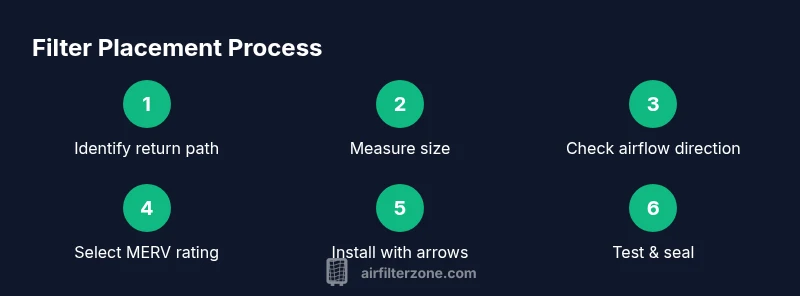
- 1
Turn off system and locate the filter
Shut down the furnace or blower to avoid moving parts. Locate the filter housing—usually in the return duct or near the air handler. If the housing is behind a panel, remove the panel carefully to access the filter. This step prevents accidental startup while replacing the filter.
Tip: Use a flashlight to clearly see the housing and ensure you’re selecting the correct airflow path. - 2
Measure the existing filter
Remove the old filter and measure its length, width, and thickness. Record the exact dimensions to buy the correct replacement. If you can’t read the size, check the furnace manual or the label on the filter frame.
Tip: Write down the size and keep a spare in the utility closet. - 3
Determine placement (return before or supply after)
Observe whether the housing sits on the return duct (before the furnace) or on the supply side (after the furnace). This determines arrow direction and helps confirm if the setup is standard or requires adjustment.
Tip: If you’re unsure, take a photo of the whole setup for a professional to review. - 4
Choose a filter with the right rating
Select a filter with the same size and a balanced MERV rating suitable for your system. Higher MERV catches more particles but can increase resistance. Ensure the chosen rating matches manufacturer recommendations.
Tip: For households with pets or allergies, higher filtration is beneficial but verify blower compatibility. - 5
Install the filter with the correct orientation
Insert the new filter with the arrows pointing toward the direction of airflow (toward the furnace if on the return side; away from the furnace toward the ducts if on the supply side). Ensure a snug fit to prevent leaks.
Tip: Gently press the filter edges to ensure a tight seal; avoid bending the frame. - 6
Test and reseal
Reattach any panels and power the system on. Feel for air at vents and listen for unusual noises. Check for air leaks around the housing and reseat if needed. Record replacement date and MERV rating for future reference.
Tip: Run the system in fan mode for a few minutes to stabilize airflow.
FAQ
Can I run my furnace without a filter installed?
No. Running a furnace without a filter allows dust and debris to enter the blower and can damage heat exchangers. It also reduces indoor air quality. Always replace or install a filter before running the system.
No. Running without a filter lets dust damage the blower and reduce air quality, so replace the filter before starting the system.
What happens if the filter is placed in the wrong location?
Placement can affect airflow and system efficiency. A return-side filter protects the blower and coils, while a post-furnace filter may restrict airflow if the system isn’t designed for it. Verify with the manual or a pro.
Wrong placement can reduce airflow and efficiency. Check your manual or ask a pro to verify.
Does filter placement affect humidity control?
Indirectly. Proper airflow supports even heating and cooling, which helps humidity control. A clogged or incorrectly placed filter can hamper performance and comfort.
Airflow affects humidity control; a clogged or mislocated filter can make humidity feel off.
How often should I replace the furnace filter?
Most homes benefit from 1–3 month replacements, depending on dust, allergies, pets, and usage. Pets and smokers may require more frequent changes. Always follow manufacturer guidance.
Typically every 1–3 months, more often with pets or allergies.
Can there be valid reasons to place a filter after the furnace?
Yes, in some retrofit or specialized setups post-furnace filters are used to address access or local air quality concerns. It’s essential to ensure the system maintains proper airflow and to consult a professional if unsure.
Sometimes post-furnace placement is used for access or specific air quality needs—check with a pro.
What MERV rating is best for homes with pets?
Aim for a MERV rating that balances filtration and airflow for your system. For many homes with pets, MERV 11–13 can be effective without overly restricting airflow, but confirm with your equipment’s specs.
For pet-friendly homes, MERV 11 to 13 often works well without hurting airflow.
Watch Video
Quick Summary
- Understand whether your filter sits before or after the furnace and the impact on airflow.
- Choose the correct size and a balanced MERV rating to protect equipment while maintaining efficiency.
- Install with arrows to match airflow direction and secure the housing to prevent leaks.
- Schedule regular replacements based on dust, pets, and activity levels.
- Consult the furnace manual or a professional if you encounter unusual duct layouts.