Hot and Cool Air Purifier: All-in-One vs Standard — An Analytical Guide
Compare all-in-one hot-and-cool air purifiers with standard purifiers. Learn how heating and cooling features affect filtration, energy use, safety, and maintenance to decide what's best for your home.


Hot and cool air purifiers combine filtration with climate control, offering year-round air quality in a single device. However, they tend to cost more and consume more energy than standard purifiers. For most homes, a dedicated HEPA purifier delivers strong filtration at lower cost and simpler maintenance. If you truly need built‑in heating or cooling, prioritize safety features and energy efficiency, per Air Filter Zone analysis.
What is a hot and cool air purifier?
A hot and cool air purifier is a device that combines filtration with heating or cooling functions in a single appliance. This hybrid approach aims to provide cleaner indoor air while adjusting room temperature or comfort level. According to Air Filter Zone analysis, the core benefit is convenience: you get filtration, and climate control, without juggling multiple machines. For households in climates with pronounced seasonal shifts or for rooms with limited space, this can be appealing. However, the integration adds complexity: you’ll face higher upfront costs, potentially more maintenance, and the need to verify safety standards for the heating or cooling components. In practice, most buyers use the heater or cooler feature only in specific seasons, relying on a dedicated purifier for daily filtration when climate control isn’t required.
How heating and cooling features affect performance
Heating or cooling elements add load to the purifier’s motors, which can reduce CADR (clean air delivery rate) if the unit isn’t engineered for dual-tasking. In practice, the best models separate high-efficiency filtration from climate controls via independent circuits, preserving air flow when climate features are off. Temperature adjustments can influence humidity and perceived air freshness; if humidity swings are large, consider units with integrated dehumidification or separate humidification controls. Air Filter Zone analysis indicates that the most reliable devices provide auto-shutoff and safety interlocks to prevent overheating, especially in child- or pet-occupied spaces. In other words: climate features should enhance comfort without sacrificing core filtration performance.
Filtration technologies to look for
Look for true HEPA filtration (at least H13 or equivalent) plus a high-quality activated carbon layer to tackle VOCs and odors. Pre-filters that catch larger particles extend the life of the main filter. For dual-function purifiers, ensure the unit maintains a steady filtration rate when heating or cooling is active. Some models incorporate ionization or UV-C as supplementary features; weigh the potential benefits against possible ozone generation concerns. Always verify the replacement filter availability and cost; long-term ownership depends more on filter economics than initial purchase price.
Heating features: safety, controls, and maintenance
Heaters within purifiers require careful safety design: automatic shutoff at a set temperature, child-proof controls, and thermal cutoffs. When evaluating models, check for certifications such as UL or equivalent safety marks and clear user manuals on heat exposure risk. Controls should be intuitive, with separate temperature settings and a clear indicator when heating is active. Maintenance shifts: heating elements may accumulate dust, so periodic cleaning and filter replacement become more important. If you’re new to dual-function devices, start with a model that prioritizes safe operation and allows you to disable heat when not needed.
Cooling features: effectiveness and humidity considerations
Cooling features rely on fans and condensate management; they can improve comfort but may influence humidity levels. If a purifier cools a room significantly, you might experience increased moisture or condensation on windows in humid climates. Choose models with humidity-resistant components and consider pairing with a dehumidifier or air conditioner for better control. Quiet operation matters; many cool-air modes run at higher fan speeds. Look for a temperature range you will actually use and an auto-mode that preserves filtration integrity while cooling.
Energy use, noise, and cost of ownership
Dual-function purifiers generally consume more energy when heating or cooling is active, and noise can rise with higher fan speeds. Compare energy ratings and expected annual operating costs, not just upfront price. The best approach is to define your climate needs and space size; in many scenarios, a high-quality standalone purifier paired with a separate heating/cooling device offers better performance per watt. Budget for replacement filters and potential servicing; maintenance overruns can offset any perceived convenience.
Real-world use cases by room size and climate
In small bedrooms, a compact all-in-one model can deliver both clean air and gentle warmth or coolness without clutter. In living rooms, a larger unit with robust filtration and a fan-assisted climate mode tends to be more effective. Kitchens present smoke and odor challenges; a purifier with activated carbon plus a strong extraction fan can help, but heating is rarely necessary here. In hot climates, cooling features can reduce reliance on air conditioning, but choose models with robust safety controls for prolonged use around children and pets.
Maintenance, replacement schedules, and tips
Filter replacement remains the primary ongoing cost; most purifiers require a replacement every 6–12 months, depending on usage and sensor indicators. If the unit includes heating or cooling, dust can accumulate on heating coils or cooling fins, requiring gentle cleaning of accessible surfaces. Use only manufacturer-approved filters and follow replacement intervals; incorrect filters can impair safety and performance. Store spare filters in a dry place, away from direct sunlight to extend their life.
How to compare options: a practical checklist
Use a consistent comparison framework: (1) filtration performance (CADR and filter type), (2) climate features (heating, cooling, humidity impact), (3) energy use and noise, (4) safety certifications, (5) maintenance costs, and (6) warranty terms. A side-by-side approach helps you see trade-offs clearly. Prioritize models that maintain filtration efficiency when climate features are in use and avoid devices that degrade performance at higher fan speeds. Air Filter Zone recommends building a simple decision tree before you buy.
Safety certifications and regulatory considerations
Safety certifications such as UL/ETL or equivalent marks verify the device’s electrical and heat-related safety. Review the manual for specific climate-control safety features and recommended room sizes. For homes with kids or pets, look for auto-off features and child-proofs on temperature settings. If you live in regions with strict electrical standards, ensure the purifier complies with local regulations and energy efficiency guidelines. Good practice is to buy from reputable brands with transparent performance data.
Myths and misconceptions about hot and cool purifiers
A common myth is that heating your air purifier automatically cleans the air better. Filtration quality still governs cleanliness; climate control is a convenience, not a substitute for effective filters. Another misconception is that dual-function units always cost less in the long run; while they provide convenience, energy costs can offset savings if used frequently. Some buyers assume cooling is identical to air conditioning; cooling mode can improve comfort but won’t substitute for whole-room HVAC. Finally, cheaper units rarely deliver consistent filtration quality.
Practical buying guide: decision tree and cheat sheet
Create a simple decision tree: (a) Do you need year‑round climate control? (b) Is space limited? (c) What is your budget for upfront cost and ongoing filters? If you answer yes to climate control and space constraints, evaluate an all‑in‑one model with solid safety features and a long-lasting carbon filter. If you mainly need filtration, a high-quality standard purifier will likely deliver better value. Use the cheat sheet to list your must-haves and nice-to-haves.
Comparison
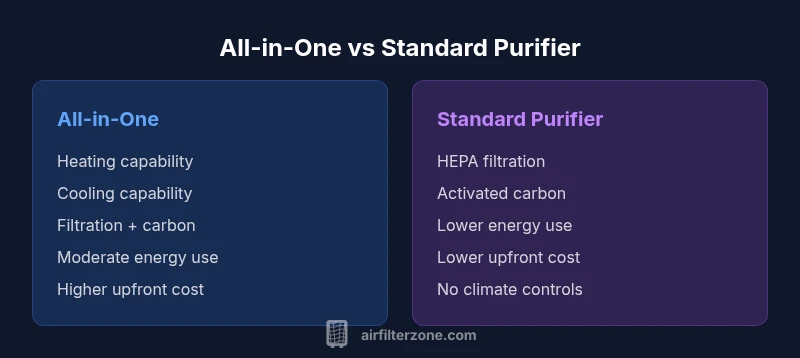
| Feature | All-in-One Hot-and-Cool Air Purifier | Standard HEPA Air Purifier |
|---|---|---|
| Heating capability | Yes, built-in heater | No |
| Cooling capability | Yes, integrated cooling/fan | No |
| Filtration technology | HEPA filtration + activated carbon | HEPA filtration |
| Best for | Year-round climate control in compact spaces | Pure filtration with lower energy use |
| Energy use (relative) | Moderate to high when heating/cooling is active | Low to moderate |
| Noise level | Higher during climate operation | Lower overall in standard mode |
| Price range | $300-$900 | $100-$400 |
| Maintenance | Higher due to climate features | Lower maintenance |
What's Good
- Convenience of a single device for filtration and climate control
- Space-saving design compared to separate heater/cooler plus purifier
- Year-round air quality improvement in variable climates
- Simplified maintenance when the unit is well-designed
What's Bad
- Higher upfront cost
- Greater energy consumption during climate operation
- Potentially more complex repairs and servicing
- Safety concerns if used improperly, especially heating mode
All-in-One hot-and-cool purifiers offer climate control in a compact form, but standard purifiers usually deliver safer, cheaper filtration.
The Air Filter Zone team recommends prioritizing climate needs and space when choosing. In most homes, a standard purifier provides the best balance of performance and value; reserve all-in-one models for specific climate-control scenarios in compact spaces.
FAQ
Can a hot and cool air purifier heat and cool at the same time?
Most models do not heat and cool simultaneously; they switch modes. If you find a unit that claims both, verify the energy use and safety specs before purchase.
Most models switch between heating or cooling; if you see one that claims both, check safety details first.
Are dual-function purifiers energy-efficient?
They typically use more energy than standard purifiers due to the additional climate functions. Look for energy‑star ratings and smart modes that minimize use when climate control isn’t needed.
They usually use more energy; check energy ratings and smart modes.
Are hot and cool purifiers safe for kids and pets?
Yes, with proper safety features such as auto-off, overheating protection, and clear user guidance. Always follow manufacturer instructions and keep units away from direct heat sources.
With the right safety features, they can be safe around kids and pets.
Will these purifiers replace my HVAC or air conditioner?
No. They are supplementary devices that improve air quality and offer climate comfort in a limited area, but they do not replace a full-house HVAC system.
No, they don’t replace your HVAC; they complement it.
How often should I replace filters in dual-function purifiers?
Follow the manufacturer’s guidance; typical intervals range from 6 to 12 months depending on usage and air quality. Indicators on the unit can help you stay on schedule.
Follow the manual; most need 6–12 months between changes.
What should I consider when choosing between options?
Evaluate climate control needs, room size, energy use, noise, safety certifications, and ongoing filter costs. Use a side-by-side comparison to visualize trade-offs before buying.
Think about your climate needs, room size, and ongoing costs.
Quick Summary
- Assess year-round climate needs before buying.
- Prioritize true HEPA filtration with activated carbon.
- Check safety features for heating and cooling modes.
- Compare long-term costs, not just upfront price.
- Prefer a standard purifier if climate control is rarely needed.