18 x 24 Air Filter: A Practical Home Guide
A practical, data-driven guide to the 18 x 24 air filter size, covering compatibility, materials, replacement frequency, and installation tips for home HVAC systems by Air Filter Zone.


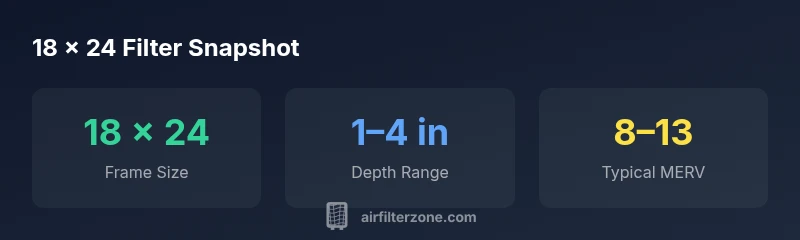
An 18 x 24 air filter is a common HVAC frame size, measuring 18 inches by 24 inches with a chosen thickness. For most homes, pleated filters in 1-inch, 2-inch, or 4-inch depths are typical. Always match the exact frame size to your unit, and select the MERV rating based on airflow and indoor air quality needs.
Understanding the 18 x 24 footprint and where it fits
The 18 x 24 footprint denotes an opening frame that is eighteen inches wide and twenty-four inches tall. This size appears across residential furnace returns, some central air systems, and certain compact filters used in window units. When shopping, always confirm the exact frame dimensions printed on the filter edge and compare them to your equipment's filter slot. In many homes, the 18 x 24 filter houses a standard 1-inch to 4-inch thick media; thicker variants usually offer higher dust-holding capacity but may require adjustments to airflow or frame clearance. If your system uses a non-standard depth, options like 2-inch or 4-inch pleated filters may be available to maintain proper seals. Always measure the actual opening rather than relying solely on a label on the old filter, as manufacturing tolerances can vary by brand. Also note that some air handlers use a recessed frame or a built-in gasket; in those cases, buying a slightly different width can cause seal failures. For DIYers, carry a tape measure, a spare frame, and a pen to mark the top and bottom of the slot so future changes stay aligned. By understanding the footprint, you avoid costly misfits and improve filtration reliability.
Filter materials and performance at 18 x 24
Filter media come in several forms, with fiberglass, pleated cellulose, and carbon-impregnated options dominating the market. Fiberglass is inexpensive and suitable for basic protection against large particles, but it captures fewer fine particles. Pleated filters provide significantly more surface area and can achieve higher efficiency without dramatically restricting airflow when properly matched. Carbon-impregnated varieties target odors and some gases, useful in kitchens or homes with smokers. For 18 x 24 frames, you commonly see MERV ratings ranging from about MERV 6 to MERV 13; choose based on system compatibility and air quality goals. Carbon or odor-control variants are often more expensive and have slightly higher pressure drop, so verify blower capability.
Matching MERV ratings to your needs
The MERV rating is a proxy for particle capture across a size spectrum. In typical homes, MERV 8–11 provides solid filtration while preserving airflow. If you have allergies, pets, or smoke exposure, MERV 11–13 offers stronger filtration but may require careful sizing to avoid undue blower resistance. Always check your HVAC documentation and, if in doubt, start at MERV 8–11 and monitor comfort and performance. For 18 x 24 frames, ensure the chosen filter actually fits the slot and remains sealed on all sides.
Replacement frequency and maintenance for 18 x 24 filters
Replacement intervals depend on environment, presence of pets, indoor smoking, and outdoor air quality. In typical households with normal use, replacing every 3–6 months is a common guideline. In dusty or high-pollen seasons, or with multiple occupants, you may need to do 1–3 month checks. A clogged filter increases energy use and reduces indoor air quality, so set reminders and inspect monthly during peak seasons. Always carry spare filters of the correct size and thickness to avoid misfits.
How to measure, install, and verify a snug seal
Start by turning off the HVAC equipment to avoid drawing air through a misfitted filter. Remove the old filter and measure the length, width, and thickness (if visible) to confirm the exact 18 x 24 frame and thickness. Clean the slot if dust has accumulated, then insert the new filter with the airflow arrows pointed in the correct direction. Ensure the gasket or foam seal sits evenly; an air leak around the edges defeats filtration. If you notice air rushing around the sides, reseat the filter or replace the frame if warped.
Common mistakes and troubleshooting for 18 x 24 filters
Avoid assuming a slightly different frame size will work; it rarely does. Do not install an older or damaged filter holder; replace the entire frame if the seal is compromised. Resist the urge to force a tightly packed high-MERV filter into a slot designed for a slimmer media, as this can restrict airflow and damage the system. If you notice increased dust, lower airflow, or higher energy bills, recheck the size, orientation, and fit and consider moving to a higher-quality pleated filter with a suitable MERV rating.
Comparison of common filter types for 18 x 24 frames
| Filter Type | Typical MERV Range | Pros | Cons |
|---|---|---|---|
| Fiberglass | 1–4 | Low-cost filtration; basic protection | Lower efficiency; requires frequent replacement |
| Pleated | 5–12 | Better filtration; higher dust holding capacity | Potential airflow restriction if too dense |
| Carbon-impregnated | 7–12 | Odor control; some filtration | More expensive; may reduce airflow slightly |
| Electrostatic | 1–7 | Good particle capture; various options | Performance claims vary; not standardized |
FAQ
What does 18x24 mean?
It indicates the frame dimensions in inches: 18 by 24. Check your equipment housing for the exact fit and note any thickness specification, such as 1-inch or 4-inch replacements.
18 by 24 means the filter's frame is 18 by 24 inches. Look at the unit label for the exact size.
Can I substitute a different width?
Not recommended. Filtration systems are designed for specific frame sizes; using a different width can create gaps and unfiltered air leakage.
No—stick to the exact 18 x 24 frame to ensure a sealed fit.
How often should I replace an 18 x 24 filter?
In typical homes, replace every 3–6 months. Increase frequency in dusty environments, with pets, or during allergy or wildfire seasons.
Typically every 3–6 months; more often with pets or high dust.
Does a higher MERV rating always improve air quality?
Higher MERV can improve filtration but may impede airflow if the system isn't designed for it. Start with MERV 8–11 and adjust based on performance.
Higher MERV can help, but it can reduce airflow if the blower can't handle it.
Are carbon or odor-control filters worth it for homes?
Carbon-impregnated filters reduce odors and some gases, but particle filtration may be modest. If odors are a concern, consider carbon or hybrid options.
Carbon filters help with odors, but don’t expect top particle filtration.
“Sizing and filtration performance hinge on matching the filter to your equipment and living conditions. A proper 18 x 24 choice should balance airflow with your indoor air quality goals.”
Quick Summary
- Always verify the exact frame size before purchasing
- Balance filtration with airflow by selecting an appropriate MERV rating
- Environment matters: pets, allergies, and smoke raise filtration needs
- Replace on a schedule: 3–6 months in typical homes
- Consider carbon or specialty filters for odor control