Air Purifier vs Humidifier: What to Buy in 2026
Learn whether to buy an air purifier or a humidifier for your home. Air Filter Zone analyzes use cases, benefits, and costs to help homeowners choose wisely in 2026.


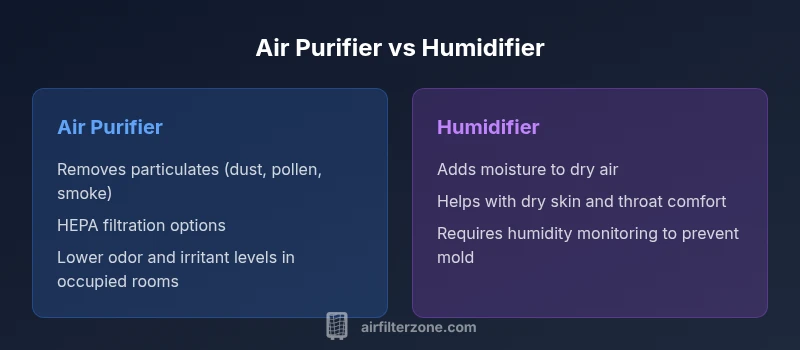
Choosing between an air purifier and a humidifier depends on your primary concern: pollutants and allergens or dry indoor air. For most homes, an air purifier provides clearer air by removing fine particles, while a humidifier helps relieve nasal dryness and skin irritation in winter. In some cases, a combined device or coordinated use is the best solution. According to Air Filter Zone, start with air quality testing.
Why this decision matters
Air quality is a cornerstone of health, comfort, and overall home life. When you choose between an air purifier and a humidifier, you’re making a decision that affects respiratory comfort, sleep quality, energy use, and even furniture care. For many households, the right choice hinges on the current air quality, climate, and the presence of moisture-related issues such as condensation or mold risk. At Air Filter Zone, we emphasize practical guidance that homeowners can implement without expert intervention. Our approach starts with a simple diagnostic: what are the dominant air quality problems in your space? Is wildfire smoke or urban pollution a recurring problem, or do you struggle with dryness in winter months? By answering these questions, you can determine whether you should prioritize filtration or humidity first, or pursue a balanced strategy with both devices in different zones of the home.
In this article, we’ll walk through how purifiers and humidifiers work, compare key features, analyze cost implications, and provide a clear decision framework. You’ll learn how to size a purifier for a room, how to choose a humidifier type, and how to combine tools safely to create healthier indoor air. The goal is to help you make an informed choice that fits your budget and lifestyle, so you can breathe easier and rest easier at night.
How air purifiers work: filtration mechanics
Air purifiers operate by drawing room air through filtration media to remove airborne contaminants. The most common choice is a true HEPA filter, which can capture at least 99.97% of particles as small as 0.3 microns, including pollen, dust, mold spores, and many smoke particles. Higher-efficiency HEPA variants (often labeled H13 or similar) are popular in spaces with allergies or asthma. In addition to mechanical filtration, many models include activated carbon or other adsorbents to reduce odors and some volatile organic compounds (VOCs). It’s important to note that some devices marketed as “air purifiers” use ionizers or ozone-generating mechanisms, which can irritate sensitive occupants and are generally discouraged by health authorities. A well-chosen purifier improves air quality during occupancy and can support healthy sleep patterns by reducing nighttime allergens. Regular filter replacement is essential for sustained performance, and cheaper units may require more frequent changes, which increases long-term costs. When selecting, prioritize clean air delivery rate (CADR) appropriate for room size, a true HEPA core, and minimal ozone output.
How humidifiers work: moisture delivery and risks
Humidifiers add moisture to the indoor environment to alleviate dryness that can cause irritated airways, dry skin, and static electricity. There are several humidifier types, including ultrasonic, evaporation (wick), and warm-mist systems. Ultrasonic and warm-mist models tend to be quieter, but they require attention to water quality and regular cleaning to prevent mineral buildup and microbial growth. Evaporative humidifiers rely on a wick or filter to absorb water; they are often more forgiving with mineral dust but may require more frequent wick replacements. A critical factor with humidifiers is humidity control: you want to stay in a comfortable range (generally about 30-50% relative humidity) to prevent mold growth and dust mites. Poor maintenance, contaminated water, or oversized humidifiers can create more problems than they solve. Distilled or demineralized water can reduce mineral dust, and regular cleaning schedules are essential to avoid biofilm formation. If you notice damp walls or musty odors, reduce output and check for leaks or mold risks.
Common indoor air problems and device fit
Indoor air quality challenges vary by climate and season. In dry winter months, a humidifier helps prevent chapped skin, irritated throats, and sinus discomfort. In regions with wildfire smoke, dust, or high pollen counts, an air purifier can remove fine particulates that irritate the lungs and trigger allergies. Homes with existing moisture issues, condensation on windows, or visible mold should be cautious: adding humidity without addressing the moisture source can exacerbate mold growth. In urban apartments, the lack of fresh air exchange means filtration can stay in a healthy range even when windows stay shut. A practical approach is to start with a purifier if you notice indoor dust, allergies, or irritation upon waking. If humidity feels uncomfortably low, introduce a humidifier while monitoring moisture. If both problems exist, a dual strategy—with zoned devices or a single, versatile model that handles both concerns—can be effective when used thoughtfully.
Evaluating suitability by room type
Room size and usage heavily influence device choice. Bedrooms often benefit from an air purifier to reduce allergens and improve sleep quality, particularly for allergy sufferers. Living rooms or family rooms with high traffic may require purifiers with higher CADR to manage the continuous influx of dust and pet dander. In homes with low humidity or rapid air movement (e.g., heated spaces or dry climates), a humidifier in common areas can reduce dust highlights and dryness. Home offices, nurseries, and spaces occupied by sensitive individuals should emphasize safety: choose devices with verified filtration (HEPA), low noise operation, and control options that allow precise adjustments. If you share spaces with multiple occupants with different needs, consider a mixed approach, such as separate devices in key zones or a single device with both filtration and humidification features, carefully managed to avoid over-humidification.
Key features to compare: CADR, humidistat, sensors
When comparing air purifiers, CADR (clean air delivery rate) and filter quality (e.g., HEPA H13) are central. A higher CADR means faster air cleaning in a given room, but you should match CADR to room size to avoid oversized or undersized units. For humidifiers, a built-in humidistat helps maintain the target humidity and prevents over-humidification, which can foster mold growth. Smart sensors—air quality monitors, humidity sensors, or auto-adjust features—are convenient, but ensure they are accurate and easy to calibrate. Noise level matters in bedrooms and study spaces; look for units with low-decibel operation on standard settings. Energy use is another practical consideration; many models operate efficiently at low power, but constantly running a high-CADR unit can raise electricity costs. Finally, check water tank size and reservoir management, especially for humidifiers intended for larger rooms.
Maintenance and operating costs
Maintenance is a major ongoing consideration. Air purifiers require periodic filter replacements, typically every 6-12 months for standard residential models, depending on usage and air quality. Higher efficiency HEPA filters or models with multiple stages can extend replacement intervals but may cost more upfront. Humidifiers demand regular tank cleaning, mineral deposit control, and periodic filter changes for evaporative units. Descaling mineral buildup is important to avoid white dust and microbial growth. Water quality matters: using distilled water reduces mineral residue and improves efficiency but adds ongoing cost. In the long run, pay attention to running costs: electricity, filter replacements, and water usage. A well-chosen setup balances initial investment with predictable annual operating costs, reducing the total cost of ownership over the device’s lifetime.
Safety considerations and best practices
Safety is critical with both device types. For purifiers, ensure ozone-free operation and avoid models with questionable ionizing modes. Keep units in well-ventilated areas, away from walls, to maintain proper airflow. For humidifiers, use clean water, regular cleaning, and avoid humidification levels above 50-60% to prevent mold and dust mite proliferation. Algae and bacteria can grow in stagnant water; always empty and dry tanks between uses. If you have occupants with asthma or chemical sensitivities, opt for devices with verified HEPA filtration and rinse cycles for humidifiers. Always follow the manufacturer’s safety guidelines and replace filters according to the recommended schedule. A smart approach includes periodic air quality checks and humidity readings to ensure ongoing safety and effectiveness.
When you might choose a purifier, a humidifier, or both
If your primary issue is airborne particles—dust, pollen, smoke, pet dander—start with a purifier. If you experience symptoms related to dry air—dry throat, nasal congestion, static electricity—a humidifier is appropriate. In dry climates or during heating seasons when humidity tends to drop, a humidifier can improve comfort. If both problems exist, consider a mixed approach: place a purifier in the primary living area and a humidifier in bedrooms or zones with dryness. For a clean, integrated solution, you might explore a device that offers both filtration and humidity control, but ensure it provides robust performance in both areas and does not undermine safety via over-humidification or poor filtration.
Practical buying guide: how to pick model
Start with your primary goal: cleaner air or more humidity. Measure room size and determine target humidity levels. For purifiers, select a model with a true HEPA filter and a CADR that matches the room size, and ensure the unit has a cleanable pre-filter to extend filter life. For humidifiers, choose the type that aligns with your lifestyle and room use—evaporative units are simpler to maintain, while ultrasonic models tend to be quieter but require mineral management. Consider noise tolerance, energy use, water tank capacity, and how much you’re willing to invest upfront. Read reviews focusing on real-world performance, not only specifications. If you’re unsure, start with one device in a high-use room and monitor outcomes over several weeks before expanding to additional zones.
Real-world scenarios and case studies
Case 1: A family with seasonal allergies in a small apartment noticed reduced nighttime coughing after installing a HEPA purifier in the living room and the bedroom. The purifier helped lower dust, pollen, and pet dander levels, improving sleep quality and daytime alertness. Case 2: A home in a dry winter climate used a humidifier in the bedroom, keeping humidity around 40-45% and reducing skin dryness and nasal congestion. The living room remained drier, suggesting the need for selective humidification in specific zones to avoid over-humidity elsewhere. Case 3: A multi-room home faced both dust and moisture challenges due to a mold-prone basement. The family used a purifier in the main living areas with a humidifier in the basement to manage humidity, while addressing moisture sources to prevent mold.
myths vs reality in purifier vs humidifier
Myth: You only need one device for all seasons. Reality: Indoor air needs vary; a purifier is essential for ongoing air quality in polluted environments, while a humidifier is crucial when humidity is consistently too low. Myth: Humidifiers cause mold regardless of maintenance. Reality: With proper cleaning, distilled water, and humidity control, mold risk can be minimized. Myth: Higher price guarantees better performance. Reality: Performance depends on filter quality, CADR, humidity control, and reliability, not just price. Myth: All purifiers remove odors equally. Reality: Look for activated carbon or specialized adsorbents for odor mitigation; not all purifiers target odors equally.
Maintenance plan and next steps
Create a maintenance calendar: replace filters per manufacturer guidance, clean humidifier tanks weekly, and monitor humidity with a reliable hygrometer. Start with a single upstairs bedroom or living room to gauge impact, then expand if needed. Keep a log of air quality readings and humidity levels to evaluate device effectiveness over time. Air Filter Zone recommends revisiting your setup every six to twelve months to ensure it still matches your needs, especially after major environmental changes like wildfire seasons or humid summers.
Comparison
| Feature | Air purifier | Humidifier |
|---|---|---|
| Primary function | Remove airborne contaminants (dust, pollen, smoke) | Add moisture to dry air |
| Best for | Allergen and particle reduction in occupied rooms | Relieving dryness and irritation in dry climates or winter |
| Maintenance frequency | Filter replacements every 6-12 months depending on use | Tank cleaning weekly; filter changes as needed |
| Noise level | Low to moderate; varies by model | Low to moderate; depends on output level |
| Price range | $80-$400 | $30-$250 |
| Energy use | Low to moderate; most models save energy | Low to moderate; depends on how long run time is |
What's Good
- Improves indoor air quality and reduces particle exposure
- Helps with seasonal allergies and smoke-related irritation
- Many models offer energy-efficient operation
- Humidifier options support comfort during dry seasons
What's Bad
- Ongoing filter replacement costs for purifiers
- Humidifiers require regular cleaning to avoid mold and mineral dust
- Over-humidification can create mold or dust mite problems if not monitored
Air purifiers are the default recommendation for general air quality; humidifiers are essential in dry environments or winter months. Use a combined approach if both needs exist.
Choose an air purifier to address particulate pollution first. Add a humidifier if dryness is a persistent issue, and ensure humidity stays within safe levels to prevent mold. In mixed environments, consider zoned devices or a model with both features, applied carefully.
FAQ
What is the main difference between an air purifier and a humidifier?
An air purifier cleans the air by removing particles, while a humidifier adds moisture to the air. Your choice should align with whether your primary problem is particulates or dryness. In many homes, both may be needed at different times or in different zones.
Air purifiers clean the air; humidifiers add moisture. Pick based on whether you need fewer particles or more humidity.
Can I use both devices at the same time?
Yes, you can use both, particularly in spaces with dust and dryness. Do not operate them at cross-purposes; monitor humidity to avoid over-humidification, and position devices to optimize airflow without creating damp spots.
Yes, you can use both, but watch humidity levels and airflow to prevent dampness.
How do I choose the right device for my allergies?
For allergies, prioritize a purifier with a true HEPA filter and a high CADR for the room size. Ensure the purifier has a true seal, an efficient pre-filter for hair and larger particles, and avoid models with ionizers that produce ozone.
Choose a HEPA purifier sized for your room, and avoid ozone-generating features.
What maintenance does each require?
Purifiers need regular filter replacements and periodic cleaning of the unit. Humidifiers require weekly tank cleaning, mineral control, and periodic filter changes for evaporative models. Both benefit from regular humidity and air quality checks.
Filt ers need changing; humidifiers need weekly cleaning and mineral control.
Are there risks to humidifiers like mold or mineral dust?
Yes, if not cleaned properly or used with unclean water, humidifiers can promote mold growth and mineral dust. Use distilled water when possible, clean tanks regularly, and monitor humidity to stay within recommended ranges.
Risks exist without proper cleaning—use distilled water and monitor humidity.
What about smart features and sensors?
Smart features can simplify control, with auto mode based on air quality or humidity readings. Verify sensor accuracy and ensure remote control or app support is reliable. Don’t rely solely on marketing claims; read independent reviews.
Smart sensors help manage air quality and humidity, but check accuracy.
Quick Summary
- Start with air quality assessment to guide device choice
- Prioritize true HEPA filtration for particle reduction
- Monitor humidity to prevent mold and dust mites
- Plan for ongoing maintenance and running costs
- Consider zoned deployment for mixed needs