Air Purifier or Dehumidifier: Which Should You Use?
Compare air purifiers and dehumidifiers to decide which device best improves indoor air quality, addressing particles, odors, and humidity with practical buying and maintenance guidance.


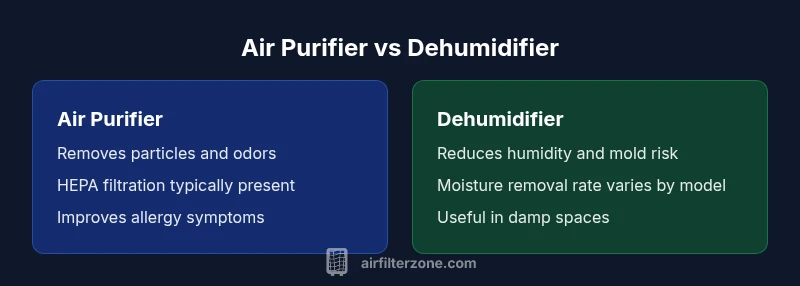
Air purifiers and dehumidifiers target different indoor air issues; for most households, an air purifier addresses fine particles and odors, while a dehumidifier reduces humidity to prevent mold. If you must choose one, prioritize an air purifier for wide benefits in air quality; if humidity is consistently high, a dehumidifier is essential. For the best result, consider a model that combines both.
Air purifier or dehumidifier: which is right for you?
In most homes, the choice between an air purifier and a dehumidifier boils down to the dominant indoor-air issue: fine particles and odors versus excess humidity. According to Air Filter Zone, your decision should start with a quick self-assessment of what bothers you most: dusty surfaces, allergy symptoms, musty smells, or damp walls. While both devices improve comfort, they address different problems. An air purifier or dehumidifier by itself cannot fix every air-quality challenge, but selecting the right tool for your space makes a measurable difference in health, comfort, and energy use. This article walks through how each device works, how to compare models, and how to decide when to combine them for optimal results. Consider your home’s typical activities—cooking, pets, smoking, and seasonal allergies—as you weigh which device to invest in first. The goal is a practical, ethics-light approach to improving air quality with tools that fit real-life routines.
How air purifiers work and what they remove
Air purifiers are designed to capture and reduce airborne particles and odors. At their core, most devices rely on a high-efficiency particulate air (HEPA) filter to trap dust, pollen, smoke, and pet dander. Some models also include activated carbon stages to adsorb smells from cooking or cooking-related VOCs. When selecting an air purifier, you’ll encounter terms like CADR (clean air delivery rate) and ACH (air changes per hour). Higher CADR values generally translate to quicker removal of fine particles in a given room, while ACH indicates how often the device can refresh air within that space. For homeowners, the general takeaway is that a well-sized purifier with a true HEPA filter can noticeably reduce irritation and improve perceived air quality over weeks of consistent use.
How dehumidifiers work and when humidity becomes a problem
Dehumidifiers, by contrast, focus on moisture removal. They extract water vapor from the air and collect condensate in a tank or through a drain hose. The key performance metric is the moisture removal rate, usually expressed in pints or liters per day, and the unit’s ability to maintain a target relative humidity (RH) in a given space. In basements, bathrooms, laundry rooms, or climates with high ambient humidity, a dehumidifier can prevent condensation, mold growth, and musty odors. When humidity levels stay above about 50-60%, many homes benefit from running a dehumidifier part of the day or continuously during humid months. Keep in mind that dehumidifiers do not filter particles, so they address moisture but not dust, pollen, or VOCs.
Key differences in performance and use cases
The most important distinction is that air purifiers prioritize particle and odor removal, while dehumidifiers target humidity control. If your goal is allergy relief or reducing smoke and cooking smells, an air purifier or a purifier-dehumidifier combo makes sense. If damp walls, mildew, or bathroom fogging are the main concerns, a dehumidifier is essential. In spaces with both problems, consider combining devices or choosing a unit that offers both functions. Other differentiators include energy use, noise, and maintenance frequency: purifiers require regular filter changes, whereas dehumidifiers require condensate management and occasional bin/ hose maintenance. A practical rule of thumb is to rank issues by severity and pick the device that directly mitigates the top problem, then add secondary tools as needed.
Practical buying considerations for air purifier or dehumidifier
When shopping, use a simple checklist that applies to the air purifier or dehumidifier decision. For air purifiers, verify whether the unit uses a true HEPA filter, has appropriate CADR for your room size, and includes a carbon filter for odors. For dehumidifiers, check the moisture removal rate for your space, tank capacity or drainage options, energy efficiency, and automatic shutoff features. Size matters: buying oversized or undersized devices can waste energy or fail to meet your needs. Look for energy-star ratings for efficiency, consider noise levels for bedrooms or nurseries, and evaluate maintenance costs like filter replacements or bag capacities. Remember that the best choice balances performance with cost of ownership and the practical realities of your living environment.
Real-world scenarios: apartment, basement, kitchen, bedroom
In compact apartments, a compact purifier-dominant approach can deliver meaningful benefits by removing dust and odors from common living spaces. In damp basements, a dehumidifier with a higher removal rate and automatic drainage minimizes mold risk and improves overall comfort. Kitchens may benefit from an air purifier to address cooking odors and particulates, while bathrooms can benefit from a dehumidifier to curb condensate and damp surfaces. In bedrooms, prioritizing low noise and efficient filtration supports better sleep and reduced allergen exposure. In cars or mobile offices, portable options can help maintain better air quality on the go, especially for passengers with sensitivities. In all cases, plan around a routine: schedule filter checks, empty condensate tanks, and align device use with humidity patterns and occupancy.
Costs, maintenance, and lifespan
Costs for air purifiers range by capacity and features, while dehumidifiers vary with moisture capacity and tank size. Expect ongoing maintenance such as filter replacements for purifiers and occasional drainage and cleaning for dehumidifiers. Longevity depends on build quality, usage, and adherence to maintenance recommendations. Instead of chasing absolute cheapest options, prioritize reliability, ease of filter replacement, and a manageable maintenance schedule. For homeowners, a mid-range purifier with a true HEPA filter and a compact dehumidifier for humidity control can deliver substantial value over the long term. Plan for annual or semi-annual maintenance checks to keep performance high and energy use efficient.
Putting it together: a balanced indoor-air strategy
The most holistic approach often combines both devices where feasible, especially in homes with multiple problem areas. Use an air purifier to tackle particles and odors in living rooms, bedrooms, and workspaces, while employing a dehumidifier in damp zones like basements or laundry rooms. Smart or dual-function units can simplify management by providing both purification and humidity control in a single device, though these models may command a premium price. Regular testing of indoor humidity and air quality, along with a maintenance calendar, helps sustain the benefits. In summary, a thoughtful mix of air purification and humidity control—guided by room usage, climate, and personal sensitivities—delivers the most reliable improvements in comfort and health.
Comparison
| Feature | air purifier | dehumidifier |
|---|---|---|
| Primary purpose | Particle removal and odor control | Moisture removal and humidity control |
| Best for | Allergy relief and cleaner air | Damp spaces and mold prevention |
| Maintenance needs | Filter changes and periodic performance checks | Tank drainage or drainage hose maintenance |
| Energy and noise | Low to moderate energy; quiet operation at low speeds | Moderate energy; operation can be noisier at higher capacities |
| Suitability for room size | Best for small-to-midsize rooms when properly sized | Best for spaces with persistent humidity (basements, bathrooms) |
| Upfront cost range | Moderate upfront cost | Moderate to high upfront cost depending on capacity |
What's Good
- Addresses different indoor air quality issues directly
- Improves comfort by reducing particles and odors
- Helps prevent moisture-related problems when used correctly
- A broad range of models to fit budgets and spaces
What's Bad
- Purifiers do not reduce humidity
- Dehumidifiers do not filter particles
- Running both increases energy use and maintenance
- Some models can be noisy or bulky for small spaces
Air purifier generally better for daily air quality; dehumidifier essential for damp spaces; for most homes, pairing both yields the best long-term results
Prioritize an air purifier to address particles and odors first. If humidity is a persistent concern, add a dehumidifier. For optimal indoor air, consider a combined or dual-function unit where feasible.
FAQ
What is the main difference between an air purifier and a dehumidifier?
An air purifier removes airborne particles and odors, improving filtration and air cleanliness. A dehumidifier lowers ambient moisture to prevent mold, condensation, and dampness. Both improve comfort, but they target different aspects of indoor air quality.
Air purifiers clean the air by trapping particles; dehumidifiers remove moisture to prevent dampness and mold.
Can a device do both air purification and humidity control?
Yes, some models offer dual-function capabilities, combining filtration with humidity management. These units can simplify setup, though they may be larger and more expensive. Check that the unit meets both your air quality and humidity needs.
Some devices combine both features, but you’ll pay more and need to ensure it fits your space.
What should I look for when buying an air purifier?
Look for a true HEPA filter, a suitable CADR for your room size, and optional activated carbon for odors. Consider noise level, filter replacement cost, and energy efficiency to ensure long-term value.
Prioritize true HEPA, right room size, and filter costs when buying an air purifier.
What should I look for when buying a dehumidifier?
Check the moisture removal rate for your space, whether it drains automatically or requires a tank, and energy efficiency. Also consider tank size and noise, especially for bedroom or office use.
Focus on moisture removal, drainage options, and energy efficiency when buying a dehumidifier.
Is there a risk of using only one device in a very humid or dusty home?
Yes. Using only a purifier won’t reduce humidity, and using only a dehumidifier won’t remove fine particles or odors. For comprehensive air quality, pair them or choose a dual-function unit if appropriate.
Relying on only one device leaves some air-quality issues unaddressed; pairing is often best.
Quick Summary
- Define your primary indoor-air issue first
- Air purifier targets particles and odors
- Dehumidifier tackles excess humidity and mold risk
- Consider dual-function devices for integrated control
- Maintain filters and condensate systems regularly