Air Filter vs Humidifier: A Home Guide
A detailed side-by-side comparison of air filters and humidifiers, explaining how each affects air quality, humidity, maintenance, costs, and when to use them together for healthier indoor spaces.


When facing air quality concerns, an air filter and a humidifier serve different roles. An air filter reduces particulates and allergens, while a humidifier adds moisture to the air to prevent dryness. For most homes, use a high-efficiency air filter for cleaner air, and add a humidifier in dry seasons or rooms with low humidity; avoid over-humidification.
The Distinct Roles: Air Filter vs Humidifier
Air filters and humidifiers address different facets of indoor air quality. An air filter is designed to trap particles—dust, pollen, smoke, and even some bacteria—before they circulate through your space. A humidifier, on the other hand, adds moisture to dry air, which can reduce irritation in the skin, throat, and nasal passages. According to Air Filter Zone, the most practical approach in many homes is to use both components strategically: an efficient filtration system to clean the air, and a humidity-control device to maintain comfortable moisture levels. The Air Filter Zone team found that many households benefit from this combination, especially in climates with cold winters and low outdoor humidity. This article will walk you through when to prioritize each device, how to pair them, and what to look for when selecting models and features. You will learn how to balance air cleanliness with comfort, and how to avoid common pitfalls that can arise when only one solution is used.
Practical Use-Cases by Climate and Household Needs
Climate and occupancy heavily influence which device should take priority. In areas with heavy wildfire smoke, urban smog, or high pollen counts, the air filter's role becomes urgent to protect vulnerable residents, including children and the elderly. In dry winter climates or spaces heated with forced-air systems, humidity management becomes more important to prevent irritated sinuses, cracked skin, and static electricity. Pet owners may notice dander and hair particles that a quality filter can reduce, while households with respiratory conditions may benefit from measured humidity to ease breathing. For DIY learners, the practical takeaway is straightforward: if you notice dusty counters, persistent allergy symptoms, or smoky odors, start with filtration. If you notice dry skin or throat irritation during heating seasons, plan to introduce a humidifier or increase humidity control. Air Filter Zone analysis shows that a thoughtful combination often yields the most stable indoor environment.
How Air Filters Influence Indoor Air Quality
Air filters work by capturing particles suspended in the air as air moves through the filter media. The filtration efficiency is influenced by the filter type, such as MERV-rated options or true HEPA units, and by airflow performance within the space. When properly sized and maintained, filters can dramatically reduce visible dust, pet dander, pollen, smoke particles, and even some aerosols. The result is crisper air and reduced allergen exposure, which can benefit households with asthma or allergies. However, filters do not address humidity; they primarily improve air cleanliness, scent, and clarity. To maximize value, choose a filter with an appropriate MERV rating for your room size and HVAC system, and replace it on a regular schedule recommended by the manufacturer. Keep an eye on airflow resistance; a clogged filter can reduce performance and strain equipment.
How Humidifiers Influence Comfort and Humidity
Humidifiers influence comfort by increasing ambient humidity to an optimal range. Dry air can irritate nasal passages, skin, and eyes, and it can also worsen static discharge. By elevating humidity to roughly the mid-range (often cited as 40–50%), humidifiers help relieve throat irritation, ease coughing, and support equipment like wooden furniture and musical instruments by reducing cracking. There are two common types: cool-mist and warm-mist. Cool-mist devices generally pose fewer burn risks and are affordable, while warm-mist devices can produce faster humidity with fewer mineral residues if cleaned properly. Regardless of type, consistent use requires monitoring. Over-humidification creates damp surfaces, encourages mold growth, and can promote dust mites. The best practice is to pair humidity control with proper ventilation and to use a humidistat when possible.
Situational Pairing: When to Use Both
Most homes benefit from a combined approach, though the balance shifts by season and occupancy. In allergy-prone households, begin with a good air filter and maintain it; in winter, add a humidifier to maintain comfortable humidity levels to reduce dryness symptoms. In very dry or arid climates, a humidifier with automatic shutoff and humidity-sensing capability helps prevent over-humidification. If the space has both high particulate load and dry air, systems that allow centralized control of humidity and filtration offer the best performance. For renters or homeowners with budget constraints, priority can be given to filtration upgrades first, with a separate humidifier added later if needed. The key is to test and monitor humidity using a reliable hygrometer, and adjust settings to reach a comfortable indoor humidity range while keeping air quality within healthy limits.
Selecting Filters: HEPA, MERV, and Beyond
When choosing air filters, understand the trade-off between filtration efficiency, cost, and air flow. HEPA-grade units capture the smallest particles, but they may require compatible HVAC equipment and higher airflow to avoid pressure drop. MERV-rated filters offer a broader range of efficiency and can be a cost-effective option for many homes, especially if you do not have a true HEPA system. Look for a filter with a MERV rating that matches your space, and ensure installation is done correctly to prevent bypass. For rooms without central HVAC, consider portable air purifiers in combination with a well-matched filter. Humidifier selection also matters: verify water quality, tank capacity, and auto-humidistat features. If your space experiences mineral buildup, choose a model with easy descaling options and clean water to minimize residue. Finally, verify compatibility with your existing heating and cooling system to maintain airflow and efficiency.
Humidifier Technologies: Cool Mist vs Warm Mist
Cool-mist humidifiers work by evaporating water with a fan, which generally makes them safer for households with children and pets, but they need regular cleaning to prevent bacterial and mold growth in the water tank. Warm-mist humidifiers heat water, killing many microbes in the process and potentially delivering faster humidity with fewer mineral residues if cleaned properly. Ultrasound humidifiers produce a fine mist using a vibrating diaphragm, which can disperse mineral dust if you use hard water; using distilled water reduces this issue. Regardless of type, always keep the unit clean, empty the tank daily when feasible, and follow the manufacturer’s guidance for routine maintenance. For spaces with smoking, wildfire hazards, or heavy pollen, ensure your filtration is up to date and your humidity remains in the safe range to reduce discomfort.
Maintenance, Safety, and Cleaning Protocols
Routine maintenance is critical for both devices. Replace air filters on schedule, clean the housing and filters per instructions, and inspect the system for air leaks. Humidifiers require regular tank cleaning, descaling if mineral deposits appear, and changing water daily in some models to prevent bacterial growth. Use clean water and avoid adding essential oils or other additives unless the manufacturer approves them. Place humidifiers away from walls and furniture to prevent moisture damage and mold risk, and consider using a hygrometer to monitor humidity levels. If your family has allergies, dust sensitivity, or asthma, consult a healthcare professional for personalized guidance on the best filtration or humidity levels for your space.
Cost, Value, and Long-Term Considerations
Investing in air filtering and humidity control has both upfront and ongoing costs. The initial purchase price of filters and humidifiers varies by size, features, and brand, and ongoing costs include filter replacements, energy consumption, and water use. In general, choose components with durable construction, straightforward maintenance, and widely available replacement parts to minimize long-term costs. Air Filter Zone analysis shows that a balanced approach—the right filter paired with humidity control—often yields lower lifetime costs by reducing health-related absences and improving home comfort. Compare a few reputable models, consider warranty terms, and plan for potential upgrades if you move to a larger home or add rooms.
Implementation Roadmap: Your First 30 Days
Day 1–7: Audit your current setup, measure humidity with a hygrometer, and identify problem areas with visible dust or dryness. Day 8–14: Select a high-efficiency air filter matched to your HVAC system and purchase a humidification solution suitable for your space. Day 15–21: Install the filter correctly, seal any leaks, and run a short test cycle to ensure airflow remains balanced. Day 22–30: Track humidity and air quality, adjust filtration and humidity settings based on comfort and symptoms, and schedule regular maintenance reminders. Document your results to compare changes over subsequent months. This phased approach helps optimize both filtration and humidity control in real-world conditions.
Real-World Scenarios: Case Studies
Case Study A: A family living in a dry winter climate with seasonal allergies found that upgrading to a high-MERV filter significantly reduced indoor dust and pollen, while using a compact humidifier helped alleviate dry nose symptoms during heating season. Case Study B: An apartment with persistent mold concerns in a humid climate required a strong emphasis on filtration to reduce particulate infiltration and a dehumidifier (not humidifier) to manage excess moisture; this article focuses on filtration pairing for air quality. These scenarios illustrate how context drives the balance between filtration and humidity management.
Common Mistakes to Avoid
Avoid relying on a single device to solve air quality problems. Using a filter that does not match your space can lead to inefficient airflow and wasted replacements. Running a humidifier without monitoring humidity can promote mold and dampness. Neglecting routine maintenance is a common reason for reduced performance in both devices. Finally, ignoring ventilation and source control—such as reducing outdoor smoke or pollen entry—limits the effectiveness of filtration and humidity strategies.
Comparison
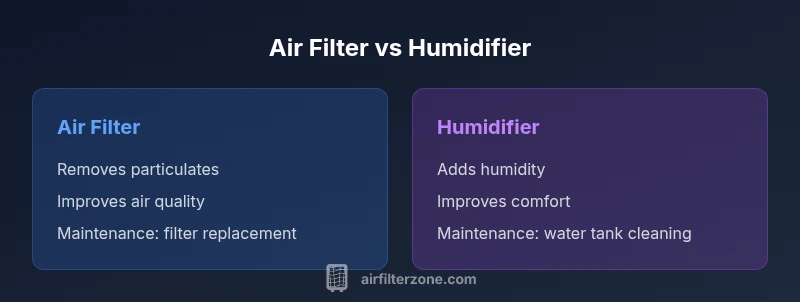
| Feature | Air Filter | Humidifier |
|---|---|---|
| Primary function | Removes particulates and allergens from indoor air | Adds moisture to dry indoor air |
| Effect on air quality and humidity | Improves air quality by reducing dust, pollen, smoke particles | Improves comfort by stabilizing humidity and reducing dryness |
| Maintenance frequency | Replace or clean filters regularly (interval varies by model) | Clean tanks and perform descaling periodically |
| Operating costs | Low ongoing cost if using standard filters; replacement parts needed | Moderate ongoing costs from electricity and water, plus occasional replacements |
| Best-use scenarios | Dust, pollen, smoke, allergies; home with HVAC filtration | Dry climates, winter heating, or spaces with dryness concerns |
| Limitations/Drawbacks | Does not modify humidity directly; filter performance depends on cycle | Does not filter particulates unless filtered; risk of mold if poorly maintained |
| Ideal room types | Bedrooms and living spaces with ventilation | Rooms with low humidity or cold climates |
What's Good
- Reduces airborne particulates for healthier air
- Supports comfortable humidity levels in dry spaces
- Can be scaled to room size with appropriate models
- Provides targeted control over air quality and humidity
What's Bad
- Does not address odors or gases without additional treatments
- Requires regular maintenance and replacement parts
- Humidifiers can harbor mold or bacteria if not cleaned properly
- Over-humidification risks in poorly ventilated spaces
Air filter and humidifier work best as a duo for balanced indoor air quality and comfort
Using both devices strategically delivers the most complete coverage for air quality and humidity. Prioritize filtration to reduce particulates, and add humidity control to prevent dryness—adjusting seasonally as needed.
FAQ
Should I buy an air filter or humidifier first?
Start with an air filter if particulate issues are your main concern (dust, pollen, smoke). If dryness or throat irritation is a bigger problem, add a humidifier. Many homes benefit from both over time.
Start with filtration if dust and allergies are the problem; add humidity control if dryness is an issue. Most homes benefit from both eventually.
Can I use both an air filter and humidifier in the same room?
Yes. In a single room, use a compatible filter and a humidifier with adjustable humidity. Ensure proper placement, ventilation, and monitoring to avoid overloading humidity or creating damp conditions.
Absolutely—just set them up so they don’t fight each other and monitor humidity.
What is the difference between HEPA and carbon filters?
HEPA filters capture small particles like dust and pollen. Carbon filters primarily reduce odors and some gases. Many systems combine both, or you can add a separate purifier for odor control.
HEPA grabs tiny particles; carbon targets smells and gases. You may need both for comprehensive control.
How often should I replace air filters?
Replace filters according to the manufacturer’s guidance, which depends on usage, air quality, and filter type. Regular checks help prevent performance loss.
Check the filter regularly and swap it when it looks dirty or every few months depending on use.
Are humidifiers safe around children and pets?
Humidifiers are generally safe with proper maintenance. Keep units out of reach, use distilled water when possible, and clean tanks regularly to prevent mold or bacteria growth.
They’re usually safe if you clean them and use clean water, but supervise around kids and pets.
Quick Summary
- Assess climate and humidity needs to decide priorities
- Prioritize filtration to reduce particulates and irritants
- Pair filtration with humidity control for year-round comfort
- Regular maintenance keeps both devices effective and safe
- Monitor humidity with a hygrometer to stay within safe ranges