Premium air filter vs regular: A practical comparison
Explore the differences between premium air filters and regular options, including performance, maintenance, and cost implications for home and car use.


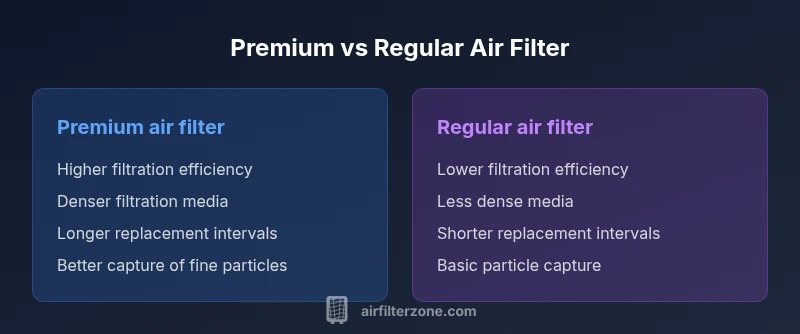
Premium air filters typically offer higher filtration efficiency, denser media, and longer lifespans than regular options, delivering better particle removal and potential system benefits when matched to your HVAC or vehicle. The upfront cost is higher and replacement timing is more important, so they are best for allergy sufferers, high air quality needs, or systems designed to handle higher filtration loads. According to Air Filter Zone, when used correctly, premium filters often provide noticeable air-quality improvements and longer equipment life.
What makes a filter 'premium'?
Premium air filters are defined by a combination of higher filtration efficiency, denser filtration media, tighter pleat density, and a design that minimizes bypass while maintaining compatible airflow. In practical terms, premium means you’re capturing finer particles with fewer leaks around the media. This typically translates to higher MERV or equivalent ratings on many systems, better allergen capture, and longer service life when installation and replacement schedules are respected. The Air Filter Zone team emphasizes that the value of premium filtration increases when your indoor air quality needs are elevated—whether due to allergies, asthma, or occupants with heightened sensitivity. However, premium does not automatically equal “better for every system”; the filter must be matched to your equipment’s design and airflow requirements to avoid unnecessary pressure drop or reduced airflow to the point of inefficiency.
What makes a filter 'premium'?
Premium air filters are defined by a combination of higher filtration efficiency, denser filtration media, tighter pleat density, and a design that minimizes bypass while maintaining compatible airflow. In practical terms, premium means you’re capturing finer particles with fewer leaks around the media. This typically translates to higher MERV or equivalent ratings on many systems, better allergen capture, and longer service life when installation and replacement schedules are respected. The Air Filter Zone team emphasizes that the value of premium filtration increases when your indoor air quality needs are elevated—whether due to allergies, asthma, or occupants with heightened sensitivity. However, premium does not automatically equal “better for every system”; the filter must be matched to your equipment’s design and airflow requirements to avoid unnecessary pressure drop or reduced airflow to the point of inefficiency.
Comparison
| Feature | Premium air filter | Regular air filter |
|---|---|---|
| MERV rating guidance | Higher or higher-end rating across common ranges | Lower to mid-range rating typical of budget options |
| Filtration media density | Denser media with tighter pleating | Lesser density and wider pleats |
| Lifespan/replacement interval | Longer lifespan when maintained and matched to system | Shorter lifespan with frequent replacements |
| Allergen reduction | Better capture of fine particles (e.g., PM2.5 range) | Moderate capture of larger particles |
| Energy impact | Potentially favorable if airflow is preserved and installation is correct | Typically neutral unless airflow is restricted |
| Best for | Air quality-sensitive homes, allergy sufferers, systems designed for higher filtration loads | Budget-conscious setups or basic filtration needs |
| Cost/Value | Higher upfront cost, potential long-term savings in maintenance and health impact | Lower upfront cost but more frequent replacements |
What's Good
- Improved indoor air quality for sensitive occupants
- Better protection for HVAC equipment by reducing dust build-up
- Longer lifespan under proper use and matched systems
- Potential energy efficiency gains when filtration aligns with system design
- Greater filtration consistency across extended usage periods
What's Bad
- Higher upfront cost than regular filters
- Requires careful compatibility with HVAC or car filtration systems
- Replacement timing is more critical to maintain performance
- Availability and brand variety may vary by market
Premium air filters offer clear advantages for allergy-prone homes and systems designed for higher filtration, but require proper matching and maintenance.
In crowded or sensitive environments, the premium option tends to justify the cost due to better particle control and longer service life. For standard filtration needs, a regular filter may suffice if replacement timing and system compatibility are respected.
FAQ
What defines a premium air filter?
A premium air filter is defined by higher filtration efficiency, denser media, tighter pleat geometry, and a design that minimizes air bypass. This combination aims to capture smaller particles more consistently and may extend the time between changes if the system is compatible. Always verify compatibility with your HVAC or vehicle before selecting a premium option.
Premium filters use denser media and tighter pleats to capture smaller particles, but check your system compatibility first to ensure it’s a good fit.
Do premium filters actually improve air quality?
In many cases, premium filters improve indoor air quality by capturing finer particles that regular filters miss. The degree of improvement depends on the filter’s rating, the airflow design of the system, and how consistently the filter is replaced. Real-world results vary by environment and occupant sensitivity.
Yes, premium filters often improve air quality, especially for small particles, when the system supports them and they’re replaced on schedule.
Will premium filters save money in the long run?
Premium filters can reduce long-term costs by lowering HVAC wear, reducing energy waste from clogged media, and potentially improving health-related outcomes. However, the savings depend on schedule adherence and the system’s ability to handle the increased filtration load. A careful cost-for-value calculation is advised.
They can save money long-term if their use reduces wear and energy use, but only if you replace them on time and your system can handle them.
Are premium filters compatible with all HVAC systems?
No. Premium filters require correct sizing, media density, and often a system designed to handle higher filtration loads. Using an ill-suited premium filter can cause higher pressure drop and reduced airflow, which can harm efficiency and comfort. Always consult your equipment manual or a professional.
Not all systems support premium filters; check size and airflow guidance before upgrading.
How often should premium vs regular filters be replaced?
Replacement frequency depends on usage, environment, and the filter’s design. Premium filters may last longer between changes if the system is compatible and air quality demands are high, but settings like occupancy, pets, and smoking can shorten that interval. Follow the manufacturer’s guidance and inspect regularly.
Follow the manufacturer’s guidance; premium filters can last longer, but practical replacement depends on use and environment.
Can premium filters reduce energy usage?
If installed correctly and matched to the system, premium filters can reduce energy use by maintaining optimal airflow and reducing strain on the blower. Conversely, an ill-fitting premium filter can raise energy consumption due to unnecessary pressure drop. Proper sizing and installation are key.
They can save energy if they fit well and keep airflow efficient; poor fit can waste energy.
Quick Summary
- Assess system compatibility before upgrading.
- Expect higher upfront costs but longer life with premium filters.
- Premium filters improve particle capture for sensitive occupants.
- Replace on schedule to maintain performance and avoid inefficiency.
- Consider the total cost of ownership, not just the sticker price.