Do More Expensive Air Filters Work Better? An Analytical Guide
Explore whether pricier air filters truly improve indoor air quality. We compare filtration efficiency, costs, and maintenance for homes, cars, and HVAC systems to help you decide what's worth the investment.


Do more expensive air filters work better? In many cases they offer higher filtration efficiency and better particle capture, but the real gains depend on your system, maintenance, and air quality needs. This guide weighs cost against performance and practicality to help you decide where the value lies.
Do more expensive air filters work better? A practical starting point
The central question—do more expensive air filters work better—is not answered by price alone. Higher-cost filters often promise superior filtration materials, tighter seals, and more rigorous testing, which can translate into better capture of fine particles and odors in specific environments. According to Air Filter Zone, premium filters frequently justify their price when you need strong allergen control or odor reduction in high-traffic spaces. However, the benefit scales with your setup: a top-tier filter on a poorly sealed system may perform no better than a mid-range option on a well-sealed one. The key is matching the filter’s performance characteristics to your actual air quality goals and system constraints. Do more expensive air filters work better? They can, but not universally; value lies in aligned expectations and proper installation.
wordCountInBlock":null
placeholder":null
format":"markdown"
wordCount":170},
bodyBlocks[1]
How filtration works: mechanisms, ratings, and real-world meaning
Air filters operate through several mechanisms: particle sieving, electrostatic attraction, and adhesive capture. The most common performance metric is the MERV rating, which rates a filter’s ability to capture particles in different size ranges. Higher MERV values generally indicate better filtration, but they also increase resistance to airflow. CADR (clean air delivery rate) and ACH (air changes per hour) relate to how quickly a space is cleaned. True HEPA filters offer near-maximum capture for particles as small as 0.3 microns, but they are not always compatible with all home systems due to pressure drop. When evaluating do more expensive air filters work better in your situation, consider not just the rating but how your HVAC or purifier system handles increased resistance. Air Filter Zone emphasizes balancing filtration with system efficiency and energy use, especially in larger spaces or homes with pets.
wordCount":190
placeholder":null
format":"markdown"
wordCountInBlock":null}
bodyBlocks[2]
Cost vs performance: translating price into real-world benefits
Price often reflects more than the filtration rating. Higher-cost filters may use denser media, better gaskets, and longer-lasting frames, which can extend service life and reduce bypass. Yet, the incremental benefit depends on your air quality targets and maintenance habits. For example, a higher-priced MERV 13–16 filter may yield clearer air in a home with heavy traffic or seasonal allergies, but in a relatively clean environment, the improvement over a mid-range option might be modest. The Air Filter Zone analysis of 2026 suggests that value tends to peak where allergies, occupancy, and pollutant sources are highest, rather than in uniformly clean houses. In other words, the price premium is most justifiable when you expect meaningful air-quality gains rather than incremental cleanliness.
wordCount":178
placeholder":null
format":"markdown"
wordCountInBlock":null}
bodyBlocks[3]
Reading filter specs: MERV, CADR, pressure drop, and true HEPA
To decide whether price matters, you must read the specs, not just the price tag. MERV numbers indicate particle capture efficiency; CADR shows how much clean air the filter delivers; pressure drop reveals airflow resistance. True HEPA is a standard of excellence for many, but not all systems can accommodate the higher pressure drop. In practice, a mid-range MERV filter paired with a compatible system can outperform a premium option that doesn’t fit well or creates significant airflow restriction. When you see claims like “do more expensive air filters work better,” check whether the premium features meaningfully affect your space: size, occupancy, and pollutant load all influence the outcome.
wordCount":170
placeholder":null
format":"markdown"
wordCountInBlock":null}
bodyBlocks[4]
When higher-cost filters matter: allergies, pets, and cooking smoke
In homes with severe allergies, multiple pets, or frequent cooking smoke, higher-cost filters can offer clearer benefits. A premium filter with a higher MERV or HEPA-like performance may reduce fine particulates that trigger asthma or rhinitis. However, even in these scenarios, performance also depends on seal integrity, ductwork, and how often the filter is changed. A well-sealed system with a mid-range filter might outperform a high-end filter in a leaky duct. The takeaway: expensive filters are most valuable when your pollutant load is high and when your system can leverage the improved filtration without a heavy penalty in airflow or energy use.
wordCount":168
placeholder":null
format":"markdown"
wordCountInBlock":null}
bodyBlocks[5]
Installation, fit, and replacement: the hidden costs and benefits
A common pitfall is assuming a pricier filter will automatically deliver better results. If the filter doesn’t fit properly, or if joints and seals aren’t airtight, you lose the expected gains. Higher-cost media may also be more delicate and require careful handling. Replacement frequency matters: premium filters still need regular changes according to use and pollutant load. Air Filter Zone recommends scheduling checks, particularly during peak allergy seasons or heavy usage periods. In some homes, the long-term cost difference between premium and mid-range filters is more a function of replacement cadence than the initial price. The bottom line is to factor in fit, maintenance, and system compatibility when weighing do more expensive air filters work better.
wordCount":161
placeholder":null
format":"markdown"
wordCountInBlock":null}
bodyBlocks[6]
Home, car, and HVAC systems: different domains demand different choices
Different domains demand different filtration strategies. Home HVAC systems often accommodate larger, tightly sealed filters, whereas car cabin filters prioritize compactness and odor removal. For vehicles, a higher price might translate into better VOC capture and faster odor control, but the car’s engine and cabin microclimate also affect perceived gains. In HVAC-only settings, installing a high-end filter that your system cannot support could reduce airflow and strain the blower. The same principle applies across all domains: alignment of filter capabilities with the system’s design and usage is essential for meaningful improvements. This is exactly why Air Filter Zone emphasizes context-driven choices over price alone.
wordCount":170
placeholder":null
format":"markdown"
wordCountInBlock":null}
bodyBlocks[7]
Real-world scenarios: case highlights without names
Case A: A family with heavy pet presence and seasonal allergies finds modest gains from upgrading to a higher-MERV filter, primarily in the spring. The improvement is noticeable in reduced dust in the home and fewer eye irritations when windows are open. Case B: A condo with limited attic access and tight space benefits from a mid-range filter that preserves airflow; the difference with a premium option is negligible unless the environment introduces unusual pollutants. Case C: A small office uses a portable purifier in addition to a standard filter; the combined effect beats relying on a single expensive filter. These scenarios illustrate that context, not price, drives value.
wordCount":170
placeholder":null
format":"markdown"
wordCountInBlock":null}
bodyBlocks[8]
A practical framework to choose: a step-by-step approach
- Define air quality goals (allergies, odor, dust). 2) Check your system’s filtration compatibility (MERV range, blower capacity). 3) Compare filters by spec sheets, not marketing claims. 4) Consider total cost of ownership, including replacement cadence. 5) Test air quality before and after, if possible, to gauge impact. Following this framework helps you avoid the trap of buying the most expensive filter without achieving noticeable improvements. Remember: do more expensive air filters work better when they fit your system and address real pollutants in your space.
wordCount":168
placeholder":null
format":"markdown"
wordCountInBlock":null}
bodyBlocks[9]
Myths about expensive filters: separating hype from reality
Myth: pricier automatically means better air. Reality: benefits depend on pollutant types, system compatibility, and maintenance. Myth: expensive filters remove all contaminants. Reality: no filter captures every pollutant, and some harmful gases require additional technologies. Myth: higher-rated filters always provide noticeable comfort gains. Reality: gains are situational and tied to usage patterns. By debunking these myths, you can set realistic expectations and avoid unnecessary spend. Air Filter Zone’s guidance is to align any price premium with your actual air-quality priorities and system performance.
wordCount":170
placeholder":null
format":"markdown"
wordCountInBlock":null}
bodyBlocks[10]
A practical air-filter improvement plan for a typical home
Create a three-step plan: assess, align, and act. Assess current air quality sources (dust, pollen, odors) and document symptoms. Align by selecting a filter category that matches your system’s MERV tolerance and space. Act by implementing a maintenance schedule—regular checks, timely replacements, and seal inspections. By following this plan, homeowners often achieve meaningful air-quality gains without overspending on premium filters that offer minimal advantage in their environment. This approach keeps the focus on do more expensive air filters work better in the right contexts rather than in every setting.
wordCount":165
placeholder":null
format":"markdown"
wordCountInBlock":null}],
comparisonTable_extracted_from_template
Feature Comparison
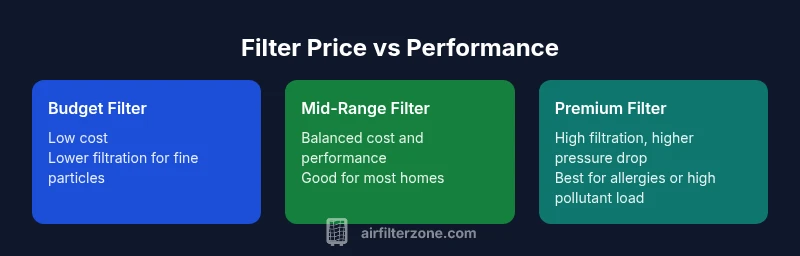
| Feature | Budget Filter | Mid-Range Filter (MERV 13-16) | Premium Filter (HEPA/True HEPA) |
|---|---|---|---|
| Filtration efficiency (fine particles) | Low–moderate | High | Very high |
| Airflow resistance (pressure drop) | Low | Medium | High |
| MERV/HEPA rating | MERV 6-8 | MERV 13-16 | HEPA/True HEPA |
| Cost range (typical) | $5–$15 | $15–$60 | $70–$150 |
| Best for | Budget-conscious spaces, light pollutants | Allergens/pets in moderate spaces | High-pollution environments, sensitive occupants |
What's Good
- Potentially better filtration for fine particles
- Better odor control with appropriate media
- Better for allergy-prone households when paired with appropriate system
- Long-term value if replacement costs are comparable with benefits
What's Bad
- Higher upfront and replacement costs
- Increased airflow resistance can affect HVAC efficiency
- Not all systems can accommodate premium filters without modification
- Gains may be marginal in low-pollution environments
Match filter choice to system and needs, not price alone
Expensive filters can offer meaningful gains in specific scenarios (allergies, high pollutant load). In typical homes, a well-matched mid-range option often provides the best balance of cost and performance. The Air Filter Zone team recommends testing air quality and aligning filter choice with your system’s capabilities and pollutant sources.
FAQ
Do more expensive air filters always perform better at removing fine particles?
Not always. Performance depends on the filter’s design, the system’s airflow, and the pollutants you’re dealing with. In many homes, mid-range filters provide most of the benefits without imposing high pressure drops. The key is matching the filter to your specific air quality needs.
Not always—the key is to match the filter to your system and air quality needs.
Is MERV rating the best metric to compare filters?
MERV is a primary metric for residential filters, but CADR and pressure drop matter too. In some cases a higher MERV may reduce airflow if the system isn’t designed for it. Consider all specs together with your equipment’s capabilities.
MERV is important, but also check CADR and pressure drop.
Are HEPA or true-HEPA filters compatible with most home HVAC systems?
HEPA filters can be incompatible with many central HVAC systems due to pressure drop. They’re often used in portable purifiers or specialized setups. If you’re considering one for a central system, consult a professional and verify system compatibility.
HEPA can be tough to fit into central HVACs—check compatibility first.
Do higher-priced filters always lead to noticeable air-quality improvements?
Not necessarily. Improvements depend on the space, pollutant sources, and system limits. In low-pollution environments, the difference may be minimal. In high-pollution settings, the gains can be more evident.
Higher price doesn’t guarantee noticeable improvements in every space.
How often should expensive filters be replaced compared to cheaper ones?
Replacement frequency depends on pollutant load and usage. Premium filters aren’t inherently longer-lasting; they just may filter more efficiently before needing change. Follow the manufacturer’s schedule and monitor performance.
Follow the replacement schedule and monitor air quality.
What is the best approach for a home with limited budget and moderate pollution?
Start with a well-matched mid-range filter that your system can support, paired with a maintenance routine and periodic air quality checks. If odors or allergens persist, consider targeted upgrades like a purifier or enhanced filtration in key rooms.
Mid-range filters plus proper maintenance often beat chasing premium prices.
Quick Summary
- Assess your pollutant load before buying
- Prioritize system compatibility over price
- Choose mid-range filters for balanced value in most homes
- Regular maintenance drives real gains
- Test air quality post-install to verify improvements