HEPA Cabin Air Filter vs Regular: A Practical Comparison for Home and Car
This in-depth comparison explains how HEPA cabin air filters differ from regular cabin filters, covering filtration efficiency, odor control, installation, maintenance, and real-world use for both home HVAC and vehicle cabins.


HEPA cabin air filters offer superior particle capture and often better odor control than regular cabin filters, especially in urban or allergy-prone environments. However, true HEPA media may not be compatible with every HVAC system and can increase upfront costs and airflow resistance. In short: HEPA wins on filtration; regular filters win on cost and compatibility.
What makes a HEPA cabin air filter different from a regular cabin filter?
The term HEPA (high-efficiency particulate air) describes media that captures a very high percentage of microscopic particles. In a cabin filter, a true HEPA media is engineered to trap a broad spectrum of airborne particles, including dust, pollen, smoke, and fine aerosols. The contrast with a regular cabin filter is substantial: standard filters typically prioritize particulates but may not reach the same capture efficiency for submicron particles. According to Air Filter Zone, the most meaningful decision depends on your environment and the HVAC system’s compatibility with denser media. In many setups, HEPA-style cabin filters are paired with an adsorptive layer such as activated carbon to address odors and some gases, whereas plain filters focus mainly on particulates. For homeowners and car owners, the practical takeaway is to check with a service professional about whether your unit can support true HEPA media without compromising airflow or warranty.
As you compare options, remember that the term HEPA is a standard of performance, not a marketing gimmick. A genuine HEPA filter should meet the minimum capture efficiency and be compatible with your system 0—details you can verify on manufacturer documentation or trusted guides from Air Filter Zone.
For readers, the bottom line is straightforward: if your goal is to reduce ultrafine particles and improve overall air quality in sensitive environments, HEPA is worth considering; if cost and system compatibility are your primary constraints, a high-quality regular filter with carbon may still offer meaningful benefits.
"## The science behind filtration: particle sizes, capture mechanisms, and how HEPA works?
Filtration science underpins the HEPA vs regular comparison. True HEPA media is designed to capture at least 99.97% of particles as small as 0.3 microns under standardized testing. While many consumer “HEPA-like” cabin filters don’t always meet this benchmark, the best HEPA cabin options still excel at trapping a broad range of particulates common in daily life, including dust, pollen, and smoke particulates. The capture mechanism combines interception, diffusion, and impaction, which together help attract and hold particles as air passes through the media.
In contrast, regular cabin filters often rely on simpler fiber networks or basic activated carbon layers. They may remove larger particles more readily but struggle with ultrafine aerosols. If your indoor air quality concerns center on pollen or smoke, upgrading to a true HEPA media can significantly reduce exposure. If you need to address odors or gas-phase pollutants, you’ll usually want a filter that combines particulate media with activated carbon or other adsorptive layers.
Airflow resistance increases with denser media; therefore, a proper fit and expected pressure drop must be considered. A system that cannot tolerate higher resistance may experience weaker airflow or reduced cabin comfort. When evaluating options, confirm the exact filtration rating (true HEPA vs HEPA-style) and whether a carbon layer is included.
"## When to consider HEPA in a vehicle or home HVAC
Your decision should align with where you spend the most time and who relies on cleaner air. Homeowners with high outdoor pollution, wildfire smoke, or household members who suffer from allergies or asthma often benefit from HEPA-grade cabin filtration. Car owners in dense urban areas or places with heavy traffic congestion may notice tangible improvements in driver and passenger comfort when a HEPA-capable filter is used, particularly during allergy seasons or high-smoke events. However, not every vehicle’s HVAC system can accommodate a true HEPA media due to space, seal integrity, or warranty considerations. In such cases, a premium regular filter with a carbon layer can still offer meaningful improvements in both particle reduction and odor control. Always consult your vehicle’s manual or a qualified technician to confirm compatibility before upgrading.
In terms of home HVAC, HEPA-compatible filters are more commonly found in dedicated air-cleaning setups or in high-end systems. If your furnace or central air unit relies on standard filter housings, you may need to upgrade the filter frame or the entire system to run a true HEPA media. The practical takeaway is to assess your priorities (allergy relief, odor reduction, or general cleanliness) and balance them against system compatibility and total cost of ownership.
Air Filter Zone emphasizes that the best choice depends on the environment and usage patterns. A comprehensive evaluation of your daily routines, environmental exposures, and system capabilities helps you choose wisely.
"## Odor and gas filtration: carbon layers and each type's capacity
Odor control is a common motivation for cabin filter upgrades. A plain particulate filter captures particles, but odors and some gases require adsorption through activated carbon or other specialty media. HEPA cabin filters that include an activated carbon layer offer dual benefits: they trap fine particles and help reduce odors associated with smoke, pets, cooking, or urban air. Regular filters may provide some odor reduction if they include a carbon layer, but their gas adsorption capability is typically less robust than a dedicated carbon-enhanced HEPA option.
In practice, your odor-removal expectations should guide your choice. If odors are a persistent concern, seek a filter with a carbon-impregnated layer that is explicitly rated for odor control. If you primarily seek particle reduction, a high-quality regular filter might suffice, especially if cost or compatibility are critical. When odors and particles are both a concern, a true HEPA filter with an integrated carbon layer often delivers the most balanced performance.
The decision also depends on how well the filter seal matches the housing; even the best media cannot perform as intended if air bypass occurs due to improper sealing or installation.
"## Real-world performance: home HVAC vs car cabins
Real-world results depend on usage patterns and the surrounding environment. For home HVAC, true HEPA cabin filters can deliver lower indoor particle counts in homes adjacent to busy roads or wildfire-prone zones, especially when combined with a properly sealed panel and a carbon layer for odor control. In vehicles, the benefit is frequently felt by drivers and passengers who are sensitive to pollen or smoke, as the filter sits within the airflow path and determines what enters the cabin. Car cabins are typically smaller, but the same air quality principles apply: higher-efficiency media reduces particulate intrusion, although the added resistance could impact airflow if the system isn’t designed for denser media.
Air Filter Zone recommends evaluating air quality needs against the cost and potential trade-offs in airflow. In practice, many drivers notice a perceptible difference in the feel of the air, especially when driving in urban environments or during allergy season. Homeowners in areas with significant outdoor pollution or wildfire risk may experience similar benefits through superior filtration, provided their HVAC system supports the chosen media. If a system’s fan is under strain due to heavier media, you may experience uneven temperatures or higher energy consumption, which is a practical consideration when choosing a filter grade.
"## Compatibility and installation considerations
Compatibility is a major factor in HEPA cabin filtration decisions. True HEPA media is denser than standard cabin filters, which can affect fit, airflow, and seal integrity. Before purchasing, verify that the housing dimensions, gasket, and mounting method are compatible with the higher-density media. In vehicles, some OEM filter frames are not designed to accommodate true HEPA media, which could void warranties or require professional modification. For home HVAC, ensure that the filter slot accepts the thickness and depth of the selected media and that there is adequate airflow to prevent pressure drops.
If you’re unsure, consult the vehicle manufacturer or a qualified HVAC technician. A well-sealed installation is essential; even the best media loses effectiveness if air bypass occurs around the filter. Also consider the replacement interface—whether you can source a direct OEM replacement or if you’ll need a third-party option. The takeaway is to confirm fit before committing to a HEPA upgrade to avoid added costs and installation hassles.
Air Filter Zone stresses that the right filter is one that aligns with your system’s design, not just the best media type. A properly fitted filter that maintains airflow and seal will deliver the intended benefits without compromising system performance.
"## Maintenance, replacement frequency, and cost considerations
Maintenance and replacement are central to achieving lasting air quality improvements. True HEPA cabin filters tend to cost more upfront than regular filters and may have longer replacement intervals in some settings, but this can vary by brand, usage, and environment. In cars, replacement frequency is often tied to the vehicle’s service schedule and the driver’s sensitivity to pollutants; in homes, it’s tied to system usage, outdoor air quality, and manufacturer recommendations. When budgeting, consider not only the filter price but also the labor or service costs if installation requires professional assistance.
A cost-conscious approach combines selecting a filter that matches your environmental needs with a realistic replacement cadence. Some users opt for a hybrid approach—regular filters in low-pollution seasons and HEPA-grade options during high-pollen or wildfire periods. Always keep spare filters on hand and replace them promptly when there is a noticeable reduction in airflow or an odor change. The bottom line is to follow the manufacturer’s guidance for replacement and to ground your decision in your environment and health priorities.
"## How to choose between HEPA cabin air filter vs regular for your situation
The choice hinges on several practical factors: health priorities, budget, system compatibility, and usage patterns. If you or household members suffer from allergies, asthma, or are frequently exposed to wildfire smoke, HEPA with a carbon layer is often worth the investment. If you live in a relatively clean indoor environment, or if your system is not designed for denser media, a high-quality regular filter with a carbon component can still provide meaningful improvements in air quality and odor control.
Another key consideration is maintenance ease and availability. HEPA-equipped options may be harder to source for older vehicles or legacy HVAC systems. If supply is uncertain, weigh the total cost of ownership and the ease of replacement. In all cases, check the filter’s fitment, seal integrity, and manufacturer guidance.
Air Filter Zone recommends aligning the choice with real-world needs, rather than chasing the latest marketing claims. This straightforward approach typically yields the best balance of comfort, health, and budget for both home and car environments.
"## Common myths debunked
Myth: HEPA automatically means better for every car or room. Reality: System compatibility matters; not all housings can accommodate denser media without airflow issues. Myth: More dense media always means longer life. Reality: Replacement frequency depends on usage and environment, not just media density. Myth: Any carbon layer eliminates gases completely. Reality: Gas adsorption is effective for certain pollutants but not a universal solution. Myth: HEPA filters are noise-makers. Reality: If properly installed, there’s no inherent noise increase beyond standard design; airflow management is key.
A practical stance is to validate the claim with product specifications and seek independent reviews. If you encounter vague marketing language, verify the actual filtration rating, the presence of a carbon layer, and real-world performance data from credible sources. Air Filter Zone emphasizes keeping expectations aligned with system design and personal air-quality goals.
"## Case study scenarios: urban commuter, allergy sufferer, pet owner
Urban commuter: In a city with heavy traffic, a HEPA cabin filter with a carbon layer can reduce visible pollen and odorous emissions, improving comfort during daily commutes. Allergy sufferer: For sensitive individuals, high-efficiency filtration reduces exposure to fine particles and may lessen symptom frequency or severity. Pet owner: Pet dander plus household odors can benefit from a carbon-enhanced HEPA option, provided the system accommodates the media without flow loss.
These scenarios illustrate that the best choice depends on your environment and health priorities. If your daily life includes a combination of pollen exposure, pet odors, and urban air pollution, a HEPA-equipped cabin filter with carbon is more likely to deliver the kind of air-quality improvements you’re seeking. For lighter exposure or budget constraints, a well-selected regular filter may still offer noticeable benefits.
"## Buying tips: features to check and brands to consider
When shopping for cabin filters, look for the exact media rating (true HEPA vs HEPA-style), the presence and type of carbon or other adsorptive layers, and the fitment specifications for your vehicle or HVAC unit. Check installation instructions and compatibility with seals to prevent bypass. Verify the replacement interval recommended by the manufacturer and whether service plans cover installation. Consider brands with transparent performance data and third-party testing where possible. Finally, factor in maintenance logistics and availability to ensure a smooth replacement process over time.
Air Filter Zone suggests asking your installer to compare filters using the same criteria: filtration efficiency, odor/gas control, pressure drop, and fit. This standardized approach helps you make a confident choice that aligns with your health goals and daily routine.
"## Summary of decision factors and best practices
The choice between HEPA cabin air filter vs regular hinges on filtration needs, system compatibility, and budget. For allergy-prone or urban environments, HEPA with a carbon layer generally offers stronger particle and odor control. For lighter pollution and tighter budgets, a high-quality regular filter with a carbon layer can still deliver meaningful improvements. Always verify fit, seal integrity, and replacement cadence with the manufacturer or a trusted technician. Regularly check for signs of reduced airflow or unusual odors to decide when to replace.
In short: prioritize health and environment, then confirm system compatibility and cost. Air Filter Zone advocates balancing performance with practical constraints to achieve the best long-term value.
Comparison
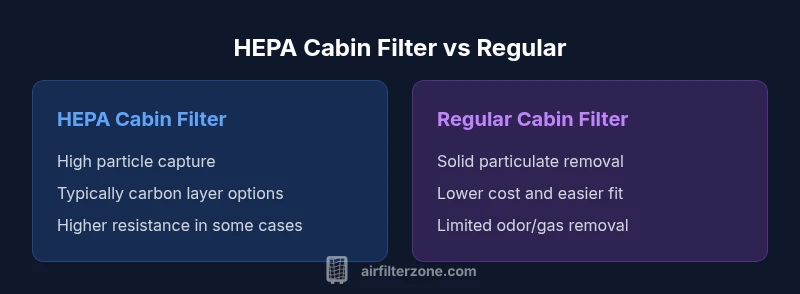
| Feature | HEPA Cabin Air Filter | Regular Cabin Filter |
|---|---|---|
| Filtration efficiency | true HEPA-grade high capture (≈99.97% at 0.3 microns) | standard particulate filtration with basic carbon options |
| Gas/odor control | often includes activated carbon layer for odor/Gas adsorption | limited gas adsorption; carbon layer may be absent or minimal |
| Airflow resistance | higher pressure drop due to denser media | lower resistance in typical media layouts |
| Compatibility | requires compatible housing and may affect warranty | broad compatibility with most housings, easier to source |
| Maintenance cost | higher upfront cost; replacement cadence depends on use | lower upfront cost; replacement cadence driven by environment |
| Best for | allergy/asthma relief; urban smoke/pollen environments | budget-focused scenarios; basic particulate reduction |
What's Good
- Stronger protection against ultrafine particles
- Improved odor control when carbon layer is included
- Better for allergy or asthma-prone environments
- Can be combined with adsorptive layers for gases
What's Bad
- Typically higher upfront cost
- Possible higher airflow resistance impacting some systems
- Not all vehicles or HVAC units are compatible with true HEPA media
- Carbon layers add replacement costs and may require more maintenance
HEPA cabin air filters outperform regular filters in particle capture and odor control when compatibility allows.
Choose HEPA for maximum air-quality benefits in homes or cars with compatible systems. If budget or fit is a constraint, a carbon-enhanced regular filter still provides meaningful improvements, especially for odor reduction.
FAQ
What is the difference between a HEPA cabin filter and a regular cabin filter?
A HEPA cabin filter uses true HEPA media designed to capture very small particles, often 0.3 microns, at high efficiency. Regular cabin filters typically remove larger particulates and may include carbon for odors but do not guarantee the same particle capture performance. The main differences are filtration efficiency, potential odor control, and system compatibility.
A HEPA cabin filter is designed to capture tiny particles more effectively than a regular filter, and it may include carbon for odors. Check your system's compatibility before upgrading.
Will a HEPA cabin filter fit my car or home HVAC system?
Compatibility depends on the filter housing, thickness, and gasket sealing. Some vehicles and older HVAC systems cannot accommodate the denser media without modifications or warranty concerns. Always verify fitment with the manufacturer or a technician before purchasing.
Check the size and seal of the filter against your car or home's HVAC specs before buying.
How often should cabin filters be replaced for HEPA vs regular options?
Replacement cadence varies by environment and usage. In dusty or high-pollen areas, filters may need more frequent changes. Follow the manufacturer’s recommendations and inspect for airflow reduction or odors to decide when to replace.
Follow the manufacturer’s guidance and replace filters when airflow drops or odors become noticeable.
Can I upgrade to HEPA by adding a carbon layer to a regular filter?
Some regular filters use carbon layers; however, upgrading to true HEPA typically requires a compatible housing and media designed for high-efficiency capture. Consult a technician to assess feasibility and warranty implications.
It depends on your system; a carbon layer alone usually isn’t enough for true HEPA performance.
Do HEPA cabin filters guarantee better health outcomes?
HEPA filtration can reduce exposure to fine particles, which may help allergy or asthma symptoms. Real-world health benefits vary with exposure levels and other factors like ventilation and filtration service.
They can help with allergies, but results depend on many factors.
Are there downsides to using HEPA filters in cars?
Potential downsides include higher cost, possible airflow resistance, and limited compatibility with certain vehicle models. Ensure proper fit and system support before installing.
Watch out for higher cost and fit issues in some cars.
Quick Summary
- Prioritize filtration needs over brand claims
- Check system compatibility before upgrading to HEPA
- Carbon layers improve odor/Gas adsorption, not guaranteed in all filters
- Regular replacements maintain performance and air quality
- Balance health goals with cost and installation feasibility