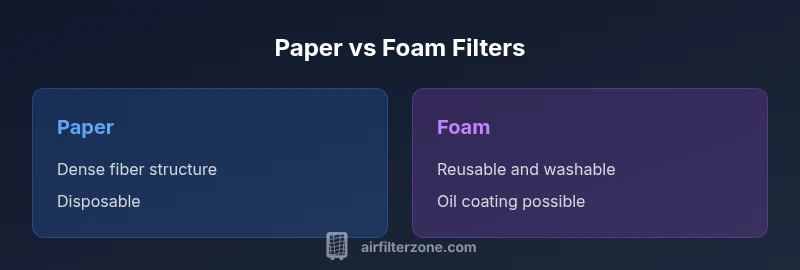
Paper Air Filter vs Foam: A Practical Comparison for Home and Auto Filtration
An analytical comparison of paper air filters and foam filters, detailing filtration efficiency, maintenance, cost, and best-use scenarios for home HVAC and vehicle intakes.


Paper air filter vs foam represent two common media choices for air filtration in homes and vehicles. Paper filters generally offer finer capture of tiny particles but are disposable, while foam filters are reusable and easier to clean but may trade off some filtration efficiency. Your best choice depends on maintenance willingness and environment.
What paper air filter vs foam filters are
When you encounter the label paper air filter or foam, you're looking at two fundamentally different media that shape how clean your air remains. Paper filters, often made from cellulose fibers, are designed to trap small particles and are typically used as disposable components in home HVAC systems, car air intakes, and portable air cleaners. Foam filters, commonly polyurethane or silicone-based, are usually used in situations where maintenance and reuse are valued. In many consumer guides, the paper air filter vs foam debate centers on trade-offs between filtration density and washability. According to Air Filter Zone, the choice should align with your environment and maintenance capacity. The core distinction is not just what the filter captures, but how you treat it after installation: do you replace regularly, or do you wash and re-use? This distinction drives long-term costs, waste, and performance in real-world settings.
How filtration media work
Filtration media trap particles by a combination of size exclusion, surface capture, and sometimes adsorptive properties. Paper filters rely on dense fiber networks that physically intercept particles as air passes through. Their pore structure is fixed during manufacturing, which means their filtration efficiency is largely a product of the fiber density and layering. Foam filters, by contrast, use open cell structures that can be shaped and prepped (and sometimes oiled) to capture particles through added surface interactions. When foam is oiled, it creates a sticky surface that improves capture of dust and can alter airflow characteristics. In both media, the key balance to manage is between filtration efficiency (how many particles are held back) and airflow (how easily air moves through). A filter that traps more particles often restricts airflow more, which can increase pressure drop in a system. For homeowners and DIYers, the practical implication is that a higher efficiency filter may require more frequent maintenance or a larger filter footprint to maintain the same airspeed.
Paper filters: advantages and drawbacks
Paper filters are the default choice for many HVAC systems and automotive intakes because they deliver consistent filtration without ongoing maintenance beyond replacement. The primary advantage is their ability to capture a broad range of particle sizes, particularly fine dust, without the need for oils or coatings. They are simple to replace and have a straightforward compatibility profile with most housings. The drawbacks, however, include environmental waste from disposables and reliance on scheduled replacements rather than cleaning. In dusty environments or in cars with variable air intake demands, paper filters can clog quickly, leading to decreased airflow and slightly higher energy costs. For households aiming for low-maintenance operation, paper filters offer predictable performance with minimal setup, but you should budget for disposal costs and routine changes.
Foam filters: advantages and drawbacks
Foam filters provide excellent reusability for those who can commit to regular cleaning. Their advantages include ease of cleaning, the possibility to re-oil (depending on design), and often lower initial cost when factoring long-term maintenance. However, the drawbacks include potential variability in filtration efficiency depending on pore size, density, and whether oiling is used, which can also alter airflow. Foam's porous networks can trap larger particles efficiently when clean, but performance can decline if not maintained properly. Another factor is compatibility; some foam designs rely on an initial seal or housing that is not universal, so you must verify compatibility with your system. Overall, foam is well-suited for environments where routine maintenance is feasible, and the user is comfortable with a cleaning routine. In those scenarios, foam can offer long-term savings and flexibility, especially for enthusiasts who perform DIY air filtration.
Maintenance and longevity: disposal vs reuse
Maintenance models differ: paper filters are designed for straightforward disposal and replacement on a set schedule, minimizing cleaning steps and the risk of backflow or improper reassembly. Foam filters, by contrast, demand regular cleaning, drying, and sometimes re-oiling to sustain performance. The time invested in maintenance translates into long-term costs, waste, and energy use. If your environment includes a heavy dust load, you may find yourself replacing paper filters more often; with foam, you need to weigh the labor cost of cleaning against the convenience of disposal. The best approach is to align your maintenance habit with the media you choose and the system's housing design to prevent leaks and ensure consistent airflow.
Home HVAC scenarios: what works where
In typical home HVAC setups, disposable paper filters are often the default due to ease of use and predictable performance. For homeowners who value low upkeep and predictable replacement intervals, paper media is a straightforward choice. Foam filters find their niche in DIY installations, older equipment, or spaces where users enjoy hands-on maintenance and want to reduce waste over time. When choosing media for your home, consider your climate, occupancy, pet presence, and allergy considerations. The decision will hinge on whether your priority is minimizing maintenance or maximizing filtration efficiency, and whether your system can accommodate the specific media type.
Car intake and portable devices: media considerations
Car air intakes and portable air-cleaning devices also reflect this media split. Paper filters deliver reliable filtration with minimal maintenance, suited for drivers who want a simple, plug-and-forget option. Foam filters shine where users enjoy cleaning routines and want to extend the interval between replacements. In some vehicles, foam filters require a particular housing or oiling method to achieve the best balance of filtration and airflow. Always verify compatibility with your engine or device and follow the manufacturer’s recommendations to avoid performance or warranty issues.
Cost and environmental impact of media choices
From a financial perspective, paper filters often have a lower upfront cost per unit but accumulate expense through repeated replacements. Foam filters can incur higher upfront costs due to materials and labor for maintenance but may reduce ongoing disposal. Environmentally, disposables generate more waste, while reusables shift the burden to cleaning supplies and energy. The optimal choice depends on your ability to sustain a cleaning routine and your tolerance for waste. If environmental impact matters, foam's reuse cycle and careful maintenance can be a greener option when done correctly.
Compatibility and installation considerations
Not every housing accepts both media types. Check the filter dimensions, frame design, and seals to ensure a proper fit to prevent bypass and reduce leak paths. Mismatched media can compromise performance and void warranties. If you need to retrofit, seek designs that explicitly support your chosen media or consult a professional to avoid unintended airflow restrictions. The right fit matters as much as the media type itself.
Cleaning, drying, and storage best practices for foam
Foam filters benefit from a disciplined cleaning routine. Rinse with cool water, avoid detergents that can leave residues, and allow thorough air drying to prevent mold growth. Some designs allow recombining with an oil coating after drying; if you use oil, apply only a light coat according to the manufacturer’s guidance. Proper drying and storage prevent warp or microbial growth, ensuring the foam remains effective across cycles.
Selecting the right media for your goals
To decide between paper air filter vs foam, start by listing your priorities: maintenance workload, filtration needs, waste tolerance, and cost. If you want simple operation and fine particle control, paper is preferable. If you value reusability and a hands-on approach, foam may be the better path. Finally, always confirm compatibility with your specific HVAC or engine housing and follow the manufacturer’s maintenance guidelines.
Quick decision checklist for choosing between paper and foam
- Define maintenance willingness: disposable or reusable?
- Assess environment: heavy dust or pet dander?
- Check system compatibility and filter size.
- Consider long-term cost and waste implications.
- Review local energy use and airflow requirements.
Comparison
| Feature | paper air filter | foam filter |
|---|---|---|
| Materials | cellulose-based paper | polyurethane foam |
| Filtration efficiency | often higher for fine particles (density-dependent) | moderate-to-high with proper design and oiling (density-dependent) |
| Durability / Reuse | disposable, single-use | reusable, washable and reusable |
| Maintenance | replace when dirty | wash, dry, and recoat when needed (if design allows) |
| Airflow impact | airflow decreases with clogging; replacement restores flow | airflow can be preserved with regular cleaning but may vary with oiling |
| Cost over time | lower upfront cost but higher long-term replacement costs | higher upfront cost but potential long-term savings with reuse |
| Best use case | disposable, standard HVAC and vehicle intake | environments where cleaning and re-oiling are feasible |
What's Good
- Provides explicit trade-offs to guide decision-making
- Foam is reusable and easier to maintain with regular cleaning
- Paper filters generally offer finer filtration with less maintenance fuss
- Both media are widely available in HVAC and automotive contexts
- Clear maintenance implications help set expectations
What's Bad
- Paper filters generate waste from disposables
- Foam filters require diligence in cleaning and drying to maintain performance
- Filtration efficiency varies with design, density, and coatings
- Not all systems support both media; compatibility matters
Foam is the better choice for reusable, maintenance-friendly setups; paper wins where the priority is finer filtration and minimal ongoing cleaning.
In most home HVAC and vehicle intake scenarios, foam excels when a DIY maintenance routine is feasible. Paper provides reliable, fine filtration with simpler upkeep and easier replacement, making it a safer default for less maintenance-intensive users.
FAQ
What is the main difference between paper air filters and foam filters?
Paper filters are typically disposable and capture finer particles with minimal maintenance, whereas foam filters are reusable and require cleaning and drying. The choice hinges on your maintenance capacity and environment.
Paper filters are disposable and catch fine dust; foam filters are reusable but need cleaning and drying.
Are paper filters more effective at capturing fine dust than foam filters?
Paper filters often provide finer filtration due to dense fibers, but effectiveness depends on the specific design. Foam can approach similar results when designed for high density or used with oil coatings.
Paper can catch finer dust, but foam can be effective with the right design.
Can foam filters be washed and reused indefinitely?
Foam filters can be washed and reused, but performance typically declines after multiple cleaning cycles and wear. Always dry completely before reuse to prevent mold.
Yes, you can reuse foam, but it wears out over time and must be dried well before reusing.
Which media is better for HVAC systems?
Most HVAC systems use disposable paper filters for reliability and low maintenance. Foam filters can work in select configurations but may require custom housings or care to maintain performance.
Paper is usually best for HVAC; foam can work with the right setup.
How often should I replace or clean these filters?
Follow manufacturer recommendations. Paper filters are replaced on a schedule, while foam filters are typically cleaned regularly and dried before reuse.
Replace paper filters as recommended; clean and dry foam filters regularly.
Are there hybrid filters that combine paper and foam?
Hybrid designs exist but are less common. Most setups use a single media type; check your device specifications to avoid compatibility issues.
Hybrid filters exist but are rare; verify compatibility with your equipment.
Quick Summary
- Assess maintenance willingness before choosing media
- Consider environment and particle load to guide filtration needs
- Foam offers reusability; paper offers finer filtration with simple replacements
- Check system compatibility to prevent airflow issues
- Plan for long-term costs and waste when budgeting