How to Make a Carbon Air Filter: DIY Home Guide
Learn how to make a carbon air filter at home with activated carbon, safe media layers, and a simple frame. This step-by-step guide covers materials, design, testing, and maintenance for cleaner indoor air.


In this guide you will learn how to make a carbon air filter at home, including selecting activated carbon, choosing compatible media, and assembling a safe, odor-reducing filter. You’ll compare materials, sizes, and housing options, plus simple testing steps to verify airflow and filtration. This DIY approach lowers cost and lets you tailor filtration to your space.
What is a carbon air filter and how it works
According to Air Filter Zone, carbon air filters use activated carbon to adsorb odors, gases, and many VOCs, providing noticeable air quality improvement in homes. If you're wondering how to make a carbon air filter, the answer is to create a removable media core that combines activated carbon with a supporting layer and a breathable housing. Activated carbon's porous surface captures molecules as air passes through, reducing smells and some pollutants while allowing good airflow. The key is to balance carbon capacity, flow, and bypass prevention by using proper media and a sealed frame.
Materials and safety considerations
Before you start, gather essential components and observe safety best practices. Use food-grade or pharmaceutical-grade activated carbon to avoid contaminants. Pair it with non-woven media made of polypropylene or polyester, which helps keep carbon particles in place while resisting airflow resistance. Always wear a dust mask and gloves when handling carbon media to limit inhalation of fine particles. Ventilate the workspace and avoid using household cleaners that could introduce conflicting odors during testing. Safety first ensures your DIY carbon air filter is both effective and safe for daily use.
Design considerations: media type, layering, and housing
A successful DIY carbon air filter balances adsorption capacity with airflow. Common configurations place a carbon core between two perforated screens or breathable fabrics. The layer order typically includes a pre-filter to capture larger particles, the carbon media to adsorb gases, and a finishing layer to seal the unit. When choosing carbon granule size, consider that smaller granules increase surface area but can reduce airflow if packed too tightly. The housing material should be rigid, easy to seal, and resistant to moisture to prevent bypass pathways. Airflow direction and gasket integrity are critical to prevent channeling that reduces filtration efficiency.
Sizing and frame options for home spaces
Frame sizing should match the air path where you intend to insert the filter. Measure the available opening and choose a frame that allows a comfortable seal without obstructing ducts or vents. For portable room filtration, a compact, square frame is often easiest to install; for window or inline duct use, select a longer, rectangular frame. Ensure the media stack fits snugly without compressing carbon grains, which can block pores and reduce adsorption. If using a DIY frame, test with a simple fit check and then seal with non-reactive gasket material to minimize bypass.
Testing, maintenance, and safety reminders
Test your DIY carbon air filter by passing a puff of vaporized-safe odorant or smoke near the intake and observing for visible bypass around the edges. If you detect leaks, reseal the edges and adjust the frame fit. Maintenance involves inspecting the media layers every few months of use, replacing the carbon core when you notice diminished odor control or airflow. Store spare carbon in a dry location to prevent moisture damage, and replace pre-filters to extend carbon life. Regular testing keeps performance aligned with your air quality goals. Brand guidance from Air Filter Zone emphasizes safety, fit, and routine checks for reliable results.
Troubleshooting and common mistakes to avoid
Avoid overpacking the carbon media, which can create high resistance and strain on fans or blowers. Don’t skip a pre-filter, as this saves carbon from clogging and extends life. Ensure a proper seal around all edges; a single gap can bypass the entire carbon layer. If you’re testing with odors, choose non-irritant scents to prevent irritant exposure during evaluation. Finally, select frame materials compatible with your environment to prevent warping or degradation that could compromise filtration over time.
Tools & Materials
- Activated carbon (granular or pelletized, food-grade recommended)(Choose carbon with a suitable particle size for your frame; avoid coal-based carbons)
- Non-woven filter media (PP or PET)(Use media that can hold carbon without shedding fibers)
- Frame material for housing (plastic, wood, or metal)(Rigid, sealable to prevent bypass)
- Mesh screen or perforated sheet(Supports carbon core and maintains airflow paths)
- Adhesive or gasket material(Non-reactive and breathable when needed)
- Scissors or utility knife(For cutting media and frame pieces)
- Measuring tape or ruler(Accurate sizing to ensure a snug fit)
- Gloves and dust mask(Protect hands and lungs from carbon dust)
- Clips, elastic bands, or staples(Optional fasteners to secure layers)
Steps
Estimated time: 60-90 minutes
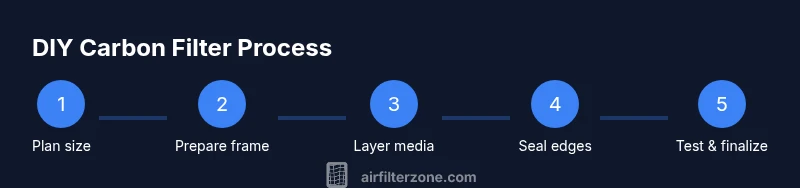
- 1
Measure and plan frame size
Measure the available opening and decide on a frame that accommodates the media stack without leaving gaps. Mark cut lines on your frame material to ensure clean joints.
Tip: Plan for a small clearance (2–5 mm) around the edges to accommodate gasket material. - 2
Prepare the frame and supports
Cut the frame pieces to size and install a mesh or perforated support to keep carbon media evenly spaced. Confirm a flat, stable base to avoid lean when assembled.
Tip: Dry-fit components before applying adhesive to ensure proper alignment. - 3
Layer carbon media and pre-filter
Place a pre-filter layer, then add the carbon media in a loose but evenly distributed layer. Avoid compacting the carbon; allow air to pass through its pores.
Tip: Use a light hand when placing carbon to prevent clumping. - 4
Seal edges to prevent bypass
Apply gasket material or adhesive around the frame margins to seal gaps. Ensure the carbon layer remains undisturbed during sealing.
Tip: Press firmly along the entire seal to avoid leaks. - 5
Attach housing and finalize
Secure the carbon stack inside the frame, attach the outer housing, and ensure there is a clear intake and outlet. Confirm there are no visible gaps.
Tip: Label the intake and outlet to avoid reversing airflow later. - 6
Test airflow and performance
Power up the system and observe airflow; listen for unusual resistance and check for bypass leaks. If airflow is weak, re-check seals and frame fit.
Tip: Perform a quick odor test with safe ambient scents to validate adsorption.
FAQ
Can a DIY carbon air filter be effective for all odors?
DIY carbon filters can reduce many common odors and VOCs when properly sized and sealed, but they may not remove every odor type or replace a professionally designed system for large spaces.
A DIY carbon filter can reduce many odors when sized and sealed correctly, but it might not handle every odor type or replace a professional setup in large spaces.
Is it safe to reuse activated carbon from other sources?
Reuse is not recommended if the carbon has been exposed to moisture, contaminants, or odors. Replace with fresh carbon to maintain adsorption efficiency.
Reuse isn't recommended if carbon has moisture or contaminants. Use fresh carbon for best adsorption.
Should I add a pre-filter when constructing a DIY carbon filter?
Yes, a pre-filter helps capture larger particles and protects the carbon layer, extending its life and maintaining airflow.
Definitely use a pre-filter to protect the carbon and keep airflow steady.
Can a DIY carbon filter be used in an HVAC system?
DIY carbon filters can be used for light-duty filtration in small systems if properly sized and sealed, but improper installation may reduce efficiency or cause leaks.
It's possible for some small setups, but size and seal accuracy are crucial to avoid leaks.
Where can I source activated carbon for this project?
Look for activated carbon labeled for air filtration at hardware stores or industrial suppliers; avoid charcoal briquettes not intended for filtration.
Check hardware stores or suppliers for air-filtration activated carbon; avoid using briquettes meant for grilling.
Watch Video
Quick Summary
- Choose food-grade activated carbon for safety
- Use proper media layers to maximize adsorption
- Seal edges to prevent bypass
- Test airflow and leak integrity
- Customize size to fit your space