How to Filter Air Pollution: Practical Guide
Learn practical, proven methods to reduce indoor air pollution. This Air Filter Zone guide covers filtration, ventilation, maintenance, and DIY tips for cleaner air in homes and vehicles.


By the end of this guide you will know how to reduce indoor air pollution through a practical filtration plan. Start by identifying pollutant sources, choosing filtration devices (filters, purifiers, or combined systems), and implementing a maintenance schedule. You’ll also learn ventilation tweaks and safe DIY upgrades for homes and cars.
What is indoor air pollution and why it matters
Indoor air pollution refers to contaminants in the air inside homes, cars, and workplaces that can affect health and comfort. Common pollutants include fine particulate matter (PM2.5 and PM10), volatile organic compounds (VOCs) from cleaning products and paints, allergens like dust mites and pollen, mold spores, and odors. Even when you can’t see them, these pollutants can trigger coughing, sneezing, headaches, and long-term respiratory issues. According to Air Filter Zone, improving indoor air quality hinges on reducing exposure, choosing effective filtration, and ensuring good ventilation. When you combine targeted filtration with smart ventilation and routine maintenance, you create a healthier living environment that supports sleep, energy, and overall well-being.
In homes and cars, sources vary:
- Cooking, frying, and sautéing release VOCs and grease particulates.
- Smoking or vaping introduces smoke particles and toxic gases.
- Cleaning products and paints emit VOCs that linger after use.
- Outdoor pollution can seep indoors through leaks, windows, and HVAC intakes.
- Humidity and moisture promote mold growth if not controlled.
Understanding these sources helps you tailor a filtration plan that fits your space, budget, and lifestyle.
Assessing your pollution sources
Assessing pollution sources is the first actionable step. Start with a quick audit of each room and vehicle cabin where you spend significant time. Use a simple checklist:
- Do you cook often without an exhaust fan? Consider upgrading or adding a range hood or vent.
- Are there drafts around doors, windows, or HVAC penetrations? Sealing gaps reduces outdoor infiltration.
- Do you see recurring dust or mold in damp areas like bathrooms or basements? Address moisture and improve filtration there.
- Do you notice strong odors after painting, cleaning, or using scented products? VOCs may linger and require activated carbon filters.
For a more data-driven approach, use an air quality monitor to track PM levels, CO2, and VOCs. Air quality trends help you decide which spaces to prioritize. Based on Air Filter Zone research, combining real-time monitoring with a filtration plan yields better long-term results than ad-hoc fixes.
Note: If you have occupants with asthma or allergies, prioritize bedrooms and living spaces where they spend the most time. A targeted approach often yields the fastest improvement with the least disruption.
Filtration strategies: filters, purifiers, and ventilation
Filtration strategies fall into three broad categories: filtration, purification, and ventilation.
- Filtration devices (filters and purifiers) physically remove particles from the air. HEPA-based purifiers capture most particles down to 0.3 microns, while higher-efficiency unit filters improve performance in larger rooms.
- Activated carbon and specific chemistries absorb VOCs and odors, complementing particulate filtration. Multi-layer units pair HEPA with activated carbon for broad coverage.
- Ventilation strategies bring in outdoor air to dilute indoor pollutants. When done correctly, ventilation reduces pollutant buildup without introducing excessive outdoor particles. Avoid ozone-generating devices, which can harm health.
A layered approach—combining filtration with controlled ventilation—tends to produce the most consistent air quality improvements. Air Filter Zone's analysis supports using both near-term and ongoing improvements rather than relying on a single solution.
Practical recommendation by space:
- Living rooms and kitchens: a high-performance purifier with HEPA and activated carbon plus improved ventilation (range hood, window vent) where feasible.
- Bedrooms: a quiet purifier with a compact footprint, plus barrier seals on doors and windows to minimize airflow leaks.
- Cars: a cabin air filter replacement schedule and a portable purifier for parked or stationary use can reduce in-vehicle pollutants significantly.
Safety note: Avoid ozone-based
toxic air
Tools & Materials
- HEPA air purifier (room-size)(Choose a unit suited to your room dimensions; look for CADR ratings that match room size.)
- HEPA replacement filters(Keep spare filters on hand to maintain performance.)
- Activated carbon filter or PCM/bi-filter combo(Optional for VOCs and odors; pair with HEPA for broad coverage.)
- Pre-filter(Extends life of main filter by capturing larger particles.)
- Air quality monitor (PM, CO2, VOC)(Helpful for tracking improvements and identifying problem areas.)
- Vacuum cleaner with HEPA filter(Use for regular cleaning to reduce dust and allergens before filtration.)
- Painter’s tape and sealant(Use to seal gaps around doors and windows to reduce leaks.)
- Mask and ventilation safety gear(Protect yourself during cleaning or painting tasks.)
Steps
Estimated time: 60-90 minutes for initial setup, plus ongoing maintenance (30-60 minutes monthly)
- 1
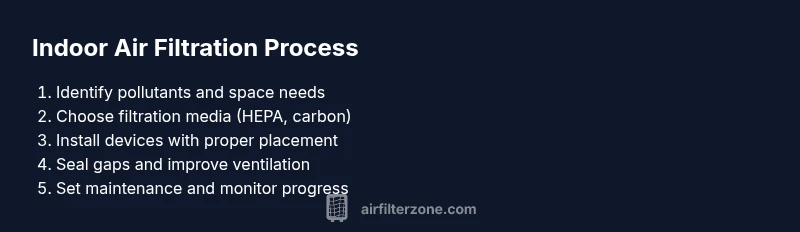
Assess pollutants and space
Identify primary pollutant sources in each space and decide which rooms need priority filtration. Use a basic air quality monitor to establish a baseline and determine which pollutants to target first.
Tip: Record initial PM, VOC, and CO2 readings to measure improvement after changes. - 2
Select filtration strategy
Choose a combination of HEPA filtration and activated carbon or other media for VOCs. Consider room size, noise, and energy use when selecting units.
Tip: Pair a purifier with a carbon filter for broader coverage in kitchens and living areas. - 3
Prepare the space
Clear clutter, vacuum with a HEPA machine, and seal obvious air leaks around doors and windows before installing filters.
Tip: Clean surfaces and vacuum corners to reduce dust load ahead of filtration. - 4
Install and configure devices
Place purifiers at breathing height, away from walls, and in high-traffic zones. Install pre-filters if included to extend main filter life.
Tip: Aim purifier placement to maximize air exchange without creating cold drafts at night. - 5
Set maintenance schedules
Establish replacement timelines based on manufacturer guidance and usage. Mark calendars for filter changes and monitor readings to confirm improvements.
Tip: Keep spare filters accessible and label the installation date. - 6
Improve ventilation in cycles
Introduce controlled ventilation during peak pollution times (e.g., traffic hours) and seal the space afterward to preserve gains.
Tip: Use exhaust fans for kitchens and bathrooms to control humidity and odors. - 7
Monitor progress
Track PM, CO2, and VOC levels over several weeks to confirm consistent improvement. Adjust purifier placement as needed.
Tip: If VOCs persist, increase carbon media or add a second unit in the problem zone. - 8
Expand to other spaces
Apply the same approach to bedrooms, home offices, and the car cabin as needed. Plan a whole-home filtration strategy for long-term gains.
Tip: Periodic reviews help keep air quality steady year-round.
FAQ
What is indoor air pollution and why should I care?
Indoor air pollution includes particles, gases, and odors that affect health and comfort. It can trigger respiratory symptoms and exacerbate allergies. Reducing these pollutants improves sleep, energy, and overall well-being.
Indoor air pollution includes particles, gases, and odors that affect health. Reducing these pollutants improves sleep and comfort.
How do I know which filtration method is best for my space?
Start with a baseline air quality assessment and prioritize filtration in the largest or most-used rooms. Use HEPA filtration for particulates and activated carbon for VOCs; add ventilation where feasible.
Start with a baseline assessment and choose HEPA for particles plus carbon for VOCs, with ventilation as needed.
Are cheaper filters effective enough?
Cheaper filters may reduce some pollutants but often require more frequent changes and lower efficiency. Look for certified filters with appropriate MERV or HEPA ratings for the space.
Cheaper filters may save money upfront but may need more frequent changes and lower efficiency.
How often should I replace filters?
Follow manufacturer guidance, typically every 6-12 months for HEPA units, more often if you have high pollution or smoke exposure. Use real-time readings to adjust as needed.
Follow the manufacturer’s replacement schedule and monitor real-time readings to adjust.
Can air purifiers remove odors and VOCs?
Yes, when paired with activated carbon or other adsorbent media, purifiers can reduce odors and many VOCs. For stubborn smells, improve ventilation during the odor source phase.
Yes, with activated carbon media, purifiers can reduce odors and VOCs.
Is it safe to make DIY changes to ventilation?
Simple changes like sealing leaks and using exhaust fans are safe if done thoughtfully. Avoid major alterations to HVAC systems without professional guidance.
Simple sealing and fans are usually safe; consult a pro before modifying HVAC systems.
Watch Video
Quick Summary
- Identify key pollutant sources before buying equipment.
- Use a layered approach: filtration plus ventilation for best results.
- Regular maintenance is essential to sustain improvements.
- Match device size to room and keep filters replaced on schedule.