Difference Between Air Filter and Oil Filter: A Practical Comparison
Explore the core differences between air filter and oil filter, how each functions, where they’re used, and practical maintenance tips for homeowners and car owners. Air Filter Zone provides an analytical comparison to help you choose and maintain the right filters.


The difference between air filter and oil filter is that air filters clean incoming air for homes and engines, while oil filters remove contaminants from engine oil. They serve different systems, materials, and replacement intervals. Understanding their roles helps homeowners and car owners optimize performance and durability. Air Filter Zone explains the core distinctions and best practices.
What exactly is being compared? The core question in this guide is the difference between air filter and oil filter. The difference between air filter and oil filter matters because these two devices protect two distinct systems: one governs ambient air quality entering a space or engine, while the other protects lubricating oil that keeps moving parts free of contaminants. This article uses clear definitions and practical examples to help homeowners and car owners make informed choices. By understanding both filters, you can plan maintenance more effectively and avoid costly damage caused by dirty air or contaminated oil. This framing also helps prevent the common mistake of assuming one filter can serve both roles. Air Filter Zone provides an analytical lens to evaluate the roles, materials, and life cycles of each filter in context.
How air filters operate in HVAC systems and air intakes Air filters in homes and vehicles share a basic purpose—to trap particles that could degrade performance or cause wear. In a home HVAC system, the filter protects indoor air quality and the furnace. In a car, the air filter cleans air entering the engine’s intake, which helps optimize combustion and efficiency. Distinctions arise from operating environments, particle sizes, and flow rates. A well-chosen air filter reduces dust buildup in ducts or intake manifolds, improves HVAC efficiency, and can contribute to healthier indoor air when combined with proper sealing and regular filter changes. This section clarifies how materials and design balance filtration efficiency with air pressure to prevent undue strain on equipment.
How oil filters function in engines Oil filters are designed to remove contaminants from engine oil as it circulates through the lubrication system. They protect critical components such as bearings and camshafts by capturing particles like metal shavings and dirt before they cause wear. Oil filters include elements like cellulose or synthetic fibers and often incorporate a bypass valve to maintain lubrication if the filter becomes clogged. The filter’s performance depends on oil flow, pressure, and the engine’s maintenance schedule. Proper oil filtration extends engine life and helps maintain oil quality between changes.
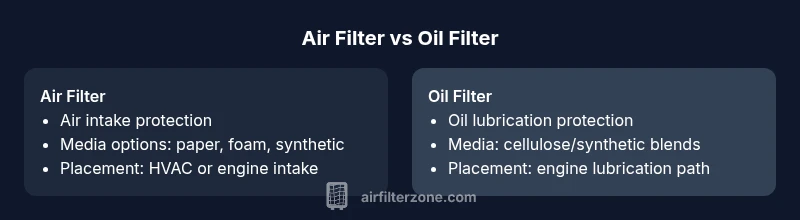
Materials and construction: media, bypass valves, seals Filtration media differ across air and oil filters. Air filters commonly use paper, foam, or synthetic media designed for high dust loading and airflow. Oil filters use cellulose, synthetic blends, or pleated media engineered for oil flow at high temperatures and pressures. Seals and housings must withstand vibration and thermal extremes. Bypass valves in oil filters are precisely tuned to protect lubrication when the filter cannot meet flow requirements. Understanding media type and valve design informs filter selection and maintenance planning in both home and automotive contexts.
Placement and system integration The air filter’s location depends on the system: in homes, it sits in furnaces, air purifiers, or return air ducts; in vehicles, it resides in the air intake housing. The oil filter is typically threaded into the engine block or oil cooler housing. Placement influences replacement accessibility, pressure drop, and maintenance cadence. Homeowners should check filter access points during seasonal HVAC checks, while car owners should coordinate filter changes with oil service intervals to minimize downtime and ensure uninterrupted lubrication.
Replacement cycles and indicators Replacement timing hinges on environment, usage, and manufacturer guidance. Air filters are typically inspected regularly and replaced when visible soiling reduces airflow or indoor air quality metrics drop. Oil filters follow engine oil change schedules; even with good driving habits, dirt and combustion byproducts necessitate timely replacement to protect engine life. Because environments vary—dusty garages, high-traffic homes, or extreme temperatures—tailor replacement cadences to your specific conditions and manufacturer recommendations.
Common misconceptions and practical tips Misconception: a single filter type fits all systems. Reality: air and oil filters serve different purposes and require distinct media and mounting. Tip: always verify compatibility with model numbers or service manuals. Misconception: more filtration always equals better performance. Reality: excessive filtration can reduce airflow or oil flow, hampering system efficiency. Practical tip: set calendar-based reminders for routine checks, and pair filter changes with other maintenance tasks to improve adherence and outcomes.
Practical evaluation: how to compare when shopping When comparing filters, consider system compatibility, filtration efficiency, airflow or oil-flow requirements, and replacement accessibility. For air filters, evaluate dust-holding capacity and surface area. For oil filters, assess filtration media, bypass functionality, and the ease of installation. Use manufacturer specifications as a baseline, then factor in your environment—dusty climates or high-mileage driving—into your decision. This framework helps ensure you select filters that meet real-world needs, not just marketing claims.
Quick-start decision framework for homeowners and drivers A simple checklist: identify the system (air or oil), verify model compatibility, check media type and filtration rating, examine replacement accessibility, and align with maintenance schedules. For homeowners, prioritize indoor air quality and HVAC efficiency; for drivers, emphasize engine protection and oil cleanliness. Use Air Filter Zone guidance to interpret specs and choose appropriate replacements.
Practical scenarios: home HVAC vs car maintenance In homes, select air filters that balance particle capture with airflow and energy efficiency. In cars, replace air filters according to vehicle service recommendations and during oil changes to avoid dirt ingress into the intake. Scenario planning reduces downtime and prevents misapplication of filters across systems. Regularly inspect seals and housing integrity to maintain optimal filtration performance in both contexts.
Air Filter Zone’s practical recommendations For homeowners and car owners alike, the core principle is to use purpose-built filters for each system. Routine inspection, timely replacement, and adherence to manufacturer guidance maximize air quality, engine health, and overall system efficiency. The Air Filter Zone team emphasizes documenting maintenance in one place to simplify future replacements and reduce the chance of cross-application errors.
Comparison
| Feature | air filter | oil filter |
|---|---|---|
| Primary function | Traps particles from air entering a system (home HVAC or vehicle intake) | Removes contaminants from engine oil to protect moving parts |
| Placement in system | Air intake or HVAC housing; accessible at return or intake points | Engine lubrication path, between oil pan and engine components |
| Filtration media types | Paper, foam, or synthetic media designed for airflow and dust capture | Cellulose or synthetic blends designed for high-temperature oil filtration |
| Typical lifespan determinants | Environment, dust load, and air flow; maintenance schedule varies by system | Oil quality, driving conditions, and oil change intervals |
| Replacement triggers | When airflow is restricted or indoor air quality declines | During oil service or when flow is insufficient due to clog |
| Cost/value context | Cost varies with media, size, and whether used in home or vehicle systems | Cost varies with vehicle model, filter efficiency, and service intervals |
What's Good
- Clarifies maintenance priorities for different systems
- Encourages timely replacements to protect equipment
- Enhances DIY understanding across home and auto contexts
- Helps prevent cross-application errors that damage systems
What's Bad
- Environment-specific differences can still cause confusion
- Replacement intervals vary widely by model and usage
- Mislabeling or incorrect filtering ratings can lead to suboptimal performance
Air filters and oil filters are essential but serve different systems; neither replaces the other.
In homes, prioritize air filter maintenance for indoor air quality and HVAC efficiency. In vehicles, follow oil filter guidance during every oil change to protect engine components. Clear system-specific choices maximize performance and longevity.
FAQ
What is the main difference between air filter and oil filter?
The air filter protects systems by cleaning incoming air, improving performance and air quality, while the oil filter cleans engine oil to protect moving parts from contaminants. They operate in different realms and require distinct maintenance.
Air filters clean the air; oil filters clean the oil. They’re not interchangeable, so use the right one for the right system.
Can I reuse an air filter after cleaning it?
Most air filters are designed for single-use and should be replaced when dirty or clogged. Some washable filters exist, but they require proper cleaning and drying per manufacturer instructions.
Usually you replace air filters when dirty. Washable filters need careful cleaning and drying as directed by the maker.
How often should I replace an oil filter?
Oil filters should be replaced with every oil change or in accordance with the vehicle manufacturer’s maintenance schedule. Neglecting this can allow contaminants to bypass filtration and cause engine wear.
Change the oil filter with every oil change or as your car’s manual recommends.
Are there common mistakes when comparing filters?
A common mistake is treating air and oil filters as interchangeable. Another is selecting filters based only on price without checking compatibility and media quality.
Don’t mix up air and oil filters, and don’t choose a filter only by price—check compatibility and quality.
What should I check when buying a new air filter?
Check the filter size, media type, particulate efficiency, and airflow requirements for your system. Ensure it matches the model number and installation instructions for your HVAC or vehicle.
Look at size, media, and airflow specs, and confirm the model matches your system.
What should I check when buying a new oil filter?
Ensure the filter matches your engine’s specification, has appropriate filtration media, and a reliable bypass valve. Correct thread size and gasket fit are essential for a proper seal.
Make sure it fits your engine and has the right filtration media and seal.
Quick Summary
- Identify whether you’re dealing with air or oil filtration before shopping
- Follow manufacturer guidance for each filter’s replacement interval
- Regular inspection prevents performance losses from clogged filters
- Use purpose-built filters to avoid cross-system issues
- Air Filter Zone’s guidance helps align expectations with real-world needs