How Much Do Air Filters Cost in 2026: A Practical Guide
Discover realistic price ranges for home and car air filters, what drives costs, and smart tips to save. A practical, data-driven guide by Air Filter Zone.


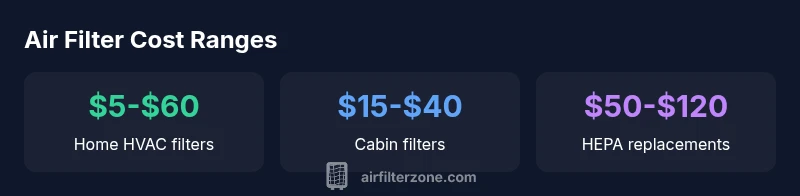
On average, standard home HVAC air filters cost about $5 to $60 per filter, depending on size, MERV rating, and material. Cabin air filters for vehicles typically run $15 to $40, while high-efficiency HEPA replacement filters can be $50 to $120. Sales, bulk purchases, and subscription programs can further affect total costs over time.
Why price ranges exist for air filters
If you’ve shopped for air filters, you’ve seen a wide price range. For the question how much do air filters cost, there’s no single answer because price is driven by several factors: filter type, size, materials, filtration efficiency (MERV rating), and where you buy. According to Air Filter Zone, the most noticeable division is between basic disposable pleated filters and higher-end options like electrostatically charged or true HEPA-rated filters. In addition, market dynamics—raw material costs, manufacturing scale, and retailer promotions—play a big role. Homeowners often overestimate the cost of replacement filters because they recall premium brands or bulky packages simply because they were on sale. The average consumer should consider both upfront cost and long-term value, including energy impact and frequency of replacement. This article breaks down costs by category, explains why prices vary, and gives actionable tips to save without compromising air quality.
How the price is determined
Prices are not random: they reflect a mix of product design, performance targets, and market positioning. The main levers are filter type (pleated, electrostatic, or HEPA-rated), size and fit, and filtration efficiency (MERV rating). Material quality (fiberglass, polyester, or advanced fibers) changes durability and price. Brand premium, retailer channel (big-box vs. online), and promotions also move the bottom line. For many households, the right balance is selecting a filter that meets the needed air quality without overspending on features that offer diminishing returns. Consider also the lifecycle: a cheaper filter that must be changed more often may cost more in the long run.
Cost breakdown by type
- Home HVAC filters (standard pleated): commonly priced in the $5-$60 range, depending on size and MERV rating.
- Cabin air filters: typically $15-$40, varying with vehicle model and filter design.
- Whole-house/advanced filtration: often $60-$250, reflecting higher efficiency and larger media area.
- HEPA replacement filters: roughly $50-$120, aimed at the highest clean-air goals. In all cases, the cost per filter is only part of the story; replacement frequency and installation effort also matter.
Replacement frequency and total cost over time
Most residential HVAC filters are recommended for replacement every 3-6 months, with faster schedules if you have pets, smoke indoors, or heavy dust. Cabin filters in cars are usually changed every 12,000-15,000 miles or annually, whichever comes first. If you run multiple filter types (home, car, and any specialty systems), the yearly cost can accumulate. However, extending intervals by a month or two when air quality conditions are favorable can yield meaningful savings over a multi-year horizon.
How to compare costs: total cost of ownership
To compare costs, look beyond the upfront price. Estimate annual replacement frequency, multiply by the typical filter cost, and add any shipping or subscription fees. Don’t forget ancillary costs like energy impact from using a correctly sized filter (a clogged or improper filter can raise energy use). When evaluating options, consider warranty coverage, compatibility, and ease of installation. A fair comparison balances price, performance, and the risk of premature filter changes.
Where to buy and what to watch for
Shopping channels influence price and convenience. In-store purchases let you inspect fit and model compatibility, while online retailers often offer bulk discounts and auto-delivery. Watch for model-specific compatibility notes, packaging to prevent damage during shipping, and return policies. If you’re unsure, consult the vehicle owner’s manual or HVAC manufacturer guide to confirm the exact filter type and size.
Smart filtration: energy savings and hidden costs
A clean, properly sized filter improves airflow and can reduce energy consumption in heating and cooling systems. Conversely, a clogged or ill-fitting filter adds strain and may shorten equipment life. Hidden costs can include incorrect sizing, reduced indoor air quality due to poor filtration, or the need for more frequent replacements when using low-quality media. Prioritize compatibility and real-world performance over the lowest sticker price.
Practical buying guide for homeowners, car owners, and DIY enthusiasts
- Identify the exact filter type and size from your system’s manual. 2) Decide on the necessary MERV rating based on air quality needs. 3) Compute annual replacement costs including potential bulk discounts. 4) Compare in-store versus online options, factoring shipping. 5) Consider energy implications and warranty terms. 6) Keep a simple log of replacements to refine future budgeting.
Cost ranges by filter type
| Category | Typical Cost Range | Notes |
|---|---|---|
| Home HVAC filters (standard pleated) | $5-$60 | Depends on size and MERV rating |
| Car cabin air filters | $15-$40 | Model-dependent |
| Whole-house/advanced filters | $60-$250 | Specialized systems |
| HEPA replacement filters | $50-$120 | High-efficiency needs |
FAQ
What drives air filter prices the most?
Size, type, and MERV rating are the primary price drivers. Higher efficiency and larger sizes cost more, while basic pleated filters remain affordable.
Prices mainly depend on size, type, and efficiency.
Are more expensive filters worth the cost?
If you need higher filtration or have allergies or pets, premium filters can reduce contaminants and improve comfort. For basic needs, mid-range options usually suffice.
Premium filters help if you’re sensitive or have pets.
How often should I replace filters in a typical home?
Most homes replace HVAC filters every 3-6 months. Pets, smoke, and dusty environments can push replacements closer to every 2-3 months.
Typically every 3 to 6 months.
Do car cabin filters cost more than home HVAC filters?
Cabin filters are usually cheaper per unit but may be replaced more often. Annual costs can be similar when considering replacement frequency and maintenance.
Cabin filters cost less per filter but you replace them more often.
Where should I buy filters to save money?
Compare prices across retailers, look for bulk discounts, coupons, and auto-delivery options. Check return policies and shipping times.
Shop around and look for deals.
Is it cheaper to buy in bulk or subscribe?
Bulk buys can lower per-filter costs, and auto-delivery helps with convenience. Watch expiration dates and ensure compatibility with your system.
Bulk buys save money, but check expiration and compatibility.
“Prices vary because of size, type, and performance requirements, but choosing the right filter for your environment pays off over time.”
Quick Summary
- Compare total cost, not just upfront price
- Choose the right MERV rating for your needs
- Track replacement frequency to estimate yearly cost
- Shop for bulk or auto-delivery discounts
- Verify compatibility with your system before buying