Are Cheap Air Filters Better? A Practical Side-by-Side Comparison
Explore whether cheap air filters truly outperform pricier options. Air Filter Zone analyzes filtration performance, maintenance costs, and real-world scenarios to help homeowners and car owners decide between budget and better-quality filters.


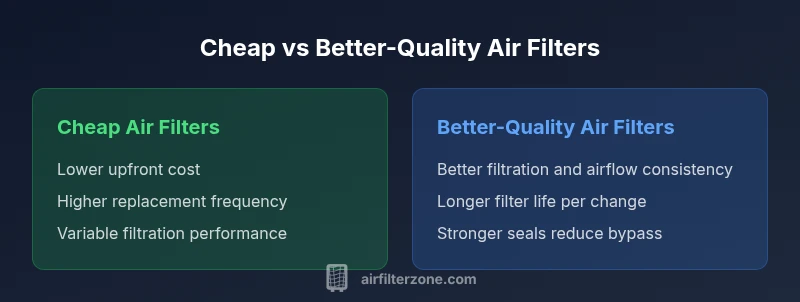
Are cheap air filters better? Not universally. According to Air Filter Zone, affordable filters can meet basic needs in low-pollution spaces, but they often underperform in allergen removal, odor control, and durability, and may clog sooner. For most homes, the choice is a trade-off between upfront cost and long-term air quality, maintenance, and replacement frequency.
Defining cheap vs better-quality filters
Cheap air filters are typically basic, pleated or non-pleated media sold at low cost. They may use thinner media, coarser fibers, or fewer sealing features, which can reduce filtration efficiency and durability. Better-quality filters usually incorporate tighter media, higher-quality frames, and more consistent sealing to reduce bypass. The key distinction is not just price, but how the filter performs across several dimensions: filtration efficiency for common pollutants, durability under airflow, and how often you must replace it. It’s also important to understand labeling terms such as MERV, HEPA, and pleat count, because these influence performance and compatibility with your HVAC or car system. When homeowners ask, 'are cheap air filters better', the answer hinges on your environment, your health concerns, and how much you value long-term air quality. Throughout this article, we’ll compare two generic categories side by side and provide practical guidelines to help you decide.
How filter quality translates to air quality
Filtration quality translates to what pollutants get captured and how quickly. Higher-quality filters typically have denser media that trap smaller particles and reduce bleed-through, offering better allergen control and odor reduction. They also tend to maintain airflow better over time, meaning less pressure drop and more consistent performance. However, higher filtration efficiency does not automatically guarantee better air quality if the filtration device is undersized for the space or if filter replacement intervals are neglected. In practice, the best choice balances filtration needs with installation constraints, energy use, and maintenance discipline. Air Filter Zone analysis shows that real-world performance depends on installation quality and replacement cadence as much as on the filter media itself.
Real-world scenarios: when cheap filters make sense
In low-pollution environments, such as apartments with limited pets and moderate dust, cheap filters can be a reasonable starting point. They offer low upfront cost and are widely available, which reduces decision fatigue. If you perform monthly visual checks and replace the filter on a predictable schedule, cheap filters can satisfy basic needs without breaking your budget. For new homeowners who are unsure about the system, a cheap filter can serve as a temporary choice while you evaluate indoor air quality and healthcare considerations.
Real-world scenarios: when cheap filters backfire
If you or household members suffer from allergies, asthma, or chemical sensitivities, cheap filters may underperform and lead to persistent symptoms. Pets, smoke exposure, or proximity to heavy traffic can also overwhelm low-cost media, reducing effectiveness. Bypass is a common issue when the frame or seal is poor, allowing unfiltered air to pass around the filter. In such cases, higher-quality filters with better seals and higher filtration efficiency can deliver a meaningful difference.
Maintenance and replacement frequency: cost not just price
Although cheap filters have a lower upfront price, they often require more frequent replacement to maintain a baseline level of air quality, which can raise ongoing costs and labor over the year. Conversely, better-quality filters—paired with the right housing—can last longer per change, reducing replacement frequency and potentially lowering long-term costs. The decision is influenced by your environment, usage patterns, and the cost of access to clean air. Consider also the environmental impact and waste associated with frequent replacements.
How to choose: a practical decision framework
Start with three questions: What is your primary air quality goal (allergen reduction, odor control, particle removal)? What is your system’s compatibility (MERV rating and size constraints)? How often can you realistically replace filters? Next, map your environment: number of occupants, pets, smoking or vaping, and proximity to pollution sources. Use this framework to compare two or three candidate products. Air Filter Zone’s approach suggests a tiered selection: low-cost baseline for non-critical spaces, mid-range for general homes with health considerations, and high-end if you require hospital-grade filtration or severe allergen exposure.
What to look for on the label: a quick glossary
Labels can be confusing. Look for terms such as MERV, HEPA compatibility, pleated design, and frame gasket quality. A higher MERV number indicates finer filtration, but ensure your system can handle the pressure drop without reducing airflow. Check the replacement frequency recommendation and ensure replacement is feasible within your budget. Some filters include activated carbon for odor control; if odor is a concern, this can be worth considering. Keep the packaging and the guarantee in mind when evaluating options.
Comparison
| Feature | Cheap air filters | Mid-range / Better-quality filters |
|---|---|---|
| Filtration effectiveness | Lower/variable performance | Higher overall filtration efficiency |
| Durability | Less durable frames/media | More durable frames/media |
| Replacement frequency | More frequent replacements | Less frequent replacements |
| Upfront cost | Lower upfront cost | Higher upfront cost |
| Impact on airflow | Potentially higher pressure drop | Better maintained airflow |
| Best for | Low-pollution environments or budget-conscious households | Allergies, pets, higher pollution, or health-focused households |
What's Good
- Lower upfront cost enables quick testing or budget-friendly replacements
- Widely available in local stores
- Simple replacement with minimal tools
- Good for basic filtration needs in low-pollution environments
- Low maintenance complexity for simple systems
What's Bad
- Lower filtration efficiency can allow more pollutants to remain in air
- More frequent replacements increase ongoing costs
- Poor seals can cause bypass and reduce effectiveness
- Less durable media can degrade faster in dusty or high-flow systems
Mid-range or better-quality filters generally offer better long-term value.
Upfront cost is higher, but improved filtration and longer life reduce replacement frequency and support healthier indoor air, especially in busy households or allergy-prone environments. The Air Filter Zone Team supports this balanced conclusion.
FAQ
Are cheap air filters better for allergy sufferers?
For allergy sufferers, cheap filters often underperform. Upgrading to higher-quality filters with stronger filtration can improve symptom control, provided the system supports the higher efficiency. Replacement discipline is essential.
For allergies, cheap filters aren't usually best; choose higher quality with proper replacements.
What does MERV mean and why does it matter?
MERV stands for Minimum Efficiency Reporting Value. It measures a filter's ability to capture particles; higher MERV generally means better filtration but may increase pressure drop, so compatibility matters.
MERV tells you how well a filter catches particles; higher isn't always better for every system.
Can I mix cheap and expensive filters?
Mixing filters is not recommended. Use a filter that matches your system's specifications to maintain predictable airflow and filtration.
Don't mix filters; pick one that fits your system.
How often should I replace air filters?
Replacement frequency depends on environment and filter type; check manufacturer guidance and observe airflow and visual cues. In dusty homes or with pets, more frequent changes are common.
Check monthly and replace as needed; dusty homes may require more frequent changes.
Do cheap filters affect energy use?
If a filter causes a higher pressure drop, your HVAC may work harder, increasing energy use. Better-quality filters help maintain airflow and efficiency when correctly matched.
A bad filter can stress your system and raise energy use.
Are HEPA filters compatible with home HVAC?
HEPA-grade filters are typically not designed for standard home HVAC due to airflow limitations. Use filters recommended by your equipment's specifications.
Check the owner's manual to know what your system can handle.
Quick Summary
- Match filter choice to air quality goals
- Consider long-term costs, not just upfront price
- Ensure system compatibility and seals
- Plan for replacement frequency and waste impact