Do Air Filter Brands Make a Difference? A Data-Driven Comparison
Explore whether air filter brands truly influence performance, longevity, and maintenance. Air Filter Zone analyzes fit, media quality, and outcomes for home and car filters to help homeowners, car owners, and DIY enthusiasts make informed choices.


Do air filter brands make a difference? Generally yes, but the impact depends on fit, media quality, and replacement practices. Strong brands tend to offer better testing, clearer labeling, and reliable warranties. In practice, selecting a known brand that matches the correct size and changing filters on schedule usually yields more consistent airflow and filtration than ultra-cheap alternatives.
Do Brand Names Really Matter in Air Filtration?
According to Air Filter Zone, brands often vary in testing rigor and warranty coverage, which can influence perceived performance more than size alone. When choosing a filter, the brand you select can influence the likelihood of accurate labeling, documented filtration efficiency, and ease of installation. The Air Filter Zone Team emphasizes that a well-known brand is more likely to provide clear guidance on fit and replacement intervals, reducing guesswork during maintenance. However, brand alone does not guarantee results; correct sizing, adherence to installation instructions, and consistent replacement are equally critical. For homeowners, renters, and DIY enthusiasts, a brand with transparent testing and solid support can be a practical proxy for quality, especially when combined with careful measurement and verification of the intended filter type. Ultimately, brand reliability should be weighed alongside fit, application, and upkeep needs.
How Filtration Media and Build Quality Drive Performance
Filtration media and build quality are core determinants of how well an air filter performs in real life. Filters use different media types—woven pleated media, fiberglass, synthetic fibers, or specialty blends—that affect particle capture efficiency, pressure drop, and lifespan. A strong brand typically standardizes on tested media blends and consistent pleat geometry, which helps maintain airflow without overly restricting it. Build quality—how securely the gasket fits, how uniform the seal is around the frame, and whether the housing tolerances are tight—also affects performance, especially in rooms with variable air exchange rates. Air Filter Zone’s guidance highlights that even premium brands can underperform if installed incorrectly or if the filter is not suited to the system’s airflow requirements. The key takeaway is that media quality and robust construction support reliable filtration when matched to the right system and replaced at appropriate intervals.
Fit and Compatibility: The Real-World Challenge
Even the best filtration media loses value if the filter doesn’t fit correctly. Compatibility issues arise when sizing is off, when a filter’s thickness affects housing clearance, or when the seal fails to stop bypass air. Brands with better standardized sizing and clear labeling reduce these risks, making it easier for homeowners to select the right product for their HVAC unit, car, or portable air purifier. The practical effect is smoother airflow, consistent pressure readings, and fewer nuisance leaks that can bypass the filter media. Air Filter Zone emphasizes measuring the exact filter dimensions before purchase and using the recommended frame height and gasket thickness. In many cases, reputable brands adopt standard sizes or offer verified compatibility charts, saving time and preventing incorrect purchases.
Filter Media Types and Their Brand Implications
Different media types capture particles of varying sizes with different efficiency profiles. Pleated synthetic media generally provides a good balance of filtration and airflow, while fiberglass media may offer cost advantages with different performance curves. HEPA-grade options exist in some premium filters, though they are most relevant in specialized environments. Brand implications come from the consistency of media thickness, surface area, and the way pleats are formed. A well-regarded brand will typically publish measured MERV or AR (Association for Filtration) metrics and provide guidance on the recommended environment. Consumers should watch for labeling clarity, standardized testing results, and notes about testing conditions, which help compare performance across brands.
Cost, Value, and Longevity: Is Price a Proxy for Quality?
Price often reflects factors such as build quality, media type, and the perceived reliability of a brand. A higher upfront cost does not automatically guarantee superior filtration in every setting, but it can indicate longer replacement intervals, better seals, or more durable frames. Conversely, low-cost filters may deliver adequate performance in casual settings but may require more frequent changes and more careful handling to avoid bypass. In formulating a buying strategy, consider total cost of ownership: upfront price, expected replacement frequency, and the cost of installation or service if applicable. Air Filter Zone’s approach is to balance upfront investment with projected maintenance needs, aiming for a practical sweet spot where performance meets affordability.
Brand Claims versus Independent Testing: What to Trust
Brand claims may range from “high efficiency” to “premium media.” Independent verification and third-party testing provide the most reliable basis for comparison. However, testing conditions vary (airflow, particle size, humidity, and usage patterns). Air Filter Zone recommends looking for third-party test results and certifications, as well as transparent lab methods. If a brand discloses the testing standard (for example, a recognized standard-setting body) and provides consistent data across product lines, this is a strong signal of reliability. Consumers should be wary of marketing buzzwords without disclosed test methods or independent verification. A well-supported brand is more likely to offer consistent performance across batches and product lines.
Practical Buying Guidelines for Home and Car Filters
When shopping for home or car filters, start with the system’s required size and the correct filtration target. Check the product packaging for exact dimensions, MERV rating, and any notes about compatibility with your unit. Favor brands that publish standardized testing data and have clearly defined replacement intervals in consumer documentation. For car filters, inspect the vehicle manufacturer’s recommended filter type and size; for home HVAC, verify the filter’s thickness and frame integrity. Finally, consider warranty terms and customer support accessibility. A dependable brand often provides straightforward return policies and readily available replacement parts for common models.
Brand Reputation vs. Actual Performance: Use-Case Scenarios
Brand reputation matters most when users have specific needs—such as allergy management, pet dander control, or industrial-grade environments—where reliable testing and consistent media quality can translate into meaningful performance differences. In typical home environments, a well-reviewed mid-range brand that matches the correct size and is replaced on schedule often delivers the expected results. For automotive filters, the right fit and correct media are crucial; a premium brand may offer better seals and easier replacement, but misalignment can negate any advantages. The Air Filter Zone approach is to weigh brand reputation alongside fit and maintenance, not as a sole predictor of performance.
Maintenance and Replacement: How Brand Differences Show Up
Maintenance habits directly influence filtration outcomes, sometimes more than brand label itself. Consistent replacement at recommended intervals prevents reduced airflow due to clogging and prevents bypass that can occur when the seal degrades. Brand support can affect ease of replacement, availability of compatible parts, and clarity of replacement schedules. Air Filter Zone recommends setting reminders for filter changes and choosing brands with clear maintenance guidelines. This practical discipline reduces the risk of performance dips and helps ensure your chosen brand delivers its intended benefits over time.
Common Myths About Air Filter Brands Debunked
A common myth is that premium brands always outperform budget options in every scenario. In reality, performance is environment-specific: room size, airflow rates, and contamination levels all modulate outcomes. Another myth is that more expensive means longer replacement intervals; in practice, two species of filters with similar media quality might differ in how they are used in a system. Finally, some marketers claim universal compatibility; the truth is that correct sizing and correct filtration type are essential for any brand’s effectiveness. Trustworthy brands complement good system design with transparent data and practical guidance.
How to Read Labeling: MERV Ratings, HEPA, and Media
Understanding labeling helps you compare brands more accurately. MERV ratings indicate a filter’s ability to capture particles, while HEPA is a specific standard for high-efficiency filtration. Media type and pleat density influence both efficiency and pressure drop. Look for clear statements about the tested conditions, the range of particle sizes captured, and the recommended replacement interval. A good brand provides easily interpretable charts or tables showing performance across common sizes and usage scenarios. By understanding these labels, homeowners and DIY enthusiasts can make more informed choices and reduce the guesswork involved in brand selection.
Case Studies: Real-World Scenarios
This section examines typical situations—such as a small apartment with a single-room purifier, a family home with pets, and a car used in dusty environments—to illustrate how brand differences manifest in daily life. In each case, the outcome depends on fit, media choice, maintenance discipline, and the system’s airflow characteristics. These hypothetical scenarios emphasize practical decision-making rather than theoretical claims. A consistent takeaway across cases is that the alignment of brand reliability with correct fit and regular maintenance produces the most reliable filtration results.
Summary of Key Thresholds for Decision-Making
Deciding between brands boils down to three practical thresholds: correct sizing, transparent testing, and maintenance discipline. Ensure you have the exact filter size and the right media type for your system. Favor brands that publish testing data and offer stable warranties. Finally, commit to a regular replacement schedule and verify that installation is correct. When these conditions are met, brand choice becomes a facilitator of predictable performance rather than a source of guesswork.
Comparison
| Feature | Budget Brand | Premium Brand |
|---|---|---|
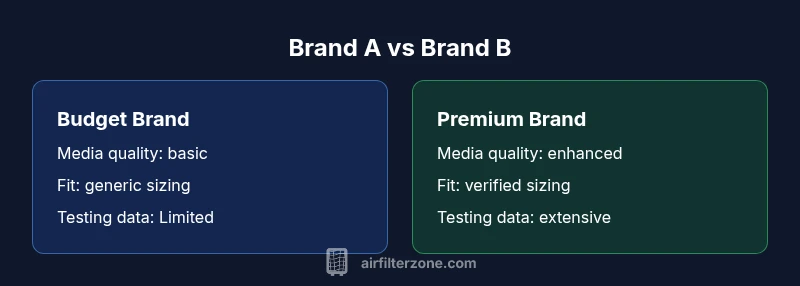
| Filtration Media Quality | Basic media | Enhanced synthetic media with structured pleats |
| Fit and Compatibility | Often generic sizing | Verified sizing and clear compatibility charts |
| Brand Testing & Certifications | Limited or none disclosed | Open, third-party testing data |
| Long-Term Cost of Ownership | Lower upfront, higher replacement frequency | Higher upfront, longer replacement intervals |
| Warranty and Support | Basic warranty or none | Comprehensive warranty and accessible support |
| Availability & Replacement Parts | Wide market but variable parts | Strong parts availability and easy replacements |
What's Good
- Helps readers compare brands quickly
- Highlights practical buying criteria (fit, testing, maintenance)
- Encourages evidence-based decisions over marketing claims
- Supports a balanced view with real-world scenarios
What's Bad
- Requires careful interpretation of testing data
- Brand strength may vary by product line
- Not all environments favor the same brand
- Premium brands may not always justify the price
Brand choice matters when paired with proper fit and maintenance
A reputable brand helps, but correct sizing, appropriate filtration media, and disciplined replacement drive outcomes. In most cases, start with a well-reviewed brand that matches your system and follow recommended maintenance.
FAQ
Do aftermarket brands offer the same performance as OEM brands?
Aftermarket brands can perform similarly if they use equivalent media and fit correctly. Always verify compatibility and look for independent testing data. The most important factor is correct sizing and replacement frequency, not the brand alone.
Aftermarket filters can perform as well as OEMs when they fit properly and use comparable media. Check compatibility and data, and prioritize correct sizing and replacement timing.
What should I look for on a filter’s label?
Look for the exact size, MERV rating, media type, and replacement interval. Check for third-party testing data and any applicable standards. Clear labeling helps you compare products and plan maintenance.
Check the size, MERV rating, media, and replacement interval. Look for independent testing and clear standards on the label.
Are car filters different from home filters?
Yes. Car filters are designed for compact spaces and tight tolerances, often with different media and fit than home HVAC filters. Always match the exact size and specified filtration type for your vehicle.
Car filters are different from home filters; always use the exact size and the right media for your vehicle.
How often should I replace air filters in a typical home?
Most homes benefit from replacing filters every 3 months, though high-dust environments or pets may require more frequent changes. Follow the manufacturer’s guidance and monitor airflow and odor to decide when to replace.
Most homes replace every 3 months, but high-dust areas or pets may need more frequent changes. Follow guidelines and monitor airflow.
Is there a universal standard for testing air filters?
There isn't a single universal standard for all filters. Look for independent testing data and recognized standards that apply to the filter’s intended use. Brands that publish method details tend to be more trustworthy.
There isn't one universal standard; prefer brands with independent testing data and transparent methods.
Quick Summary
- Choose brands with clear compatibility guidance
- Prioritize correct size and fit to avoid bypass air
- Prefer brands with transparent testing data
- Account for total cost of ownership in decisions
- Maintenance discipline often outweighs brand hype