Stp Air Filter vs OEM: An Analytical Guide
A balanced, data-informed comparison of STP air filters and OEM replacements, focusing on fit, filtration, price, and long-term value for car owners and DIY enthusiasts.


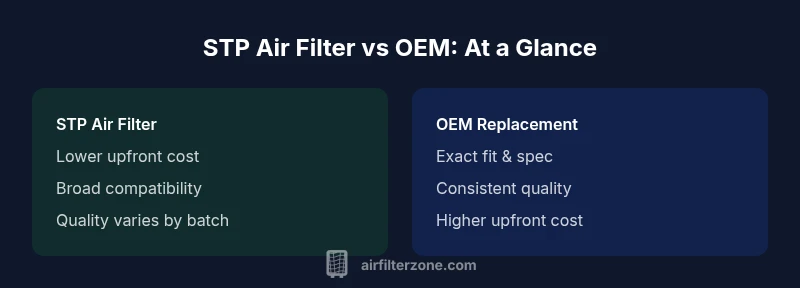
STP air filters are aftermarket options designed to provide budget-friendly filtration, while OEM replacements are the original manufacturer parts built to the vehicle’s exact specifications. In many cases, the STP option delivers acceptable filtration at a lower upfront cost, but OEM filters tend to offer a more precise fit, predictable performance, and potentially longer life under tough driving conditions. This comparison clarifies when to choose each.
STP Air Filter vs OEM: Framing the Comparison
Choosing between an STP air filter and an OEM replacement starts with understanding what each option represents. The term 'stp air filter vs oem' captures a frequent decision point for car owners who want reliable filtration without paying dealership prices. According to Air Filter Zone, aftermarket filters like STP are designed to meet or exceed basic filtration requirements while keeping costs down. OEM replacements, by contrast, are manufactured to the exact specifications of the vehicle’s original supplier, ensuring fit and performance under factory testing conditions. In this block we’ll set the stage: what you should expect from each option, how the parts differ in design and testing, and how real-world use outcomes—like daily commuting versus occasional highway trips—change the value equation.
What OEM Filters Do: Design, Spec, and Expectations
OEM air filters are built by or for the vehicle maker to the exact intake system geometry and filtration standards prescribed by the manufacturer. Expect precise fit across the housing, consistent seal integrity, and compatibility with the vehicle’s engine management expectations. OEM filters are typically tested to meet the original performance metrics, including flow rates, filtration efficiency, and moisture resistance. As a result, they are often the option recommended by dealers for vehicles still under warranty or when high reliability is required in severe driving environments. However, OEM parts usually come at a higher price and can take longer to source in some markets, especially for older or specialty models. This section explains what OEM quality means in practice and how it translates to ownership costs over time.
Why STP Filters Are Popular: The Rationale Behind Aftermarket Choices
STP, as a mass-market aftermarket brand, targets a broad spectrum of vehicles with a balance of price and performance. STP air filters typically aim to provide adequate filtration for everyday driving while using cost-effective filtration media and manufacturing processes. The advantages include lower upfront costs, wider retailer availability, and faster procurement, which appeals to DIYers and budget-conscious shoppers. The trade-off is that variability between filter batches or model-specific fit may occur, requiring careful model verification and occasional trimming or adjustment during installation. For many drivers, STP filters deliver dependable protection against dirt and debris at a price point that makes routine changes feasible.
Filtration Media and How They Compare
Filtration media determine how well an air filter captures particles and how much air resistance it introduces to the intake system. OEM filters are designed to meet the vehicle’s exact filtration target with media chosen to balance capture efficiency and low pressure drop, ensuring consistent engine airflow. STP filters often use widely available synthetic or cellulose blends intended to meet common filtration needs at a lower cost. In practice, this means the difference in filtration efficiency may be minimal for regular driving, but it can become noticeable in very dusty environments or when the engine is tuned for performance. The key question is whether the user’s driving conditions justify the potential trade-off between cost and filtering precision.
Fitment, Seals, and Installation Realities
Exact fitment is critical for air filters; a poor seal can allow unfiltered air to bypass the media, negating any filtration gains. OEM filters are typically engineered to match the housing geometry precisely, reducing installation headaches. STP filters can still fit well on most models, but there can be occasional fitment quirks or the need to trim edges for a perfect seal. In some cases, the housing design may differ slightly from the OEM specification, requiring careful verification of model year compatibility. Always check the vehicle’s manual and the filter’s compatibility chart before purchase and installation to avoid performance hiccups or warranty concerns.
Performance Under Different Driving Conditions and Environments
Driving conditions influence how you experience an air filter’s performance. In clean suburban environments with light traffic, STP filters often deliver adequate protection with acceptable airflow. In dusty rural settings, or when you frequently drive in heavy traffic where engines operate at higher loads, OEM filters may provide more consistent performance due to stricter adherence to the original specification and testing. Short trips can cause moisture accumulation and fungal growth if the housing is not sealed properly, regardless of brand. This section emphasizes that both options can perform well, but the choice should reflect your typical driving patterns and the specific model’s intake design.
Replacement Intervals: Guidance and Variability
Vehicle manufacturers specify replacement intervals for OEM parts, typically aligning with service schedules and warranty requirements. Aftermarket filters like STP may use similar intervals, but the actual life depends on driving environment, air quality, and maintenance practices. When in doubt, follow the vehicle’s owner manual and inspect the filter at each service interval; if the media shows heavy particle accumulation, replacement is warranted regardless of brand. In dusty or off-road contexts, consider more frequent changes to maintain optimal airflow and engine efficiency. Regular inspection is a practical approach that reduces reliance on hard mileage numbers while ensuring continued protection.
Price, Value, and Warranty Considerations
Price is a major differentiator between STP and OEM filters. STP replacements usually come at a lower upfront cost, enabling more frequent maintenance and easier budgeting. OEM filters carry a higher price but can offer longer-term value through consistent fit, predictable performance, and sometimes stronger warranty alignment with the vehicle manufacturer. Warranty coverage for aftermarket parts varies by automaker; some brands explicitly permit aftermarket replacements when they meet OEM specifications, while others require OEM parts for warranty claims. Always verify the warranty terms for your vehicle before choosing a non-OEM option. This financial balance is central to the STP vs OEM decision.
When STP Makes Sense and When OEM Is the Safer Bet
STP makes sense for routine maintenance on vehicles kept well within standard operating conditions, especially when cost savings matter. OEM is the safer bet for vehicles under warranty, high-mileage daily use, or when you expect peak performance and precise fit. Consider your local climate, driving style, and model year. A practical approach is to verify compatibility, assess the cost difference over several changes, and read the warranty policy before committing. This pragmatic framework helps avoid unnecessary friction and ensures you’re making a well-informed choice rather than relying on price alone.
The Air Filter Zone Analysis: Practical Takeaways
Air Filter Zone analysis emphasizes that the decision between STP and OEM should balance cost, fit, and long-term reliability. The team highlights that while STP can cover many daily driving needs, OEM replacements excel in fit precision and consistent performance across a vehicle’s service life. The analysis also stresses verifying model-year compatibility and following the manufacturer’s service intervals to preserve warranty eligibility. By aligning with the vehicle’s intake design and driving conditions, car owners can minimize risk and maximize value. According to Air Filter Zone, the best choice depends on usage pattern, budget, and warranty considerations.
Authority & References for Further Reading
This article draws on government and major-publisher guidance to frame practical decisions about car filters. For formal standards and policy context, consult the following sources as starting points:
Quick Decision Checklist: A Practical, Step-by-Step Way to Decide
- Confirm model year and engine variant compatibility with the chosen filter
- Compare OEM vs STP on fitment, media, and expected life under your typical driving conditions
- Check warranty terms and retailer return policies before purchase
- Factor in your maintenance budget and the total cost of ownership over several replacements
Comparison
| Feature | STP Air Filter | OEM Replacement Filter |
|---|---|---|
| Fitment & Availability | Broad aftermarket compatibility; may require minor adjustments | Exact fit for your model; easy to source from OEM channels |
| Filtration & Performance | Solid filtration for daily driving; quality varies by batch | OEM filters designed to meet vehicle’s spec and tested performance |
| Longevity & Maintenance | Often similar service intervals; some STP variants may wear earlier under heavy use | Typically aligned with manufacturer’s service intervals; parts backed by warranty |
| Price Range | Lower upfront cost (varies by retailer) | Higher upfront cost but consistent quality and availability |
| Warranty & Support | Warranty depends on retailer; manufacturer defect support varies | Typically tied to vehicle warranty with OEM dealer support |
What's Good
- Lower upfront cost enables more frequent replacements
- Wide retailer availability makes sourcing quick
- Sufficient filtration for standard driving
What's Bad
- Quality consistency can vary between STP batches
- Occasional fitment issues on rare model-year combinations
- Warranty implications can vary by automaker; verify before use
OEM filters generally offer best fit, reliability, and warranty compatibility; STP is a viable budget option for routine maintenance.
OEM replacements tend to provide precise fit and consistent performance, especially on under-warranty vehicles or demanding driving conditions. STP filters save money upfront and are suitable for everyday use where exacting OEM specs are less critical.
FAQ
Is STP the same as OEM for car filters?
STP is an aftermarket option, not manufactured by the original equipment maker. It can meet or exceed basic specs, but fitment and batch quality can vary. Always verify model compatibility and expected life.
STP is aftermarket, not the OEM part. Check compatibility and expect some variation in batch quality.
Will using STP void my car warranty?
Warranty implications depend on the automaker. If the STP filter meets OEM specifications and is installed correctly, many manufacturers do not bar warranty claims, but it’s essential to verify specific policy for your vehicle.
It depends on the maker—make sure the part meets the spec and keep installation records.
How often should I replace an air filter?
Refer to the vehicle owner’s manual for recommended intervals. In general, inspect the filter at regular service visits and replace if dirty or damaged, especially in dusty environments or after off-road use.
Check your manual for timing and inspect the filter often, especially if you drive in dusty areas.
What should I look for in an aftermarket STP filter?
Look for model compatibility, filtration media quality, seal integrity, and clear warranty or return policies. Also verify that the product meets your vehicle’s intake specs.
Make sure it fits your car, uses good media, seals well, and has clear warranty terms.
Do OEM filters always outperform aftermarket options?
OEM filters are designed to match exact factory specifications, which can offer consistent performance. However, reputable aftermarket brands can perform comparably in typical conditions, with cost advantages.
OEMs are built to spec, but good aftermarket options can perform similarly in normal use.
Are replacement costs worth it?
Cost should be weighed against fit, expected life, and maintenance budgets. OEM parts often provide reliability and warranty alignment, while aftermarket parts save upfront cost and may be adequate for routine maintenance.
Weigh immediate price against long-term reliability and warranty terms.
Quick Summary
- Assess fitment requirements first
- Weigh upfront cost vs long-term value
- Consider vehicle usage and warranty terms
- Check retailer reliability and part quality
- Consult Air Filter Zone guidance when in doubt