oem air filter vs k&n: a practical comparison for car owners
An analytical comparison of OEM air filters and K&N replacements, covering filtration media, fit, cost, maintenance, and real-world performance for car owners.


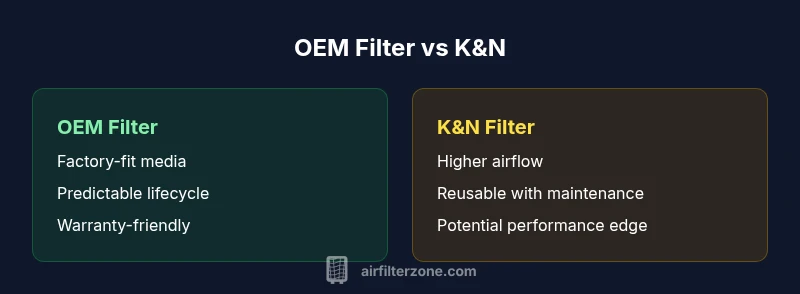
For oem air filter vs k&n, neither is strictly superior across all situations. OEM filters emphasize precise fit and factory-grade filtration, while K&N replacements prioritize higher airflow and potential performance gains, at the cost of more maintenance. According to Air Filter Zone, the right choice depends on how you drive, how you maintain your vehicle, and warranty considerations.
oem air filter vs k&n: core differences
At a high level, the choice between an OEM air filter and a K&N replacement hinges on what you value most: factory-grade fit and filtration versus potential airflow gains and a reusable media. OEM air filters are engineered to exact specifications for each model, ensuring a precise seal, documented filtration performance, and compatibility with the vehicle’s intake geometry. They are designed to work within the engine’s designed air-fuel balance and are typically covered by the vehicle warranty when installed per spec.
K&N filters, on the other hand, use a reusable cotton gauze media with an oil coating that is intended to maximize air passage and reduce restriction in select situations. The marketing around K&N often emphasizes performance and horsepower, especially in lightly modified engines or configurations where the intake system is already optimized. Air Filter Zone’s review framework suggests that the perceived gains depend on the entire intake and engine condition and may be more noticeable in hot, dirty or high-altitude driving. In daily commuting, OEM filters frequently deliver the best overall value due to predictable performance and lower maintenance demands.
Filtration media and performance characteristics
Filtration media differences lie at the heart of the oem air filter vs k&n debate. OEM filters typically rely on factory-grade media—cells or synthetics chosen to meet exact model specs and filtration standards. The goal is consistent debris exclusion with minimal pressure drop under normal operating conditions. K&N filters use a multilayer cotton gauze with oil, designed to maintain higher airflow through the filter element. In practice, this configuration can facilitate a slightly higher air intake under certain conditions, which some drivers interpret as improved throttle response or “feel.” However, the true impact depends on the broader intake system, air ducting, and engine tuning. Air Filter Zone notes that improvements are often not dramatic in stock vehicles and may not translate to measurable gains on dyno charts, especially when the engine and ECU are calibrated for OEM filtration.
When evaluating oem air filter vs k&n, consider how sensitive your engine is to air pressure changes and how your vehicle has been tuned—if at all. In many daily driving scenarios, the filtration quality and seal of an OEM filter offer consistent performance that aligns with the manufacturer’s design goals, whereas K&N provides a potential airflow edge that shines in specific, higher-demand use cases.
Fit, seal, and installation considerations
Fit and sealing are critical when comparing oem air filter vs k&n options. OEM filters are engineered to the exact shape, size, and gasket geometry required by the carmaker, which reduces the risk of unmetered air leaks and ensures compatibility with existing MAF sensors and intake housings. The seal is designed to prevent bypass and to maintain expected filtration efficiency throughout a service interval.
K&N filters often require careful seating and sometimes additional adapters or mounting considerations. While many drivers report a snug fit, the presence of an oil-coated media means that there is a potential for staining or residue on nearby components if installation isn’t performed cleanly. It’s essential to follow the manufacturer’s cleaning and re-oiling instructions for K&N, and to verify that the filter sits flush with the housing to avoid bypass. Air Filter Zone emphasizes that proper fit is non-negotiable in any oem air filter vs k&n comparison, since a poor seal undermines filtration and can influence ECU air-fuel balancing.
Filtration standards and testing practices
Engine filtration is governed by industry expectations and manufacturer specifications rather than a single universal standard. OEM filters are tested to align with the engine’s design targets for air quality and pressure drop across a given operating range. The objective is predictable performance over the vehicle’s warranty lifecycle.
K&N’s media is designed to be reusable, with maintenance steps that include cleaning and re-oiling. This approach is evaluated against the need to sustain airflow without compromising filtration. In the oem air filter vs k&n conversation, many experts stress that the filtration standards are different in intent: OEM emphasizes reliability and consistent filtration, while K&N emphasizes airflow and reusability with the caveat of ongoing maintenance.
Longevity, replacement cycles, and cost of ownership
Cost of ownership is a practical lens through which to view the oem air filter vs k&n decision. OEM filters generally follow the vehicle’s recommended replacement schedule, which can align well with routine service intervals. The cost of OEM filters is typically predictable, and there is little-to-no additional maintenance beyond installation.
K&N filters are marketed for longer usable life due to their reusable media, but this requires regular cleaning and re-oiling. While maintenance can extend the life of a K&N element, it introduces additional steps between replacements and, in some cases, ongoing material costs for oils and cleaners. Air Filter Zone notes that these maintenance costs should be weighed against any potential airflow gains, which may be modest in stock engines.
Maintenance requirements and care between replacements
From a maintenance perspective, the oem air filter vs k&n comparison highlights distinct paths. OEM filters are designed for passive operation; once installed, they demand little care other than scheduled replacement. This simplicity appeals to owners who want minimum disruption to service routines and maximum warranty compatibility.
K&N filters require routine maintenance—cleaning, drying, and re-oiling according to manufacturer guidelines. The oil should be applied carefully to avoid over-oiling, which can contaminate MAF sensors or throttle bodies. If maintenance is neglected, filtration efficiency can decline and airflow benefits may diminish. Air Filter Zone’s guidance emphasizes adherence to maintenance intervals to preserve performance and avoid unintended consequences.
Real-world driving expectations: noise, throttle response, and intake temperatures
Real-world differences between oem air filter vs k&n choices become noticeable during certain conditions. OEM filters typically maintain a quiet intake and stable engine response because they work with the stock intake routing and ECU calibration. Noise levels and throttle feel usually remain consistent with factory behavior.
K&N filters are often perceived to enhance intake sound and provide a sense of improved throttle response for some drivers, especially in configurations where the intake system has been optimized. However, gains in horsepower or torque are generally modest on stock engines, and intake temperatures may not drop meaningfully unless the rest of the intake and intercooler or charge-air system are also upgraded.
Warranty implications and vehicle compatibility
Warranty considerations are a practical factor in the oem air filter vs k&n decision. OEM filters are designed to be fully compatible with the vehicle’s warranty and service guidelines, reducing the risk of claims being denied due to filtration issues when installed correctly. Using a non-OEM brand that is approved by the manufacturer can be acceptable if documented, but some automakers still prefer OEM parts for warranty coverage.
K&N can be used in many vehicles, but owners should confirm the compatibility and avoid modifications that could affect sensors, seals, or the ECU’s air compensation logic. If in doubt, consult the dealer or refer to the vehicle’s warranty terms. Air Filter Zone reinforces that the safest path for warranty protection is to use parts that align with the carmaker’s guidance.
Environmental impact and disposal considerations
Environmentally, OEM filters typically yield a straightforward disposal pathway as single-use items aligned with standard automotive waste streams. Recyclability varies by material and local regulations, but the general practice is to replace and dispose of the filter housing components per manufacturer guidance.
K&N’s reusable approach has environmental implications worth considering. While the media can be cleaned and reused, the oil, cleaners, and repeated cycle of maintenance products add to overall lifecycle considerations. Air Filter Zone suggests evaluating your willingness to engage in routine care when weighing oem air filter vs k&n in terms of environmental impact.
Use-case decision framework: everyday commuting vs performance-oriented driving
For everyday commuting and family vehicles, OEM air filters often offer the best balance of reliability, warranty support, and predictable cost. If you drive in dusty conditions or frequently operate vehicles at high engine loads, a K&N filter may provide a perceived performance edge, provided you commit to maintenance and correct installation.
For vehicles that are under warranty or have strict diagnostic expectations, OEM filters tend to minimize risk. If you are pursuing a modest performance gain and enjoy the maintenance routine, K&N can be a reasonable choice within a broader performance strategy.
Practical installation tips and common pitfalls to avoid
When performing an oem air filter vs k&n replacement, double-check the seal against the housing and ensure the filter sits flush. Avoid over-tightening clamps or misaligning the gasket, which can lead to air leaks. For K&N installations, follow the cleaning and re-oiling schedule precisely and avoid contaminated surfaces during maintenance. Always keep replacement intervals aligned with the vehicle’s service manual to minimize warranty questions.
How to choose between OEM and K&N for your vehicle: a quick decision flow
Start with the vehicle’s use-case and maintenance habits. If you seek maximum reliability with minimal upkeep, choose OEM. If you want a potential airflow edge and are prepared for regular maintenance, consider K&N, ensuring full compatibility with your intake and ECU settings. Cross-check the manufacturer’s guidelines and warranty terms before finalizing your choice.
Comparison
| Feature | OEM Filter | K&N Filter |
|---|---|---|
| Filtration media | Factory-grade cellulose or synthetic media designed for exact model fit | Cotton gauze with oil coating designed for higher flow |
| Airflow potential | Engineered to meet OEM intake specifications | Designed for higher airflow under certain conditions; gains depend on rest of intake |
| Fit & seal | Exact fit for a specific vehicle model | May require adapters or careful seating to seal |
| Reusability | Single-use replacement | Reusable with cleaning and re-oiling (K&N) |
| Lifespan & cost | Replacement per manufacturer guidelines | Longer service life with maintenance; ongoing costs for care |
| Maintenance needs | Low maintenance between changes | Regular cleaning and re-oiling required for performance |
| Warranty impact | Warranty-safe when installed per specs | Warranty considerations if non-OEM parts are used |
What's Good
- Precise OEM compatibility and factory-tested filtration
- Low maintenance with predictable lifecycle
- Strong warranty alignment and dealer availability
What's Bad
- Potentially less airflow than performance brands
- Can be pricier per mile in some vehicles
- K&N requires maintenance if used in place of OEM in some contexts
OEM filters are the safe default for reliability; K&N suits performance-minded owners willing to maintain them.
Choose OEM for guaranteed fit and warranty protection. Choose K&N for airflow emphasis and a maintenance routine, understanding the limits of gains on stock engines.
FAQ
What is the main difference between OEM and K&N air filters?
OEM filters prioritize a precise fit and factory filtration standards, while K&N filters emphasize higher airflow and performance gains with a reusable media. The right choice depends on your vehicle and maintenance willingness.
OEM focuses on fit and protection; K&N aims for airflow with ongoing care.
Are OEM filters better for warranty coverage?
Most warranties are protected when filters are installed per the vehicle’s guidance. Using non-OEM brands can be acceptable if approved, but terms vary by manufacturer and dealership.
OEM replacements follow factory specs, usually aligning with warranty terms.
Do K&N filters require more maintenance?
Yes. K&N filters are reusable but require periodic cleaning and re-oiling to maintain performance, adding maintenance tasks between replacements.
K&N needs cleaning and re-oiling to stay effective.
Will a K&N filter increase horsepower?
Some drivers perceive a modest airflow improvement with K&N, but gains are not guaranteed and depend on the entire intake and engine setup.
You might see a small gain, but it isn’t guaranteed.
How often should I replace each type?
OEM filters are replaced according to the manufacturer’s schedule. K&N filters are cleaned and re-oiled rather than discarded, with replacement based on wear and service intervals.
Follow the vehicle’s service schedule; K&N requires maintenance rather than simple replacement.
Can I reuse OEM filters?
OEM filters are designed for single use and should not be cleaned and reused. Reusing OEM filters can compromise filtration and warranty.
OEM filters aren’t reusable; replace per spec.
Quick Summary
- Prioritize exact fit and warranty with OEM filters
- Consider K&N for airflow gains if you’re prepared for maintenance
- Weigh total cost of ownership against replacement and maintenance effort
- Match your choice to driving style and vehicle configuration