OEM Air Filter vs Aftermarket: A Practical Comparison
A detailed comparison of OEM air filters vs aftermarket options, covering fit, performance, warranty implications, and value for car owners, homeowners, and DIY enthusiasts.


When weighing OEM air filter vs aftermarket, most drivers benefit from OEM by guaranteed fit and factory-tested performance, especially for warranty alignment. However, reputable aftermarket options can offer cost savings and comparable filtration if you verify fitment and media quality. This guide explains how to evaluate both paths for your vehicle and DIY setup.
What OEM air filters are and how they differ from aftermarket counterparts
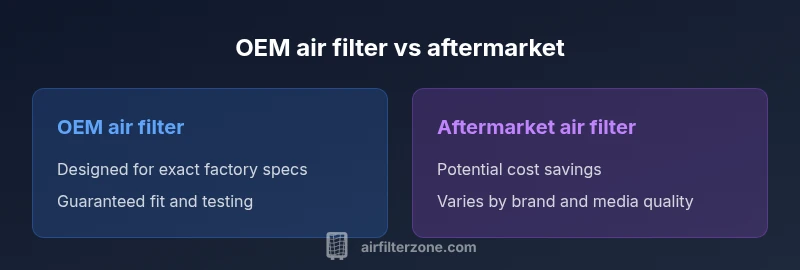
OEM air filters are manufactured to meet the exact specifications set by the vehicle's original equipment manufacturer. They are designed to complement the engine's intake system and maintain warranty terms by aligning with factory testing standards. Aftermarket filters, by contrast, are produced by third-party brands and can vary widely in media quality, sealing design, and fitment. For homeowners, car owners, and DIY enthusiasts, understanding this difference is essential when weighing cost against reliability. The core question is whether the additional cost of OEM is justified by guaranteed compatibility and factory-tested performance, or whether a high-quality aftermarket option offers equivalent protection at a lower upfront price. According to Air Filter Zone, the answer often hinges on fitment verification, filtration media quality, and how the chosen filter behaves under your typical driving conditions.
Material science: filtration media, pleat density, and seal designs
Filtration media and pleat density determine how well air is cleaned before entering the engine and how much pressure drop occurs across the filter. OEM filters typically use media that has been vetted for the specific intake geometry of a given model, ensuring consistent filtration across service intervals. Aftermarket filters may use a range of media, from standard cellulose to synthetic blends, with pleat counts that claim higher dirt-holding capacity or improved airflow. The seal design, gasket material, and end caps also affect fit and leak prevention. Even if two filters claim similar filtration efficiency, a poor seal can defeat the purpose by allowing unfiltered air to bypass the media. When shopping for OEM air filter vs aftermarket options, inspect the media quality, pleat geometry, and the gasket thickness to gauge how closely they align with the factory specification.
Filter performance in real-world conditions: airflow, filtration efficiency, and pressure drop
In practice, you want a filter that maintains steady airflow without introducing excessive restriction. OEM filters are engineered to preserve the engine’s designed air intake characteristics, which can support optimal horsepower, fuel economy, and emissions performance. Aftermarket filters may offer comparable filtration in many cases, but performance can vary by brand and line. Some amateurs notice minor changes in throttle response or engine sound when moving from OEM to aftermarket, while others see no perceptible difference. The key is to compare independent tests or owner reports for your exact model and driving profile. Always verify that any aftermarket option maintains the same or better filtration efficiency and doesn’t introduce a significant pressure drop that could affect engine performance over time.
Durability and longevity: how long filters last under typical driving conditions
A well-made OEM filter is designed to meet the service intervals recommended by the vehicle manufacturer, with predictable degradation patterns that align with your maintenance schedule. Aftermarket options vary more widely—some brands match OEM durability, while others may show accelerated clogging in dusty conditions or reduced structural integrity after several heat cycles. As a result, determining longevity requires considering your climate, driving style, and maintenance cadence. If you frequently drive on dirt roads or in hot climates, you may notice faster saturation with aftermarket media, necessitating earlier replacement. In contrast, a reputable aftermarket option with high-quality media and robust seals can deliver parity with OEM in many scenarios.
Warranty considerations and long-term costs
Warranty coverage is a common concern when choosing between OEM air filter vs aftermarket. In most regions, using an aftermarket filter should not automatically void a vehicle warranty, provided the aftermarket part is properly installed and does not cause the problem being claimed under warranty. However, some manufacturers or service agreements may have specific conditions or require proof that the non-OEM part did not contribute to the issue. Always review your vehicle’s warranty terms and consult the dealer or service manual if in doubt. From a cost-per-mile perspective, aftermarket filters can offer immediate savings on the purchase price, but you should factor in potential differences in replacement intervals and the risk (perceived or real) of warranty questions when calculating long-term value.
Costs and value: upfront price vs long-term cost
OEM air filters tend to carry a higher upfront price, reflecting factory testing and guaranteed fit. Aftermarket options often come at a lower sticker price, with some brands delivering equivalent filtration quality at a reduced cost. The real question is value: how does a given filter perform over the life of the air intake system, and what are the replacement intervals you’ll actually follow? For many DIYers, the savings on a single replacement can be attractive, but this must be weighed against potential added labor time or verification steps to ensure correct installation. Air Filter Zone’s analysis shows that the cheapest option isn’t always the best over the long term, because a poor fit or inferior media can lead to higher maintenance costs.
Fitment, certification, and quality control: how to verify a filter fits your vehicle
Fitment accuracy is the hinge on the OEM vs aftermarket decision. OEM filters are designed for a narrow range of models with precise mounting points and seals. Aftermarket options may cover broad model years but require careful cross-checking of part numbers, vehicle trim, and intake hose compatibility. Look for official certifications where applicable, such as vehicle-specific part numbers, and verify the fit with a quick physical check after installation (seal press, no light leakage, proper seating). In cases of older vehicles where OEM parts are scarce, reputable aftermarket options can provide a reliable alternative if they are explicitly listed for your model and have positive user feedback.
Environmental impact and recycling considerations
From an environmental perspective, the materials and manufacturing processes differ between OEM and aftermarket filters. OEM filters are typically designed for easier recycling within the manufacturer’s program, while aftermarket brands may vary in sustainability initiatives. Regardless of choice, proper disposal and recycling of used filters reduces waste and supports greener maintenance practices. If you care about environmental impact, check the brand’s recycling policies and opt for filters that use recyclable or lower-impact materials when possible.
How to evaluate a purchase: a practical buying checklist
When deciding between OEM air filter vs aftermarket, use a simple checklist:
- Confirm model/year compatibility and part number accuracy.
- Compare filtration media quality, seals, and construction.
- Read independent reviews and, if possible, local user tests for your vehicle model.
- Check warranty language and dealer guidance for aftermarket parts.
- Assess replacement intervals and total cost of ownership over the vehicle’s expected lifespan.
- Consider climate and driving conditions; dusty environments favor higher-quality media.
Common myths debunked: separating fact from fiction
Myth: OEM is always better for performance. Reality: OEM ensures factory specs and warranty alignment, but reputable aftermarket options can match performance in many cases. Myth: Any aftermarket filter will void my warranty. Reality: Warranty implications depend on policy and whether the aftermarket caused the issue. Myth: All aftermarket filters are inferior. Reality: Media quality and manufacturing processes vary; select brands with solid reputations and clear model fit.
Case scenarios: when OEM makes sense vs aftermarket
If you own a new car under warranty, OEM filters are usually the safer choice to maintain factory compliance. If your vehicle is older or hard to source OEM parts for, a trusted aftermarket option with explicit model compatibility and strong reviews can save money without sacrificing protection. In high-dust regions, investing in premium aftermarket media can maintain airflow and reduce clogging, while in a casual urban setting, standard-grade aftermarket filters may suffice. The best approach is to assess fit accuracy, media quality, and warranty terms for your unique situation.
The decision framework: step-by-step guidance for homeowners and DIYers
Use the framework: identify your vehicle model, check OEM part numbers, compare media and seals, evaluate warranty implications, and verify installation steps. Keep a record of the part numbers and installation instructions for both OEM and aftermarket options. If you’re unsure, start with a reputable aftermarket option that explicitly lists your exact model, then reassess performance and any maintenance implications after a few thousand miles.
Comparison
| Feature | OEM air filter | Aftermarket air filter |
|---|---|---|
| Filtration efficiency and OEM spec alignment | Designed to meet factory specifications and testing | Varies by brand; some match OEM, others differ |
| Fitment precision | Typically exact for listed models | Requires verification; some models may need adapters |
| Filtration media quality | Original-grade media or equivalent | Quality varies by brand and line |
| Price range and upfront cost | Higher upfront price aligned with factory standard | Lower upfront price with varied margins by brand |
| Warranty impact and policy | Generally compatible with OEM warranties when installed correctly | Policy-dependent; verify with dealer/manufacturer |
| Availability and model coverage | Model-specific and widely supported for new vehicles | Coverage can be broad but inconsistent for older models |
What's Good
- Exact fit for approved vehicle models
- Designed to meet factory specifications and testing
- Clear service history and potential resale confidence
What's Bad
- Higher upfront cost compared to many aftermarket options
- Limited availability for older or niche models
- Some brands offer less consistent media quality
OEM air filters are the safer, more reliable choice for most vehicles.
OEM filters provide guaranteed fit and factory-aligned performance, supporting warranty terms. Reputable aftermarket options can offer cost savings but require careful verification of compatibility and media quality.
FAQ
Is OEM air filter always better than aftermarket?
Not always. OEM filters guarantee factory specs and fit for warranty purposes, while reputable aftermarket filters can match performance at a lower cost. Your model, driving conditions, and the aftermarket brand quality drive the outcome.
OEM filters guarantee factory specs and fit, but reputable aftermarket options can match performance. Check your model and brand quality before replacing.
Will using aftermarket void my vehicle warranty?
Generally not, if the aftermarket part did not cause the issue and installation was proper. Warranty terms vary by manufacturer, so verify with your dealer or owner’s manual before proceeding.
Usually not, but check your warranty terms and confirm with the dealer.
How should I verify fitment for my model?
Cross-check the part number against your vehicle’s year, make, and model. Look for model-specific listings and read reviews from owners with the same vehicle. If in doubt, consult the manufacturer or a trusted mechanic.
Double-check the exact model and part number, and read model-specific reviews.
Do aftermarket filters provide better filtration?
Some aftermarket lines use premium media and can offer equal filtration efficiency. Others may underperform if media quality or seals are inferior. Always compare media specs and customer feedback.
It depends on the brand—some perform on par with OEM, others don’t.
How often should I replace filters?
Follow the vehicle’s owner manual or the filter manufacturer’s recommendations. Driving in dusty conditions or using aftermarket filters may necessitate shorter intervals. Monitor performance and airflow as indicators of when to replace.
Stick to the recommended intervals and watch for signs of clogging or reduced airflow.
What is the best approach for DIY replacement?
Gather the correct filter size, disconnect safely, remove the old filter, inspect the housing, install the new filter with the correct orientation, and reseal the housing. Dispose of the old filter properly and reset service indicators if applicable.
Have the right size, follow orientation marks, and reseal the housing after replacement.
Quick Summary
- Prioritize fitment verification for aftermarket choices
- OEM maintains factory specs and warranty alignment
- Media quality and seal design are decisive for performance
- Consider climate and driving conditions in your choice
- Check warranty terms before buying aftermarket filters