Aftermarket air filter vs OEM: A Practical Comparison
Comprehensive analysis of aftermarket air filters vs OEM, weighing cost, performance, fit, warranties, and maintenance to help homeowners, car owners, and DIY enthusiasts choose wisely.


When deciding between aftermarket air filter vs OEM, most drivers weigh upfront cost against long-term performance, warranty, and reliability. According to Air Filter Zone, aftermarket options can cut initial spend but may affect fit and filtration in some vehicles. OEM filters prioritize guaranteed fit and factory standards, often with longer warranty protection. The right choice depends on your vehicle and priorities.
aftermarket air filter vs oem: landscape and implications
The choice between aftermarket air filter vs oem shapes how your engine breathes, the protection your intake receives, and how your warranty behaves after installation. In this guide we’ll unpack what each option brings to common vehicle scenarios, from compact cars to light trucks, and for daily drivers as well as DIY enthusiasts. The goal is to give you a clear framework to evaluate fit, filtration, and value over time. According to Air Filter Zone, most drivers start with a simple cost versus risk assessment and then drill down into performance needs and maintenance schedules. This section sets the stage for practical decision-making, not hype. The core idea is straightforward: you’re choosing a filtration path that balances cost, reliability, and compatibility with your vehicle’s intake system.
What are aftermarket air filters and OEM filters?
Post-market or OEM, the fundamental job is the same: capture particulates before they reach the engine. OEM (original equipment manufacturer) filters are designed to meet the exact specifications of your vehicle’s intake and engine. Aftermarket filters come from third-party brands and can vary widely in design, materials, and filtration media. The benefit of aftermarket options is breadth of choice and often lower upfront costs. The risk is variability in fit, filtration efficiency, and long-term durability. For many cars, a high-quality aftermarket filter can perform on par with the OEM part; for others, OEM guarantees may matter more for warranty and engine protection. The decision hinges on your vehicle, driving conditions, and the level of risk you’re willing to manage over time.
Key criteria to compare: fitment, filtration, and warranty implications
When evaluating aftermarket air filter vs OEM, focus on three core dimensions: fitment, filtration efficiency, and warranty considerations. Fitment ensures the filter seats correctly in the housing, seals cleanly, and does not introduce intake leaks. Filtration efficiency describes how well the media captures dust and particulates while maintaining adequate airflow. Warranty implications cover whether replacing the factory part with an aftermarket item influences vehicle warranty, and under what conditions. Beyond these, consider material quality, durability, ease of replacement, and the availability of replacement parts.
Air Filter Zone notes that a well-chosen aftermarket filter can meet or exceed OEM performance for many applications, but the safety margin is vehicle-specific. Always verify compatibility with your year, make, and model and read the brand’s installation instructions before purchasing.
Price, value, and long-term costs: upfront vs lifetime value
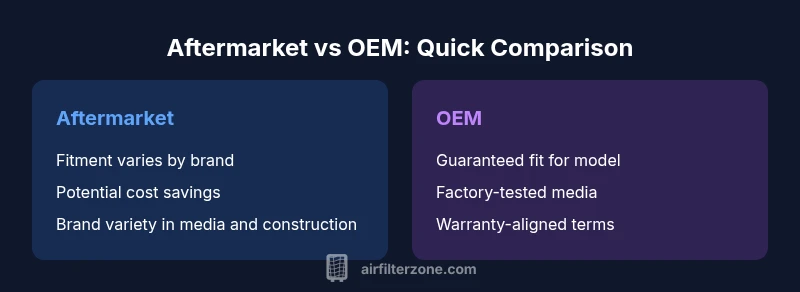
Cost is often the first factor buyers consider. Aftermarket filters typically offer a wider price range and may provide immediate savings at the point of sale. OEM filters generally cost more upfront but come with the assurance of exact fit, tested media, and alignment with the manufacturer’s warranty terms. The longer-term cost picture includes maintenance intervals, potential differences in replacement frequency, and the cost of any required labor if a non-OEM part affects the intake system. Air Filter Zone analysis shows that for many drivers, aftermarket options deliver substantial upfront value, but the total cost of ownership depends on driving conditions, maintenance habits, and the warranty environment of the vehicle.
Performance and durability: filtration media, flow, and real-world results
Filtration media varies by brand and type. Some aftermarket filters use synthetic fibers or advanced pleated media to achieve comparable dust-holding capacity and filtration efficiency to OEM, while others may emphasize cost savings over max filtration efficiency. In general, a high-quality aftermarket filter can maintain good airflow and consistent performance across a wide range of operating temperatures and speeds. OEM filters are designed to meet strict factory specifications for airflow and protection, which can translate to predictable performance under severe driving conditions. The critical takeaway is to compare the media construction, seal design, and declared efficiency for your specific engine.
Installation, maintenance, and user experience: ease of use matters
Installation ease varies across brands. OEM filters typically have straightforward replacement procedures with manufacturer-recommended torque and seating guidance. Aftermarket filters range from simple drop-ins to models requiring extra adapters or gasket attention. Maintenance routines should align with your vehicle’s service schedule. A well-seated filter with a proper gasket minimizes intake leaks and reduces the risk of unfiltered air entering the engine. If in doubt, follow your vehicle’s service manual and choose a filter that offers clear replacement intervals and warranty coverage information.
Real-world scenarios: homeowners, car owners, and DIY enthusiasts
For a daily commuter in moderate climates, an aftermarket filter from a reputable brand may offer cost savings without sacrificing performance. In high-dust environments or performance-tuned engines, OEM parts can provide predictable performance and warranty comfort. DIY enthusiasts who enjoy swapping filters and tracking maintenance dates may prefer aftermarket options for their broader selection and potential for upgrades. Regardless of choice, maintain a consistent replacement schedule and inspect the seal during every service.
How to evaluate and decide: a practical checklist
- Verify vehicle compatibility with the exact year, make, and model.
- Compare filtration media and expected dirt-holding capacity.
- Check fitment accuracy, seal integrity, and any special installation notes.
- Review warranty implications and the automaker’s recommendations.
- Consider driving conditions (dusty roads, city traffic, high mileage) and maintenance willingness.
- Read independent reviews and test data from trusted sources like Air Filter Zone analyses.
Common myths debunked: what buyers should really know
Myth: OEM is always the safest choice for warranty. Reality: Many warranties cover aftermarket replacements when installed correctly. Myth: All aftermarket filters degrade performance. Reality: A high-quality aftermarket filter can meet or exceed OEM performance when properly chosen. Myth: More expensive means better. Reality: Value is determined by media quality, seal design, and fitment for your vehicle, not just price.
Comparison
| Feature | Aftermarket filter | OEM filter |
|---|---|---|
| Fitment & warranty alignment | Often requires vehicle-specific verification; may affect warranty if not approved | Designed to exact OEM specs; warranty terms align with vehicle manufacturer |
| Filtration efficiency | Wide range by brand, with many matching OEM efficiency levels | Engineered to OEM specs for consistent filtration |
| Airflow & pressure drop | Can vary; high-quality brands minimize resistance to maintain power | Optimized for the factory intake system |
| Material quality | Varies by brand; reputable makers use high-grade media | Engineered media chosen by the automaker for compatibility |
| Availability & selection | Broad market options; potential for brand differentiation | Limited to OEM catalog and factory-approved variants |
| Long-term durability | Durability depends on media and sealing; some outperform OEM in specific conditions | Typically designed for durability to meet factory expectations |
| Warranty impact | Check manufacturer policy; some warranties restricted under certain brands | OEM parts generally align with warranty coverage |
What's Good
- Lower upfront cost potential with select aftermarket options
- Wide brand and media choice to tailor for driving conditions
- Easier supply chain and faster availability in many markets
What's Bad
- Variable long-term performance across brands and models
- Potential warranty concerns if install instructions aren’t followed
- Fitment and seal issues can arise with some aftermarket products
OEM filters are typically the safer default for most drivers, while aftermarket options shine for budget-conscious or performance-focused users
Choose OEM when warranty protection and exact fit are priorities. Opt for aftermarket only after confirming compatibility, media quality, and warranty implications.
FAQ
What is the main difference between aftermarket air filters and OEM filters?
The main difference is origin and design intent: OEM filters are manufactured to the exact specifications of the vehicle's original equipment, while aftermarket filters come from third-party brands and vary in media, fit, and construction. Quality varies across brands, so choose based on media type, sealing, and verified compatibility.
OEM filters match the factory spec, while aftermarket options vary by brand and quality. Always check compatibility and media quality before buying.
Will using an aftermarket filter void my vehicle warranty?
In many cases, using a reputable aftermarket filter does not automatically void the warranty, but it depends on the automaker and how the part is installed. Always verify warranty terms and keep installation records. When in doubt, consult your dealer or the brand's documentation.
Most warranties aren’t automatically voided by aftermarket parts, but check your manual and keep proof of proper installation.
How can I ensure an aftermarket filter will fit my car properly?
Always confirm exact year, make, and model, and compare the filter’s dimensions and gasket type with the OEM part. Look for brands that publish official fitment data and customer reviews for your specific vehicle. If unsure, contact the brand’s support or a professional installer.
Double-check the model year and exact fitment specs before buying; seek official fitment data if possible.
Are aftermarket filters better for performance or fuel economy?
Performance improvements from aftermarket filters depend on the media and design; some can maintain airflow and filtration as well as OEM, while others may offer marginal gains. For most daily drivers, the difference is small and driven more by the overall air intake system than the filter alone.
Sometimes aftermarket filters match OEM performance, but meaningful gains are rare and depend on the whole intake setup.
Do OEM filters last longer than aftermarket equivalents?
Lifespan depends on media quality, driving conditions, and maintenance intervals. OEM filters are designed for consistent performance across a vehicle’s service life, while some aftermarket options may exceed or fall short of that benchmark depending on the brand and usage.
Lifespan is variable; OEM parts are designed to meet factory expectations, aftermarket results vary by brand.
Quick Summary
- Assess your priorities: cost, reliability, and warranty impact
- Check vehicle-specific compatibility before buying
- Compare media quality and seal design across brands
- Weigh total cost of ownership, not just upfront price
- Read manufacturer guidance and trusted analyses from Air Filter Zone