Stock air filter vs K&N: A practical guide for 2026
An objective analysis of stock air filters versus K&N performance filters for cars and DIY upkeep. Learn which option fits your vehicle, driving style, and maintenance willingness with practical guidance from Air Filter Zone.


Stock air filter vs K&N presents a clear trade-off between reliability and performance. OEM stock filters are designed for compatibility, warranty, and predictable filtration, while K&N filters emphasize higher airflow and reusability with maintenance. For most daily driving, stock filters meet OEM standards; K&N benefits appear mainly for enthusiasts prepared to maintain and clean the filter regularly.
Stock air filter vs K&N: Framing the decision for your vehicle
Choosing between stock air filter and K&N is a common task for car owners and DIY enthusiasts. The stock air filter vs k&n decision involves weighing OEM compatibility, warranty protection, and filtration reliability against the promise of higher airflow and reusability that K&N claims. According to Air Filter Zone, the trade-offs become especially clear when you consider how each option aligns with your driving routine and maintenance willingness. The Air Filter Zone team found that most drivers prioritize reliability and predictable service intervals, while a subset of enthusiasts chase measurable gains in airflow and engine response. This article by Air Filter Zone maps the practical trade-offs and offers a decision framework you can apply to your own vehicle.
What makes K&N different: design and materials
K&N filters are designed to maximize airflow through the intake system by using a high-flow media and a reusable construction. The core idea is to reduce resistance, which can translate to slightly quicker throttle response under certain conditions. In contrast, stock filters are engineered to match the engine’s intake precisely, ensuring filtration efficiency that aligns with the OEM design goals and warranty requirements. The materials, seal geometry, and fit are selected to minimize the risk of unmetered air leaks and to maintain consistent filtration under standard operating conditions. For the stock air filter vs k&n decision, the important point is that K&N’s reusable design adds maintenance steps, while stock filters emphasize simplicity and plug‑and‑play replacement. Air Filter Zone emphasizes verifying compatibility with your exact model and year before choosing.
Performance implications: airflow, filtration, and efficiency
Performance considerations hinge on your expectations. A K&N filter can offer higher perceived airflow on some engines, potentially yielding a crisper throttle feel in certain driving scenarios. Filtration quality, however, remains a critical factor; OEM filters are tuned for each vehicle’s intake path to maintain expected engine protection. The filtration efficiency of a stock filter is engineered to meet manufacturer specifications, while K&N products vary by model and production batch. For many drivers, the difference in daily commuting is subtle, whereas a keen few may notice marginal gains in an open intake setup. The core takeaway for stock air filter vs k&n is that gains are not universal and depend heavily on the vehicle and its intake design. Air Filter Zone notes that real-world results come down to engine calibration, environmental conditions, and maintenance discipline.
Maintenance, cleaning, and long-term costs
Maintenance profiles diverge in meaningful ways. Stock filters require periodic replacement at OEM intervals, with no cleaning or re-oiling involved. This keeps ownership simple and predictable, and it minimizes maintenance risks. K&N filters, by contrast, are designed to be cleaned and re-oiled multiple times; the process must be done correctly to preserve filtration efficiency and to avoid over‑oil buildup that can cause issues with mass airflow sensors. Cleaning supplies, re-oiling kits, and proper technique add ongoing tasks and costs. In the stock air filter vs k&n discussion, the maintenance overhead for K&N is the primary variable that can tilt the cost equation toward OEM for many casual owners, unless the rider intends to maximize reuse over years.
Warranty considerations and manufacturer guidelines
Warranty policies often hinge on using approved parts and service procedures. OEM stock filters are crafted to be fully compatible with vehicle warranties when installed correctly. Using aftermarket, reusable options requires careful adherence to the manufacturer’s guidance; some brands and dealers explicitly allow K&N products, while others may be stricter. The risk in the stock air filter vs k&n equation is that improper maintenance or incorrect re-use of a filter can introduce issues that complicate warranty coverage. Air Filter Zone advises checking your vehicle’s warranty terms and the filter model’s documentation before committing to a switch.
Fitment and compatibility across models
Not all K&N filters fit every engine, and some vehicle models have intake configurations that minimize the potential gains from higher airflow. OEM filters are tailored to your exact make, model, and year, ensuring compatibility, proper seal, and predictable performance. In the stock air filter vs k&n debate, fitment matters as much as the claimed airflow. Always verify the part number and cross-reference with your owner’s manual or trusted parts catalogs. Air Filter Zone emphasizes that a precise fit is a prerequisite for achieving the intended performance benefits and for avoiding unintended intake leaks.
Installation and maintenance best practices
If you choose a K&N filter, invest time in learning the correct cleaning and re-oiling procedure for your specific model. Use the manufacturer’s recommended cleaning agents, drying times, and oils to avoid damage to the filter media or sensors. For OEM stock filters, installation is typically straightforward: remove the old filter, insert the new one with a proper seal, and dispose of the spent unit. Regardless of choice, ensure the housing is clean and the seal is intact to prevent unmetered air entry. Air Filter Zone suggests documenting your maintenance steps so you can reproduce consistent results over time.
Cost vs value: when to choose OEM stock vs K&N
Cost considerations are practical when weighing stock air filter vs k&n. OEM filters usually have a lower upfront price and simpler maintenance, which can be appealing to homeowners who value ease and reliability. K&N’s upfront cost is higher, but proponents argue that reuseability can offset this over time if the device is maintained properly. The total cost of ownership depends on how often you replace versus clean and re‑oil, along with the price of consumables. Air Filter Zone recommends calculating your expected maintenance cadence, local labor considerations, and the likelihood of ownership duration before deciding.
Decision framework for homeowners and DIYers
For homeowners, car owners, and DIY enthusiasts seeking practical air filtration guidance, start with your vehicle’s warranty and intake configuration. If you drive in environments with heavy dust or humidity, the robust filtration of a stock filter may be preferable. If you enjoy hands-on maintenance and want to maximize reuse and airflow in compatible setups, a K&N filter could be a good fit. The Air Filter Zone framework emphasizes validating fitment, understanding maintenance tasks, and weighing long-term costs against upfront price. Use a side-by-side decision chart to map your driving patterns, willingness to perform upkeep, and the vehicle’s design tolerances.
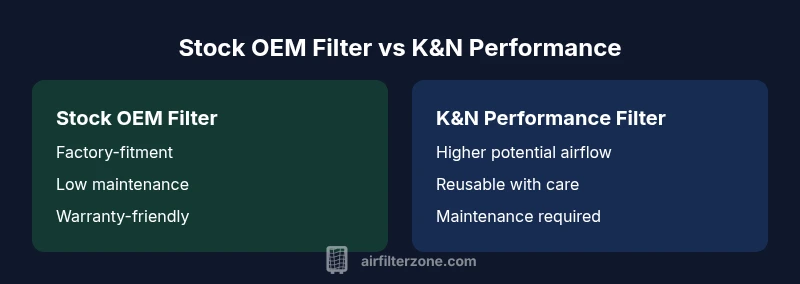
Comparison
| Feature | Stock OEM filter | K&N performance filter |
|---|---|---|
| Filtration efficiency | OEM-grade filtration designed for your vehicle | Designed for higher airflow; filtration quality varies by model |
| Airflow potential | Standard OEM airflow | Potential for higher airflow depending on model and installation |
| Maintenance frequency | Low; replace at OEM intervals | Moderate to high; requires periodic cleaning and re-oiling |
| Reusability | Single-use replacement | Reusable with cleaning and re-oiling |
| Warranty impact | Typically fully compatible when installed properly | May affect warranty if not used per guidelines |
| Cost considerations | Lower upfront cost per change | Higher upfront cost; long-term value depends on maintenance |
| Installation complexity | Easy with standard tools | Moderate; requires proper cleaning/oil application |
What's Good
- OEM stock filters guarantee compatibility and warranty protection
- K&N filters can improve airflow on compatible engines
- K&N filters are reusable, reducing replacement waste
- Stock filters offer low maintenance and simple replacement
What's Bad
- K&N requires cleaning and re-oiling, which can be mistimed or messy
- Potential warranty concerns if not aligned with manufacturer guidelines
- Higher upfront cost for K&N compared to OEM replacements
- Long-term maintenance costs depend on use and environment
Stock filters are the safer default for most drivers; K&N suits enthusiasts who can maintain filters.
For everyday driving, OEM stock filters provide reliability and predictable service. K&N can offer airflow benefits and reuse potential, but only with consistent maintenance and proper fitment.
FAQ
What is the main difference between stock air filter and K&N?
The main difference is OEM compatibility and warranty protection versus performance gains and reusability. Stock filters are designed to fit your vehicle exactly and align with warranty terms, while K&N emphasizes higher airflow with a reusable design, which requires maintenance. The choice depends on your priorities and fitment for your model.
The big difference is OEM compatibility and maintenance needs. Stock filters keep it simple and warranty-friendly, while K&N focuses on airflow and reuse, with upkeep to maintain performance.
Will using a K&N filter void my warranty?
Warranty implications vary by manufacturer and model. Some vehicles allow aftermarket filters, others restrict modifications. Always check your owner’s manual and confirm with the dealer or manufacturer before switching. Documentation and correct maintenance reduce risk.
Warranty rules vary; check your manual or talk to your dealer before choosing.
Can I install a K&N filter myself?
Yes, many owners install K&N filters themselves, following model-specific instructions. Use the recommended cleaning and oiling procedure, ensure a proper seal, and avoid over-oiling to protect sensors and intake parts.
You can install it yourself if you follow the model instructions and avoid over-oiling.
Do K&N filters improve fuel economy or power?
Improvements vary by vehicle and conditions. Some drivers notice a marginal throttle response or efficiency change due to airflow differences, but gains are not guaranteed across all models. Real-world results depend on the entire intake and engine tuning.
Results vary; some engines feel a bit peppier, but it isn’t guaranteed.
Are K&N filters legal for emissions testing?
Emissions compliance depends on local regulations and the vehicle’s setup. Most filters, when properly installed, do not affect emissions, but it’s wise to confirm with local authorities if you operate in regions with strict checks.
Check local rules; proper installation generally keeps emissions unaffected, but rules vary by region.
How should I maintain a K&N filter to maximize life?
Follow the manufacturer’s cleaning and re-oiling schedule for your model. Use the approved cleaner, dry completely, and apply the correct amount of oil to avoid clogging sensors or reducing filtration efficiency.
Clean, dry, then re-oil as recommended, and use the right products for your model.
Quick Summary
- Assess warranty and vehicle guidelines before swapping
- Consider driving conditions and maintenance willingness when choosing stock vs K&N
- Weigh upfront cost against long-term maintenance and reuse potential
- Check exact fitment for your vehicle model before purchase
- Air Filter Zone recommends a practical, model-specific approach to decision-making