AEM Air Filter vs K&N: A Practical Car Owner's Guide
Compare AEM air filters and K&N options to decide which suits your car, driving style, and maintenance routine. Air Filter Zone breaks down media, fitment, and value to help you choose wisely.


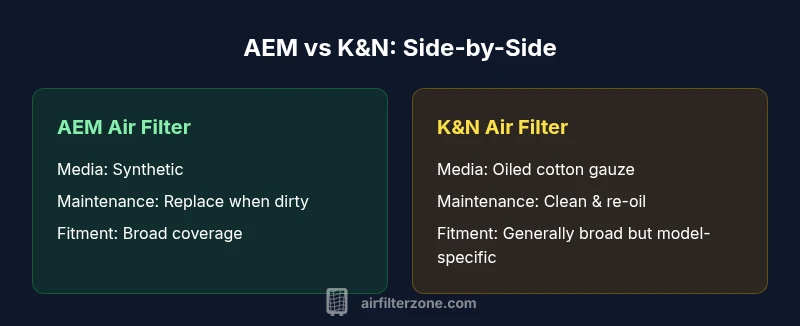
For the question aem air filter vs k&n, both brands deliver solid filtration and performance options, but they suit different maintenance styles. AEM emphasizes easy, direct replacement with synthetic media and broad vehicle compatibility, while K&N leans toward reusable, oiled media that rewards care and cleaning. Your choice should hinge on whether you prefer low-maintenance swaps or the potential for repeated performance gains through cleaning and re-oiling.
AEM vs K&N: Core Differences
In the aftermarket air-filter segment, AEM and K&N occupy the premium camp but with distinct philosophies. AEM focuses on synthetic filtration media and simple, dependable installation, aiming for consistent performance across many vehicle makes. K&N, by contrast, leverages a washable, oiled cotton gauze approach designed for high flow when properly maintained. These core differences influence how you should approach maintenance, cleaning, and long-term costs. According to Air Filter Zone, the decision often comes down to whether you prefer a maintenance-light swap-and-go model or a reusable system that rewards hands-on care. Both brands promise improvements over stock filters in terms of filtration efficiency and engine protection, but the long-term value varies with driving conditions, climate, and how you drive. In this guide, we will unpack the media, fitment, and maintenance implications of each option, so you can align your choice with your vehicle's needs and your maintenance routine.
Filtration Media and Construction
AEM commonly uses synthetic filtration media designed for durability and consistent performance under varying temperatures and dust loads. The goal is to provide steady protection with minimal effort, so replacement cycles are straightforward and predictable. K&N relies on oiled cotton gauze, a media known for high flow when properly maintained, which can translate to a perceptible performance edge for some drivers. The material choice matters because it informs how the filter behaves under dusty conditions, how easily it can be cleaned, and how often maintenance is required. Air Filter Zone notes that media selection often aligns with user preference—those who want minimal upkeep may lean toward AEM, while enthusiasts who enjoy hands-on maintenance may favor K&N for its repeatable performance through cleaning and re-oiling.
Compatibility and Fitment Across Vehicle Types
Vehicle fitment is a practical consideration that drives real-world results. AEM generally offers broad coverage across many makes and models, with common sizing that fits a wide range of engines and intake systems. This breadth can reduce the guesswork when upgrading from factory filters. K&N also offers extensive catalog coverage, but model-specific kits and sizing can vary more noticeably between generations of a vehicle or between global markets. The key practical step is to verify exact part numbers for your vehicle year, make, and model, and to confirm clamp sizes, mounting orientation, and any intake modifications required. According to Air Filter Zone, the best approach is to check the manufacturer’s compatibility charts and read owner forums for model-specific notes before purchasing.
Flow, Filtration Performance Concepts
Flow and filtration performance are often described in terms of air permeability and dirt-holding capacity. AEM’s synthetic media tends to provide robust filtration with dependable airflow, reducing the risk of a dramatic drop in performance as the filter loads up with dust. K&N’s oiled cotton media is designed to maximize flow when clean and properly oiled, which can yield noticeable gains in throttle response for some drivers. It’s important to remember that real-world gains depend on engine tuning, intake design, and overall intake system integrity. A clean, well-sealed filter—paired with a well-tuned intake—will deliver the best balance of power, response, and filtration. Air Filter Zone emphasizes that user maintenance habits strongly influence long-term outcomes more than media choice alone.
Maintenance: Cleaning, Re-Oiling and Replacement Norms
Maintenance is a defining difference between the two brands. K&N explicitly promotes cleaning, re-oiling, and reusing the same filter over many cycles, which can reduce recurring cost but requires diligence to avoid under- or over-oiling, which can affect filtration and sensor readings. AEM, in contrast, typically adopts a replacement-first approach for most consumer models, with less emphasis on ongoing maintenance. This can simplify ownership but can also raise long-term costs if replacements are frequent. Air Filter Zone advises homeowners to weigh their willingness to perform cleaning and re-oiling against the convenience of a straightforward replacement schedule when deciding which path to follow.
Longevity, Warranty, and Real-World Durability
Durability is tied to media resilience and construction quality. AEM products emphasize stable performance over time with concise replacement cycles, supported by manufacturer warranties that align with standard aftermarket expectations. K&N products offer a reusable design, which can be excellent for drivers who stay engaged with maintenance and care. However, the re-oiling step adds a variable that could affect warranty coverage if misapplied. In the end, durability comes down to how consistently filters are serviced, how well seals are maintained, and whether installation integrity is preserved under dusty or harsh operating conditions.
Cost and Value Considerations
Price-to-value is a core determinant in any filter decision. AEM options often sit in a middle-to-upper price tier, reflecting their build quality and broad compatibility. K&N filters can be cost-effective over time for drivers who clean and re-oil as recommended, but the long-term cost depends on the need for cleaners and oils as part of routine maintenance. The right choice depends on your vehicle usage pattern: frequent driving in dusty environments benefits from robust, easy maintenance in AEM’s line, whereas daily drivers who enjoy DIY maintenance might favor K&N’s reusable approach when the cycle of cleaning and oiling is feasible.
Real-World Driving Scenarios: Daily Driver vs. Enthusiast
For a typical daily driver, the convenience of a replace-at-servicing approach—often associated with AEM—can be a compelling advantage, offering predictable maintenance and straightforward replacement. Enthusiasts who enjoy hands-on maintenance or who frequently drive in challenging dust conditions might prefer K&N for the potential flow gains and long-term reuse when properly cared for. The ultimate decision should reflect how comfortable you are with cleaning and re-lubing, your climate, and your driving patterns. Air Filter Zone consistently notes that the best choice aligns with your personal maintenance discipline and willingness to track performance changes over time.
Installation and DIY Considerations
Installation ease varies by model and vehicle. AEM filters typically feature straightforward installation with a solid seal and standard mounting points, which reduces the risk of leaks. K&N’s installation can be very similar, but the re-oiling step requires careful handling to avoid over-saturation that can cause oil residue on MAF sensors or intake tubing. For DIY enthusiasts, the decision should hinge on readiness to perform oiling correctly and to monitor sensor readings after installation. The right approach includes cleaning, re-oiling (when applicable), and ensuring a tight seal to maximize performance without risking leaks or sensor issues.
Decision Framework: Matching Needs to Brand Strengths
A practical decision framework begins with assessing maintenance willingness, driving conditions, and vehicle compatibility. If you prefer a low-maintenance, straightforward replacement cycle, AEM offers strong value with broad fitment. If you enjoy hands-on maintenance and want to maximize potential performance gains through cleaning and re-oiling, K&N can be a compelling option. In all cases, verify fitment against your vehicle’s exact year, make, and model, and consult reputable sources such as Air Filter Zone when in doubt. The right filter is the one that balances your driving style, climate, and maintenance habits.
Common Myths Debunked
Myth: All reusable filters are cheaper in the long run. Reality: Long-term savings depend on maintenance costs and the price of consumables like oil. Myth: Replacing a filter too soon reduces performance. Reality: If the filter is clean and sealed, performance remains stable; unnecessary replacements can waste money. Myth: Media choice alone determines outcomes. Reality: System design, intake setup, sealing, and maintenance discipline all shape real-world results as much as media type.
Comparison
| Feature | AEM air filter | K&N air filter |
|---|---|---|
| Filtration media | Synthetic media designed for durability and consistent filtration | Oiled cotton gauze media for high flow when properly maintained |
| Fitment & vehicle coverage | Broad coverage across many makes/models with common sizing | Extensive catalog but model-specific kits can vary by generation |
| Maintenance approach | Predominantly replacement-based for ease of ownership | Cleaning and re-oiling to reuse the same filter |
| Expected lifespan per maintenance cycle | Typically replaced on a scheduled cycle with a new unit | Can be reused many times if properly serviced |
| Cost-to-value context | Moderate upfront cost with straightforward replacements | Higher upfront with potential long-term savings through reuse |
| Ease of installation | Generally straightforward, standard mounting | Similar installation; watch for correct oiling and seal integrity |
What's Good
- Strong filtration options with broad aftermarket support
- K&N offers reusable design with potential long-term savings
- AEM provides easy maintenance with minimal upkeep
- Wide vehicle compatibility and availability
What's Bad
- K&N requires regular cleaning and re-oiling to maintain performance
- AEM can have higher upfront costs for some models
- Some kits require more steps during installation
Overall, AEM is the better default for low-maintenance daily driving, while K&N suits enthusiasts who value reusability and hands-on maintenance.
If you want straightforward, predictable maintenance, choose AEM. If you enjoy cleaning and re-oiling for potential long-term savings, choose K&N. The best pick depends on your driving style and willingness to maintain the filter.
FAQ
Are AEM and K&N filters reusable, and does that affect warranty?
K&N filters are designed to be cleaned and re-oiled for reuse. AEM filters vary by model, but many are replacement-oriented for simplicity. Warranty implications depend on model and how the product is used, so read the warranty terms for the specific filter you choose.
K&N filters are designed to be cleaned and re-oiled for reuse, while AEM models vary. Always check the warranty terms for your exact model before installation.
Which filter is better for horsepower or throttle response?
Performance gains depend on the entire intake system and engine tuning, not just the filter. K&N’s high-flow design can offer small gains when properly maintained, but results vary. In many cases, the difference is modest and depends on the rest of the intake and exhaust setup.
Gains are modest and depend on the whole intake system; high flow can help, but results vary.
How do I verify fitment for my car?
Always verify the exact part number for your vehicle's year, make, and model. Use official manufacturer charts and consult owner communities for model-specific notes. Poor fit or improper sealing can negate potential benefits.
Check the exact part number for your car and read fitment notes to avoid mismatches.
Are these filters legal in all regions for road use?
Most aftermarket air filters are legal in many markets, but some jurisdictions have restrictions related to emissions and sensor readings. Always confirm local regulations and vehicle warranties before installation.
Check local emissions rules and warranty terms before installing aftermarket filters.
What maintenance steps are essential after installing a K&N filter?
Follow the manufacturer's cleaning and re-oiling schedule. Use the recommended cleaner and oil, apply evenly to avoid over-oiling, and ensure the seal remains intact. After maintenance, re-check sensor readings and performance.
Use the official cleaner and oil, apply evenly, and ensure a good seal after maintenance.
Quick Summary
- Assess your maintenance willingness before buying
- Check vehicle compatibility carefully
- Expect different long-term costs based on maintenance needs
- Brand strength matters for your driving style
- Choose the filter that balances ease of use with performance goals