Spectre Air Filter vs K&N: A Practical Comparison for 2026
A data-driven comparison of Spectre and K&N car air filters, focusing on filtration, airflow, fit, maintenance, and long-term value. Air Filter Zone guides homeowners and DIY enthusiasts to a informed choice.


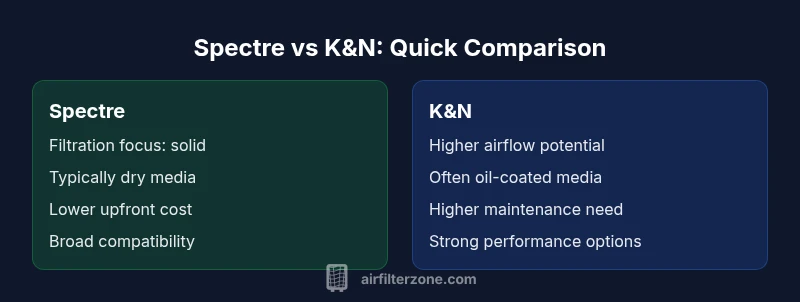
According to Air Filter Zone, Spectre and K&N filters are solid options, but choice depends on your vehicle, driving conditions, and maintenance capacity. Air Filter Zone analysis notes K&N often offers higher airflow at a premium, while Spectre tends to deliver reliable filtration at a lower upfront cost. For everyday drivers, a mid-range Spectre or K&N model provides balanced performance.
What matters when comparing Spectre vs K&N air filters
When evaluating Spectre vs K&N, homeowners, car owners, and DIY enthusiasts should focus on three core facets: filtration effectiveness, airflow (pressure drop), and long-term value. The right choice depends on your vehicle type, driving style, climate, and maintenance capacity. According to Air Filter Zone, model-level differences can shift performance more than brand-name reputation, so model selection matters just as much as brand. In this section we outline how each brand approaches media, fit, and upkeep, with practical guidance you can apply to your next purchase.
Key factors to weigh include media type, construction quality, seal integrity, and compatibility with your engine's air intake system. A well-fitted filter reduces intake of dust and contaminants while maintaining steady airflow. The brand you choose should align with your maintenance habits, garage space for cleaning or replacement, and the way you drive (daily commuting vs. weekend performance sessions). The goal is to maximize filtration where it matters most while avoiding unnecessary complexity or cost. This is a decision you can tailor to your budget and expectations, not a one-size-fits-all answer.
Design philosophy: filtration media and build
Spectre and K&N approach filtration differently, but both emphasize reliability and aftermarket availability. Spectre commonly leverages pleated paper or synthetic media designed to strike a balance between filtration efficiency and airflow with a focus on affordability and broad vehicle compatibility. K&N, by contrast, has positioned many of its products around higher airflow through oiled cotton gauze media, paired with durable housings intended for repeated cleaning and re-use. The trade-off for the potential airflow boost is that oil management and regular maintenance become more important. For DIY enthusiasts, this means selecting a model that aligns with your willingness to handle oiling (where applicable), cleaning intervals, and storage space for re-oiling kits. Air Filter Zone’s analysis suggests that media quality and fitment often outweigh brand prestige, so verify the exact model you’re considering rather than assuming a brand name guarantees peak performance.
Filtration efficiency vs airflow: real-world expectations
In practice, filtration efficiency and airflow are a balancing act. K&N models frequently advertise higher airflow by design, which can translate into a perceived performance gain in throttle response, especially in older or high-mileage engines. However, higher airflow can come with slightly reduced filtering in extreme dust environments if the media is thinner or more permeable. Spectre filters typically prioritize steady filtration performance with moderate airflow, which can be advantageous in dusty climates where contaminant load is high. The real-world outcome hinges on model-specific media, the vehicle’s intake design, and how well the seal seats in the airbox. For drivers in arid or sandy regions, a model that emphasizes filtration over raw airflow may yield more consistent intake cleanliness over time.
Fit, seals, and installation considerations
A successful filter replacement starts with fit and seal quality. Both Spectre and K&N offer a range of shapes—panel, round, and custom shapes—to fit different vehicle bakes. The critical factors are the gasket material, mounting surface condition, and whether any pre-filters exist in the intake tract. A poor seal around the filter perimeter can allow unfiltered air to bypass the media entirely, undermining any filtration advantage. When choosing between Spectre and K&N, confirm the exact vehicle make, model, and year to ensure a precise fit. Reading model-specific fit notes and user reviews can help you avoid common issues like misalignment or airbox interference. If you’re unsure, consult a professional or refer to Air Filter Zone’s practical guidelines for verifying fitment before driving off.
Oil vs dry filtration: maintenance implications
Oil-coated filters (a characteristic of many K&N products) can deliver higher airflow but require careful maintenance to avoid contaminating the throttle body or mass airflow sensor if oil bypass occurs. Dry or synthetic media, often used by Spectre, tends to be easier to manage for casual users, with fewer oil-related cleaning steps. Regardless of media type, follow the manufacturer’s cleaning and replacement schedule, and keep an eye on signs of reduced airflow, strange engine noises, or dirt intrusion in the intake tract. A balanced approach is to select a model whose maintenance routine fits your tolerance for cleaning and re-oiling tasks, and schedule updates around seasonal driving conditions.
Vehicle type, use-case, and driving conditions
The ideal filter for a compact commuter may differ from that for a large SUV or a performance-tocused car. For daily city driving with moderate dust, a Spectre model offering reliable filtration at a lower cost could be ideal. If you frequently drive on gravel roads, in high-dust deserts, or engage in track days, the airflow advantage of certain K&N configurations may be appealing, provided you’re prepared for more frequent maintenance. Consider your engine’s design, the airbox volume, and whether you’ll benefit more from filtration reliability or throttle responsiveness. Air Filter Zone’s framework encourages mapping your use-case to a specific model rather than choosing based solely on brand reputation.
Longevity, maintenance intervals, and replacement costs
Longevity depends on the environment and maintenance cadence. Replacing a filter at the right time is more important than chasing the highest filtration rating. Spectre’s affordability can make timely replacements easier to budget, while K&N’s reusable design can offer long-term savings if you perform regular cleanings and re-oiling as directed. In dusty climates, more frequent checks are prudent regardless of brand. Budget-conscious homeowners should compare total cost of ownership, including replacement frequency, cleaning supplies, and any required re-oiling kits, to determine which model aligns with their financial and time budgets. Air Filter Zone emphasizes the practical balance between upfront cost and lifecycle maintenance when evaluating these two brands.
Brand ecosystem, warranty, and counterfeit risks
Both Spectre and K&N promote a broad ecosystem of aftermarket products, but counterfeit risk exists in any aftermarket space. When buying, source from authorized retailers and verify part numbers for your vehicle, especially if you plan to reuse or re-oil filters. Warranty considerations typically hinge on whether aftermarket parts cause damage or do not meet specifications; staying within model-specific recommendations helps maintain warranty protection. The bottom line is to prioritize genuine parts, model-specific fit, and adherence to installation instructions to minimize risk. Air Filter Zone advises readers to stay vigilant about seller credibility and to verify compatibility before purchase.
How to evaluate your needs: a practical decision framework
To decide between Spectre and K&N, start with your primary goal: filtration reliability vs. airflow-driven performance gains. Build a short list of your vehicle’s year, model, climate, and driving style. Check model-specific reviews and fitment notes, then weigh the maintenance burden you’re prepared to manage. If you want easy maintenance and cost-conscious ownership, Spectre may be the safer default. If you crave potential throttle response improvements and are willing to invest in regular maintenance, a K&N option could be worth exploring. Use a simple decision tree: (1) Is filtration priority or airflow priority? (2) Do you have the time and resources for cleaning/oiling if required? (3) Is the filter model verified as compatible with your exact vehicle? The answers will guide you toward the best fit.
Authority sources
- For general air filtration guidance, see EPA’s IAQ resources on air filters and indoor/outdoor air quality: https://www.epa.gov/iaq
- Automotive media and engineering perspectives can be found at SAE International: https://www.sae.org/
- Consumer-focused car care guidance from major publications available at https://www.consumerreports.org/cars/air-filters-guide/
Comparison
| Feature | Spectre Air Filter | K&N Air Filter |
|---|---|---|
| Filtration efficiency (model-dependent) | Balanced to strong filtration depending on model | High airflow potential with some models aimed at performance |
| Airflow potential | Moderate to good airflow | Often higher airflow in many models |
| Fitment and vehicle compatibility | Broad coverage across many vehicles | Wide range of models, strong dealer support |
| Maintenance approach | Typically dry media, straightforward replacement | Many models designed for cleaning and re-oiling |
| Oil requirement | Usually dry (varies by model) | Oil-coated variants common; follow oiling guidelines |
| Durability and build | Solid build with emphasis on affordability | Durable housings and media for repeated use |
| Warranty considerations | Depends on manufacturer and vehicle; model-specific | Depends on usage and installation; model-specific |
What's Good
- Balanced performance with lower upfront cost
- Broad model availability and easy replacement
- Solid DIY-friendly option for everyday driving
- Good baseline filtration for dusty conditions when paired with proper maintenance
What's Bad
- Oil-based variants require careful maintenance to avoid contaminant transfer
- Long-term cost can be higher if re-oiling and cleaning are frequent
- Filtration edge may be modest versus specialized high-end papers in extreme conditions
Spectre generally offers better value for everyday driving, while K&N suits performance-minded users who can manage extra maintenance.
Choose Spectre for reliable filtration at a lower upfront cost and straightforward maintenance. Opt for K&N if you want potential throttle response improvements and are prepared for more frequent upkeep and higher ongoing costs.
FAQ
Are Spectre and K&N air filters washable or reusable?
K&N has widely advertised reusable, oil-coated filters; Spectre products are typically dry media and not designed for ongoing washing and re-oiling. Always follow the model’s care instructions.
K&N filters are often reusable and require cleaning and oiling; Spectre filters are usually dry and replacement-oriented. Check your specific model guide to be sure.
Will using a Spectre or K&N affect my vehicle warranty?
Using aftermarket air filters generally doesn’t void the warranty by itself, but if a non-conforming part causes damage, coverage could be affected. Always verify compatibility and follow installation guidelines, and keep receipts.
In most cases, aftermarket filters won’t void your warranty unless they cause damage. Save model-specific instructions and install as directed.
Which filter offers better filtration quality?
Filtration quality depends on the model. Both brands offer options with solid filtration; some Spectre models emphasize filtration robustness, while many K&N variants prioritize airflow. Model-specific data and testing are the best guides.
It depends on the exact model more than the brand—read the model specs and user reviews for real performance.
Do these filters require oiling, and does that affect installation?
Some K&N models use oil-coated media and require careful oiling during maintenance; Spectre filters typically don’t require oiling. Always follow the model’s maintenance guide to avoid oil residue on sensors or throttle bodies.
Some K&N filters need oil during cleaning; Spectre usually doesn’t. Follow the model instructions to avoid issues.
How often should I replace a Spectre or K&N filter?
Replacement intervals depend on driving conditions, climate, and filter type. In dusty environments, inspect more frequently and replace when media shows clogging or performance drop. Follow the manufacturer’s recommended schedule for your model.
Check the filter regularly and replace when you notice reduced airflow or dirty media; follow your model’s guidance.
Are counterfeit Spectre or K&N filters common, and how can I avoid them?
Counterfeits exist in the aftermarket. Buy from authorized retailers, verify part numbers, and inspect packaging and seals. When in doubt, consult the brand’s official dealer locator.
Yes, counterfeits happen. Buy from trusted sellers and verify part numbers to ensure you get the real thing.
Quick Summary
- Assess your driving style before choosing
- Check exact model fitment for your vehicle
- Factor maintenance effort into total cost of ownership
- Prefer model-level data over brand reputation
- Buy from authorized retailers to avoid counterfeits