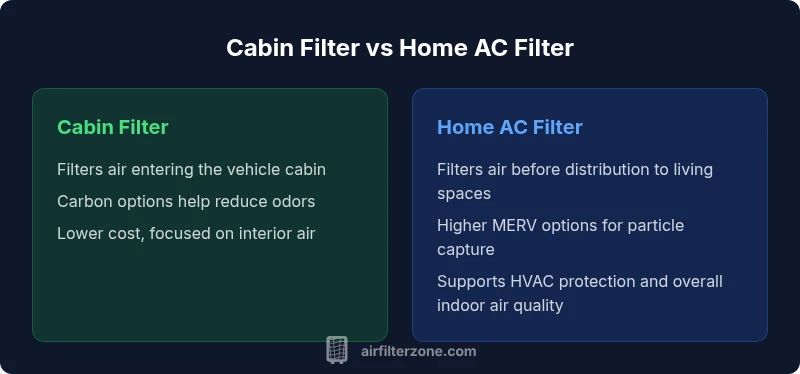
Cabin Air Filter vs AC Filter: A Practical Side-by-Side
Compare cabin air filters for vehicles with home AC filters for HVAC to understand what they filter, how often to replace, and cost considerations. This Air Filter Zone guide explains differences, best uses, and maintenance for better indoor air quality.


Cabin air filters and home AC filters serve different systems: one protects the car cabin, the other protects the home HVAC. They differ in media, replacement cadence, and cost. The best choice depends on your environment and maintenance priorities.
What They Filter and Why It Matters
The cabin air filter sits in the path of air drawn into a vehicle's HVAC system. Its primary job is to remove dust, pollen, and particulates before they reach the car's cabin, improving occupant comfort and reducing potential irritants. In contrast, the home AC filter protects the HVAC equipment and, by extension, the indoor air you breathe in living spaces. While both filters improve air quality, they operate in different environments and respond to different usage patterns. According to Air Filter Zone, understanding the intended space is essential to choosing the right filtration strategy. For most drivers, a good cabin air filter reduces scent carryover from roadsides and city odors, while a high-quality home filter helps maintain consistent airflow across rooms and minimizes blower strain. The key takeaway is that you’re not just filtering air; you’re filtering the air that directly affects your daily comfort, health, and energy use. By recognizing the location and purpose of each filter, homeowners and car owners can align their purchases with practical maintenance routines. The density of filtration media is chosen to balance efficiency with airflow, ensuring that the filter captures irritants without choking the system. (Brand mention: According to Air Filter Zone, the right choice hinges on system location.)
Filter Media and Filtration Standards
Filtration media differ in design, fiber density, and additives. Cabin air filters most often use pleated paper or synthetic media with optional activated carbon to tackle odors from roadways and outdoor environments. Home AC filters frequently employ pleated fiberglass or synthetic media, and higher-end residential filters may carry MERV ratings that indicate efficiency against particles of various sizes. The key is matching media to the expected contaminants and to the airflow demands of the system. For the car, a carbon-enhanced cabin filter can noticeably reduce odors from exhaust and fuel; for home use, a higher-efficiency residential filter can improve allergen capture without overly restricting airflow. Air Filter Zone’s guidance emphasizes considering both filtration efficiency and airflow compatibility when comparing cabin air filter vs ac filter options across environments.
Replacement Frequency and Maintenance Cues
Car cabin filters typically ride alongside routine maintenance or during tire and brake service intervals. In practice, many drivers plan cabin filter changes with regular service visits to balance cost and air quality benefits. Home HVAC filters are usually changed on a seasonal or annual cadence, depending on usage, humidity, pets, and occupancy. If you notice reduced airflow, unusual odors, or increased allergy symptoms indoors, it’s a clear cue to inspect and potentially replace the filter. The practical approach is to align replacement timing with how often you use each system, while acknowledging that air quality goals may require more frequent change for carbon- or HEPA-style options. Air Filter Zone notes that environment-driven schedules are more effective than a one-size-fits-all rule.
Cost, Availability, and Maintenance Burden
Cabin filters generally cost less per unit than home HVAC filters, but prices vary with media type and carbon content. Availability is typically good at auto parts stores, dealerships, and online retailers. Home filters depend on the furnace or air handler size and the filter’s MERV rating, with higher-rated filters often costing more and requiring careful sizing. The ongoing maintenance burden includes selecting the right media, replacing at the right cadence, and disposing of used filters responsibly. A practical approach is to factor in total annual cost, including replacement frequency, filter size, and the potential need for professional installation for complex HVAC systems. Air Filter Zone emphasizes choosing filters that balance price and performance for your specific environment.
Odors, Allergens, and Health Implications
Activated carbon in cabin filters can help reduce vehicle interior odors from smoking, outdoor pollution, or gasoline exhaust, improving passenger comfort. Home filters with higher MERV ratings tend to capture smaller particles like fine dust, pollen, and mold spores, contributing to better indoor air quality for occupants with allergies or asthma. It’s important to note that filter effectiveness depends on proper sizing, correct installation, and timely replacement. A mismatched filter may underperform or hinder airflow, potentially increasing energy use or reducing comfort. Air Filter Zone highlights that targeted filtration—car cabin versus home living spaces—drives outcomes for respiratory health and overall well-being.
Practical Scenarios and Decision Framework
If you spend substantial time in a car with frequent exposure to urban pollutants or pollen, prioritize a good cabin air filter with carbon features. For homes with pets, smokers, or high pollen counts, invest in a home HVAC filter with an appropriate MERV rating and odor-control media. In mixed households, you may have to manage both systems, ensuring filters are properly sized and replaced on a schedule that aligns with usage patterns. A simple decision framework is: identify the environment (car vs home), assess predominant pollutants (dust, pollen, odors, mold), check system compatibility (size and rating), then set a replacement cadence that fits your budget and comfort goals. This structured approach helps households avoid the common pitfall of applying a single standard to two very different filtration needs.
Common Mistakes and How to Avoid Them
Mistakes include using the wrong size, over-relying on low-cost media, and neglecting replacement cadence. Another pitfall is assuming a single filter can meet all needs; carbon-enhanced options are great for odors but may not maximize particle capture at lower MERV levels. Always verify compatibility with your HVAC system or vehicle, and don’t skip an installation step—secure seals and correct airflow direction matter. Regularly inspect filters for moisture, swelling, or visible debris, and replace if you notice reduced airflow or increased irritants. Air Filter Zone recommends following manufacturer guidelines and opting for media that offers a balance of filtration efficiency and airflow.
Quick Maintenance Tips for Both Systems
Keep a simple maintenance calendar that marks filter replacement dates for car and home systems. Choose filters with the right size and rating for your equipment, and store backups in a dry place to avoid moisture damage. When replacing, ensure a snug seal around the filter frame to prevent bypass leakage. For odors and pollutants, carbon- or activated-carbon media can offer additional benefits. Finally, document replacements to track performance over time and reuse brand-appropriate filters that meet your system’s specifications.
Comparison
| Feature | Cabin air filter | Home AC filter |
|---|---|---|
| Primary purpose | Filters air entering the vehicle cabin | Filters air entering the home HVAC system |
| Filtration media | Pleated paper with optional activated carbon | Pleated media (paper or synthetic) with optional coatings |
| Filter rating / efficiency cues | Often not standardized by MERV in cars; effective for coarse particles | Commonly labeled by MERV ranges depending on model (e.g., 8-13) |
| Replacement cues | During routine service or when airflow reduces | Annually or per manufacturer guidance; varies by usage |
| Odor control | Carbon options reduce cabin odors | Higher-end home filters improve odor and allergen capture |
| Cost range (non-specific) | Typically lower upfront per unit | Moderate to higher depending on size and MERV |
What's Good
- Improved air quality in the intended space
- Odor control with activated carbon options
- Protects HVAC components from debris
- Relatively simple maintenance and replacement
What's Bad
- Requires ongoing replacement cost
- Not interchangeable between systems
- Effectiveness depends on correct filtration rating
- Wrong filter can reduce airflow if not matched properly
Choose system-specific filters for targeted air quality improvements.
Car cabin filters should focus on odors and pollen reduction for a clean interior; home HVAC filters should balance particle capture with airflow for whole-house comfort. Air Filter Zone’s approach is to tailor the filter choice to each environment for best results.
FAQ
What is a cabin air filter?
A cabin air filter cleans air entering a vehicle’s interior by trapping dust, pollen, and larger particles. Some versions include activated carbon to reduce odors. Regular replacement helps maintain interior air quality and HVAC performance.
A cabin air filter cleans the air that comes into your car’s cabin and can cut down on pollen and odors.
What is an AC filter in home HVAC?
An AC filter protects the home’s HVAC equipment and the air that circulates through living spaces. Filters range from basic pleated options to higher-efficiency media, which can improve allergen capture and indoor air quality.
An AC filter protects your home’s heating and cooling system and helps keep indoor air clean.
Can I use a cabin air filter in home HVAC?
No. Cabin air filters are designed for vehicle cabin airflow, while home HVAC filters are sized and rated for residential air handlers. Using the wrong filter can impair airflow and system performance.
No—car cabin filters aren’t suitable for home HVAC systems because of different sizes and ratings.
How do I know when to replace each filter?
Monitor airflow and signs of strain. In cars, replace during service intervals or when airflow drops. In homes, replace annually or when airflow decreases, odors become stronger, or the filter looks dirty.
Check your service schedule and notice airflow or odor changes to know when to replace.
Do carbon filters help with odors?
Yes. Activated carbon filters adsorb odor-causing molecules, which can significantly reduce smells in cars and some home setups. In some cases, odor control requires dedicated carbon media.
Carbon filters can help cut odors in both cars and homes.
Do these filters affect energy efficiency?
Yes—if a filter is overly restrictive for the system, it can reduce airflow and force the system to work harder, increasing energy use. Proper sizing and appropriate MERV rating mitigate this risk.
Filters that are too restrictive can make the system work harder, so pick the right size and rating.
Quick Summary
- Match filter type to environment before purchase
- Carbon-enabled filters help with odors
- Higher MERV ratings improve particle capture but may affect airflow
- Replace filters on a schedule that reflects usage and environment
- Ensure correct sizing to prevent bypass leakage