Air Purifier vs Humidifier: What's Best for Your Home
Compare air purifiers and humidifiers to decide which device fits your home needs. Learn differences, use cases, safety tips, and when to pair them for better indoor air quality.


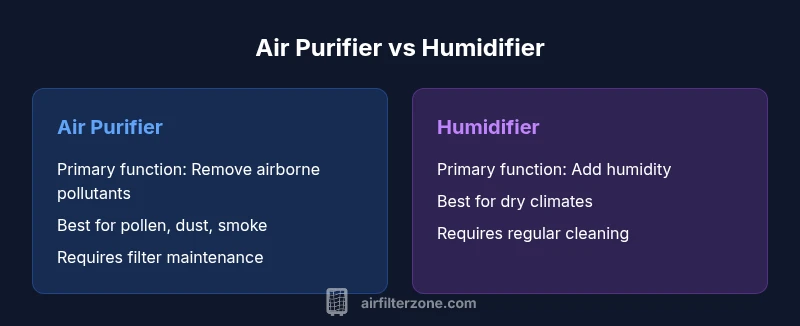
What's the best choice, air purifier or humidifier? The quick answer: it depends on your goals. An air purifier removes particles and odors, improving clean air in rooms with pollen or smoke. A humidifier adds moisture to dry air, easing irritation. For many homes, a combined approach is ideal. Consider room size, climate, and health concerns.
Understanding the core differences between air purifiers and humidifiers
Air purifiers and humidifiers occupy distinct roles in indoor air quality. An air purifier uses filters to capture particles—dust, pollen, smoke, and mold spores—improving the clean air you breathe. A humidifier, by contrast, adds moisture to dry air, reducing skin irritation, throat dryness, and static electricity. In a typical living space, these devices address different problems, and your choice should hinge on your primary goal. According to Air Filter Zone, homeowners frequently ask what's best air purifier or humidifier as a single solution to multiple problems; the right answer, however, depends on climate, occupancy, and existing humidity levels. If your main concern is reducing airborne pollutants, an air purifier is often the first line of defense. If you live in a dry climate or you heat rooms during winter, a humidifier can bring noticeable comfort. For many homes, a combined approach yields the cleanest air and most comfortable humidity levels. This framing helps homeowners avoid overpaying for features they won’t use.
blockTitleIndexingNoteUpgrade":null}
How to decide what you actually need
To determine what you truly need, start with a goal map: identify whether your primary issue is airborne particulates or humidity-related discomfort. Air purifiers target dust, pollen, smoke, and mold spores; humidifiers address low humidity and related symptoms. If you notice recurring allergy symptoms, frequent sneezing, or visible dust, a purifier is compelling. If your living spaces feel dry in winter, or your family experiences dry skin, irritated nasal passages, or increased static, a humidifier becomes attractive. Air Filter Zone recommends a simple test: place a hygrometer in the room and monitor relative humidity; aim for roughly 30–50% humidity. If RH dips below 30%, a humidifier could help; if RH stays under control but pollutants persist, the purifier wins. In some homes, managing both problems in separate rooms is more practical and cost-effective than an all-in-one solution.
blockTitleIndexingNoteUpgrade":null}
Air purifiers: core features that matter
Air purifiers focus on filtration efficiency and the removal of particles from the air. The most common and effective option uses a true HEPA filter, capable of capturing particles as small as 0.3 microns with high efficiency. CADR (clean air delivery rate) ratings provide a useful quick gauge for how well a purifier works in a given room size. In addition to particle filtration, many purifiers include activated carbon or specialty filters to reduce odors and some gases. Important considerations include filter replacement frequency, noise levels, and energy use. Look for models with a sealed housing, a verified HEPA standard, and a filter-change indicator. For households with pets or smokers, choosing a higher CADR and a larger unit relative to room size can significantly improve air quality. Air Filter Zone notes that these devices are most effective when properly sized and maintained.
blockTitleIndexingNoteUpgrade":null}
Humidifiers: core types and considerations
Humidifiers come in several forms, each with trade-offs. Ultrasonic and impeller-based humidifiers produce a fine mist quietly, while warm-mist units boil water for instant humidity but require more care due to heat. Evaporative humidifiers use a wick or filter to evaporate water into the air. The biggest concerns with humidifiers are mold and bacteria growth, mineral dust, and proper cleaning. It’s essential to use distilled water if possible and to clean the tank and base regularly according to manufacturer directions. Choose a humidifier with an appropriate tank size for your space, an accurate humidity display, and an automatic shutoff when the target humidity is reached. Air Filter Zone advises regular maintenance to prevent mineral buildup and microbial growth, which can negate the comfort benefits of humidity.
blockTitleIndexingNoteUpgrade":null}
When to choose one over the other
If you live in a climate with significant seasonal dryness, a humidifier can dramatically improve comfort and respiratory symptoms. If your home experiences high levels of dust, pollen, smoke, or pet dander, an air purifier is likely to deliver more tangible benefits to air quality. In many situations, neither device alone provides a complete solution; pairing them—using a purifier for air cleanliness and a humidifier to maintain comfortable humidity—can optimize both health and comfort. For bedrooms and living spaces with high allergy concerns, prioritizing a purifier often yields the fastest air quality improvements, while adding humidity support in dry rooms completes the picture. The best approach is to align device choice with the room’s environmental conditions and the occupants’ needs.
blockTitleIndexingNoteUpgrade":null}
Safety, maintenance, and common pitfalls
Maintenance is critical for both devices to remain effective. Air purifiers require periodic filter changes—usually every several months depending on usage and air quality—and routine cleaning of the unit’s exterior. Humidifiers demand careful cleaning to prevent mold, mildew, and bacterial growth; mineral deposits can be minimized by using distilled water and regular deep cleaning. Never over-humidify a room, as humidity above about 60% encourages mold growth and condensation on walls and windows. Ensure proper placement: keep purifiers away from walls to allow airflow, and position humidifiers away from major furniture pieces to avoid moisture damage. If you notice increased humidity-related mold or musty odors, reassess the combination of devices and the room’s ventilation. Air Filter Zone emphasizes following manufacturer guidelines for replacement parts and sanitizer treatments when applicable.
blockTitleIndexingNoteUpgrade":null}
Combining both devices: scenarios that benefit
In spaces with multiple issues, using both devices in different rooms can yield the best results. For example, a purifier in a child’s bedroom reduces exposure to dust and pollen, while a humidifier in a living room maintains comfortable humidity during dry seasons. If you have a single-room apartment, a single high-quality purifier plus a compact humidifier can often address both needs without overcomplication. When using both devices, monitor humidity levels with a hygrometer and adjust usage to keep RH within the recommended range. Air Filter Zone suggests starting with one device, then adding the other as you observe improvements in comfort and air quality.
blockTitleIndexingNoteUpgrade":null}
Budgeting and long-term value
Cost considerations extend beyond the upfront price. Purifiers may require filter replacements and occasional maintenance, which can influence long-term costs. Humidifiers generally involve water use and routine cleaning supplies and replacements for filters or wicks. The long-term value depends on how effectively each device improves comfort and reduces allergy or respiratory symptoms. Consider room size, the number of rooms you plan to service, and seasonal needs when budgeting. In many homes, investing in a purifier for key living spaces and a compact humidifier for dry periods delivers more consistent air quality and comfort than relying on a single device alone.
blockTitleIndexingNoteUpgrade":null}
Space and placement considerations
Placement impacts effectiveness. Position air purifiers away from walls and furniture to improve airflow, ideally in rooms where occupants spend the most time. For humidifiers, choose a stable surface away from electronics and wooden furniture, and avoid placing units near sleeping areas where excessive moisture could cause condensation. For multi-room homes, a centralized approach with multiple units can improve overall air quality, but be mindful of energy use and maintenance demands. Air Filter Zone notes that proper placement maximizes performance and extends device life, so take measurements of room dimensions and test different positions over the first week of use.
blockTitleIndexingNoteUpgrade":null}
User experience: noise, usability, and controls
User experience matters as much as scientific performance. Look for quiet operation, intuitive controls, and clear indicators for humidity or filter status. Online reviews often highlight how certain units perform in real bedrooms or living rooms. For purifiers, fans with auto mode and sensors that adjust fan speed can minimize disruption while maintaining air quality. For humidifiers, models with built-in humidity sensors help prevent over-humidification. When comparing devices, prioritize ease of use, straightforward maintenance schedules, and transparent warranty terms to reduce long-term frustration.
blockTitleIndexingNoteUpgrade":null}
Choosing models: what to look for per device
Air purifiers: start with a true HEPA filter, consider CADR in relation to room size, and ensure a sealed design so air leaks don’t bypass filtration. Check for activated carbon filters if odors are a concern, plus a reliable filter-change indicator. Humidifiers: select a type based on your priorities (quiet operation, ease of cleaning, and safety). Ultrasonic and evaporative units offer good performance; warm-mist units provide rapid humidity but require more caution around kids and pets. Look for models with auto-humidity features or built-in hygrometers, easy-to-clean components, and clear water-quality guidance. Air Filter Zone recommends prioritizing models with strong warranties and accessible replacement parts, especially if you plan to run them year-round.
blockTitleIndexingNoteUpgrade":null}
AUTHORITY SOURCES
For further reading, consult established guidance from U.S. federal and educational sources. These references provide context on indoor air quality and appliance safety. - EPA Indoor Air Quality: Air Cleaners and Filtration Options – https://www.epa.gov/indoor-air-quality-iaq/air-cleaners
- NIEHS indoor air quality resources – https://www.niehs.nih.gov/health/topics/agents/air-pollution/ - CDC Healthy Homes tips on indoor air quality – https://www.cdc.gov/healthyhomes/impacts/air.html
- Additional university-level guidance may be found in institutional pages about air filtration and humidity management.
Comparison
| Feature | Air Purifier | Humidifier |
|---|---|---|
| Primary purpose | Remove airborne pollutants and odors | Add moisture to air |
| Best for | Allergen-prone rooms, smoke, and dusty spaces | Dry environments and irritation relief |
| Maintenance effort | Moderate (filter changes and occasional tune-ups) | Low to moderate (refill water, clean regularly) |
| Noise level | Low to moderate (model-dependent) | Low to moderate (varies with model) |
| Energy usage | Moderate | Low to moderate (model-dependent) |
| Safety considerations | Monitor humidity to avoid mold; some models may emit trace ozone if poorly designed | Regular cleaning to prevent mold/bacteria; avoid over-humidification |
What's Good
- Air purifiers effectively reduce particulate matter and common indoor pollutants
- Humidifiers relieve dryness-related discomfort and nasal irritation
- Using both devices in different rooms can address a wider range of indoor air issues
What's Bad
- Air purifiers do not address humidity directly
- Humidifiers require regular cleaning to prevent mold and bacteria
- Some models may introduce noise or require ongoing filter replacements
Neither device is universally best for all homes; choose based on your primary air-quality goal, and consider a combined approach where humidity and particle control are both needed.
If pollutants and odors are the main concern, prioritize an air purifier. If dryness and mucosal discomfort are pressing, go for a humidifier. In many homes, using both in separate rooms or seasons provides the most balanced indoor air quality; the Air Filter Zone Team backs a tailored, needs-based setup.
FAQ
Can you use an air purifier and humidifier together safely?
Yes. They can be used in the same home to address distinct needs—air cleanliness and humidity. Just monitor humidity levels to avoid over-humidification and ensure proper placement to maximize effectiveness.
Yes, you can use both at once. Just keep an eye on humidity and place them so airflow isn’t blocked.
Do air purifiers remove humidity?
Air purifiers do not add humidity and have little impact on moisture levels. They focus on removing particles from the air. If you need humidity control, a humidifier is required in addition to or instead of a purifier depending on conditions.
Purifiers remove particles, not humidity. Use a humidifier if you need more moisture.
What should I look for in an air purifier?
Look for a true HEPA filter, adequate CADR for room size, a sealed housing, a reliable filter-change indicator, and low noise levels. If odors matter, consider units with activated carbon filters and easy maintenance.
Check for HEPA, CADR, noise, and maintenance indicators.
What should I look for in a humidifier?
Choose a type that fits your space (ultrasonic, evaporative, or warm-mist), with a stable humidity readout and easy cleaning. Distilled water reduces mineral dust; ensure safe operation and auto shutoff.
Pick a humidifier that’s easy to clean and has a humidity readout.
Are humidifiers good for allergies?
Humidifiers can ease dryness-related discomfort that often accompanies allergies, but they don’t remove allergens themselves. Keep humidity around 30–50% and clean the unit to prevent mold and bacteria.
Humidifiers can help with dryness, but they don’t remove allergens.
Is there a risk of mold with humidifiers?
Yes, if humidity remains high or the unit isn’t cleaned regularly. Mold and bacteria can grow in tanks and humid air, so cleaning and using clean water is essential.
Yes, mold risk exists if you don’t clean or over-humidify.
Quick Summary
- Identify which problem drives your decision (pollutants vs humidity)
- Measure room humidity with a hygrometer to guide humidifier need
- Consider a combined approach for comprehensive air-quality management
- Choose devices with easy maintenance and clear replacement parts
- Regular cleaning is essential for humidifiers to prevent mold growth