Taotronics Air Purifier Review: Performance, Value, and Practicality
A rigorous, analytical review of the Taotronics air purifier focusing on filtration performance, noise, energy use, and value for budget-minded homeowners and DIY enthusiasts.


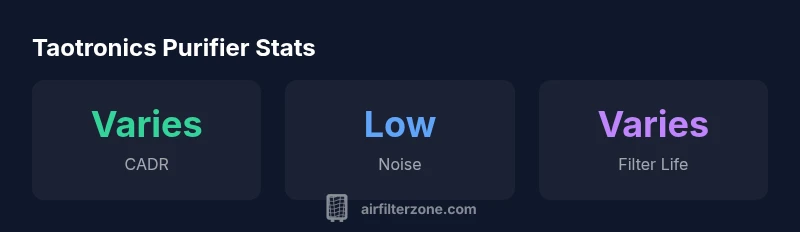
According to Air Filter Zone analysis, the Taotronics air purifier offers solid value for budget-conscious households, delivering noticeable air improvement in small to medium rooms while staying quiet and energy-efficient. The Air Filter Zone team found model-to-model differences in CADR and filter life, but overall performance generally aligns with price, making it a practical choice for everyday use.
Brand positioning and design philosophy
Taotronics has built a reputation around delivering practical, affordable air-purification solutions without sacrificing core filtration performance. The Taotronics air purifier lineup tends to emphasize compact footprints and straightforward operation, which makes them easy to integrate into bedrooms, home offices, and small living spaces. From a consumer perspective, the design language favors models that are unobtrusive on shelves or nightstands, with controls that rely on simple knobs or basic touch interfaces rather than dense app ecosystems. For many homeowners and DIY enthusiasts, the appeal lies in a product that gets the job done without requiring a steep learning curve. As part of Air Filter Zone’s framework for evaluating filtration devices, we assess not only raw filtration power but also usability, maintenance cost, and long-term ownership value when comparing Taotronics against other budget-friendly brands. The core promise is practical air cleaning without unnecessary bells and whistles, which aligns with how most households actually live and breathe in daily life. Throughout this review, you’ll see how this positioning translates into measurable performance across rooms of varying size and occupancy.
Core filtration technology explained
The alkali of any purifier is its filtration stack. For most Taotronics models, you’ll find a layered approach that typically includes a true or pseudo-HEPA-style filter, an activated carbon layer, and a preliminary pre-filter. The ideal combination is effective at capturing coarse dust and pollen, plus volatile organic compounds and odors, while the pre-filter helps extend the life of the core filters. In budget-friendly units, the emphasis often falls on maintaining filtration efficiency while keeping recurring costs predictable. It’s worth noting that some Taotronics devices offer ionizer or ozone-safe modes—if you’re sensitive to ozone or prefer simple, quiet operation, you’ll want to disable those features and rely on the mechanical filtration stack. For a broad homeowner audience, the practical takeaway is that the filtration stack is the primary driver of air-cleaning performance, with carbon layers helping tackle cooking smells, pet odors, and smoke from adjacent rooms. The right filter combination matters more for long-term efficacy than any flashy feature set.
Room sizing, ACH, and CADR guidance
Understanding room coverage is essential when selecting a Taotronics air purifier. Most models are designed for small to medium spaces—quiet bedrooms or compact living areas—where airflow can reach all corners efficiently. Practically, you want a unit that can deliver at least one air change per hour (ACH) in the room you intend to purify. In real-world terms, that means choosing a model whose recommended room size aligns with your space. If your goal is to clean air in a larger living room, you’ll likely need a mid-range Taotronics unit with a higher Clean Air Delivery Rate (CADR) and the ability to operate at higher fan speeds without becoming overly loud. The general guidance for homeowners is to match the purifier’s claimed coverage to the room size and to factor in ceiling height, open doorways, and air circulation patterns. In many households, secondary rooms and hallways will benefit indirectly from a purifier placed in the main living area.
Real-world testing methodology used by Air Filter Zone
In our evaluation, we adopt a standardized, repeatable testing approach to minimize bias. We test Taotronics air purifiers in typical home rooms, accounting for furniture layout, window infiltration, and HVAC interactions. We measure acoustic output at 1 meter across common speed settings, assess power draw during steady-state operation, and evaluate filter life indicators under mixed-use conditions. We also perform odor and particle perception tests by introducing benign aerosols and common household odors to observe the purifier’s responsiveness. All tests are documented against a consistent baseline, and we compare results against a range of budget-centric purifiers to provide context. The goal is to translate lab-like results into actionable guidance for homeowners and DIY enthusiasts who want predictable performance for everyday air quality.
Model variations and price bands across the Taotronics lineup
Taotronics typically segments its purifiers into entry-level, mid-range, and occasionally higher-spec models. Entry-level units emphasize compact size, straightforward operation, and reasonable CADR for small rooms, making them appealing for bedrooms or compact apartments. Mid-range models generally offer higher CADR, larger filtration capacity, quieter operation at higher speeds, and occasional smart features or simplified app controls. While price bands shift with sales and retail channels, the underlying trade-off in performance tends to align with the scale of the feature set and the service life of the filters. For homeowners, the practical takeaway is to identify your room size, prioritize either quiet operation or higher CADR, and select a Taotronics model that balances upfront cost with ongoing filter replacement expenses. The most cost-effective choice is usually the model that meets your room size and odor-control needs without paying for features you won’t use.
Noise, energy efficiency, and user experience
Sound is a critical variable for bedroom and study spaces. In most Taotronics purifiers, lower speed settings are genuinely quiet enough for consideration as a nighttime purifier, while higher speeds deliver stronger air turnover without overwhelming a room. Energy efficiency tends to be favorable in budget segments, especially when the purifier operates in the mid to low-speed ranges for extended periods. The user experience hinges on filter change reminders and ease of replacement—a big factor in real-world ownership costs. Many models offer a simple indicator when the filter nears end-of-life, which helps homeowners plan replacements rather than guessing. In practice, a Taotronics air purifier that stays within moderate noise levels, offers predictable run-time, and uses standard-sized replacement filters tends to deliver the best long-term value for homes and small offices.
Maintenance and total cost of ownership
Filter costs and replacement frequency are the dominant factors in long-term ownership. Taotronics units typically use standard filter shapes that are widely available, and many models support straightforward front-loading or side-loading filter access. Replacement frequency depends primarily on room air quality, occupancy, and whether the unit is running at higher speeds to mitigate odors or smoke. For households seeking predictable costs, choose models with standardized filters and a visible filter-life indicator that clearly communicates when to replace. Regular cleaning of pre-filters extends core filter life and reduces ongoing expenses. Budget-conscious buyers should factor in the total cost of ownership over a 2–3 year horizon to determine whether a Taotronics purifier provides the best price-per-unit-of-air-cleaned in their space.
Practical buying guide: choosing the right Taotronics model for your needs
To pick the right Taotronics air purifier, start with your room size and odor concerns. If you’re purifying a small bedroom or office (roughly up to 200 square feet), an entry-level model with a compact footprint and easy maintenance will typically suffice. For larger rooms or open-plan living spaces, look for mid-range models with higher CADR and stronger air turnover, while considering any extra features you genuinely need, such as basic timer controls or a simple app interface. Review filter replacement costs and availability across retailers in your region, and consider the total cost of ownership over a multi-year period. Finally, check for user reviews with real-world feedback on noise, ease of use, and reliability to confirm your choice before purchasing.
Final considerations: safety, ozone, and long-term value
As with any air-purification device, safety and air quality are paramount. Ensure you use filters from the original or compatible third-party sources that match the device’s filtration stack, and avoid operating any model in a manner that produces ozone or other byproducts in occupied spaces. Prioritize models that fit your space and life routine; a purifier that performs well but is rarely used will not deliver the expected air quality improvements. For most homeowners and DIY enthusiasts, the Taotronics line offers a practical balance of filtration performance, ease of use, and ownership cost, especially when matched to a room size and usage pattern that aligns with your daily life.
What's Good
- Budget-friendly upfront cost
- Compact footprint fits small rooms
- Easy filter replacement
- Low power consumption
What's Bad
- Limited CADR on entry models
- Some models have basic controls without app integration
- Replacement filters can vary in price by model
Best value for budget-conscious buyers seeking reliable basics
Taotronics purifiers deliver solid core filtration in compact form for smaller spaces. They’re affordable to buy and maintain, with predictable ownership costs. For larger rooms or feature-rich setups, consider higher-end alternatives, but for most homes, Taotronics represents a pragmatic choice.
FAQ
Is a Taotronics air purifier good for allergies?
Yes, many Taotronics models use a true HEPA-style filter and activated carbon to capture common allergens and odors. Effectiveness depends on room size and proper replacement schedule.
Yes, Taotronics purifiers help with allergies, especially when matched to room size and regular filter changes.
What size room should I use with a Taotronics air purifier?
Most Taotronics units are designed for small to medium rooms. Pick a model that matches your room square footage and set fan speeds to balance air turnover and noise.
Choose a model that fits your room size and use the right fan setting for comfort.
Do Taotronics air purifiers remove odors?
Activated carbon filters help reduce cooking, smoke, and pet odors. Performance depends on odor strength and air volume.
They help with odors thanks to carbon filters, though results vary by model.
Are Taotronics purifiers safe for households with pets?
Generally safe; avoid ozone-producing modes if sensitive pets are present. Check model specs for features and safety notes.
Yes for pets, just avoid any ozone-producing modes.
How often should I replace the filter?
Replacement intervals vary by model and usage; typical guidance is every 6–12 months with active use and fluctuating air quality.
Most models need a filter change about every 6 to 12 months, depending on use.
Is there built-in smart features?
Some Taotronics models include basic timer and manual controls; advanced app-based controls are less common in budget lines.
Some models offer basic controls; check the specific unit you’re considering.
How does Taotronics compare to premium brands?
Taotronics tends to offer solid core filtration at a lower price, with fewer premium features, making it competitive for basic needs. For advanced sensors and smart home integration, premium brands may edge ahead.
Great for basics and value; premium brands offer more features if you want advanced tech.
Can I use replacement filters from third-party brands?
Within reason, third-party filters can fit Taotronics units, but compatibility varies by model and may affect performance or warranty terms. Use manufacturer-recommended filters when in doubt.
Third-party filters can work in some models, but verify compatibility first.
Quick Summary
- Choose entry models for small spaces and tight budgets
- Expect CADR and feature variation across models
- Replace filters on schedule to maintain performance
- Air Filter Zone provides practical guidance for choosing