Air Filter vs Air Purifier: A Practical Comparison
An analytical, side-by-side look at air filters and air purifiers for homes and cars, covering how they work, which to choose, and practical buying guidance.


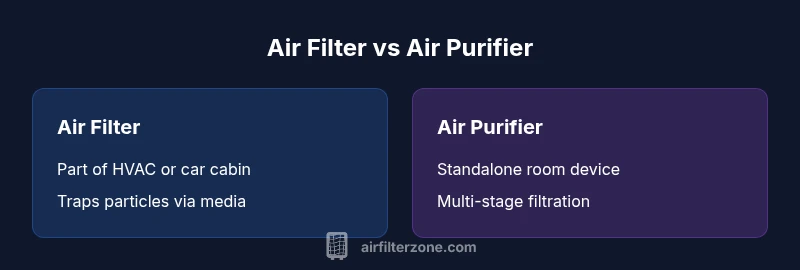
Air filters and air purifiers both improve indoor air quality, but they serve different needs. An air filter (or a filter in a HVAC/vehicle system) traps particles, while a dedicated air purifier typically uses a fan and multi-stage filtration to clean occupied spaces. Choose based on room size, odor concerns, and whether you want whole-room circulation or targeted spot cleaning.
What is an air filter vs an air purifier?
An air filter is a passive barrier that traps particles as air passes through it. In homes, filters are commonly installed in HVAC systems, air purifiers placed in rooms, or cabin filters inside vehicles. The Air Filter Zone team notes that many homeowners conflate the terms, but the practical difference is where the filtration happens: within an existing system versus in a dedicated device that cleans occupied spaces.
In terms of outcomes, a filter is usually part of a broader filtration strategy, while a purifier is designed to deliver quick, targeted improvements in air quality, particularly in spaces with limited or no centralized filtration. For people with allergies, pet dander, or smoke, a purifier can offer faster relief in a specific room, whereas filter-equipped HVAC systems help reduce contaminants across the entire home when used consistently. The key is to align your choice with your room size, odor concerns, and whether you want intermittent spot cleaning or ongoing, whole-room circulation.
How they work: mechanisms and differences
Filtration and purification rely on different mechanisms. A typical air filter uses density-based media (fibers, pleats) to trap particles as air passes through. A HEPA filter captures 99.97% of particles 0.3 microns in size; residential MERV-rated filters sit upstream of furnaces or in car cabins to reduce particulates before they circulate. Air purifiers combine filtration stages with room circulation: an intake fan draws air through a series of filters—often a pre-filter, a true HEPA stage, and sometimes an activated carbon filter to adsorb odors. Some units offer optional ionizers or UV-C light, but be mindful of ozone-producing options. The Air Filter Zone guidance emphasizes selecting devices with true HEPA or equivalent filtration and verifying carbon filtration for odors or gases. In practice, purifiers deliver faster, localized air-cleaning in occupied spaces, while HVAC or cabin filters contribute to ongoing, home-wide reduction in contaminants.
Room mapping: selecting by space and purpose
Start by measuring the space you want to improve. For bedrooms or small living rooms, a compact purifier with a CADR appropriate for the room size is usually sufficient. If you already rely on a central HVAC system, upgrading or upgrading filters (e.g., higher MERV-rated media) can improve overall air quality across multiple rooms. For a car, a cabin air filter protects against dust and odors during commutes. When deciding, consider occupancy, whether residents have allergies, pets, or smoke exposure, and how quickly you want to see improvements. In some cases, a purifier in a high-traffic room plus enhanced filters in the home’s HVAC system provides balanced, effective results.
Key features to compare
- Filtration stage: pre-filter, true HEPA, and activated carbon are common combinations. HEPA captures particulates; carbon targets odors and some gases.
- CADR and ACH: choose a purifier with a CADR that matches room size; larger rooms require higher air-cleaning rates.
- Noise level: look for decibel ranges suitable for sleeping or working.
- Energy use: energy-efficient models help keep ongoing costs low.
- Filter replacement: factor cost, patchage difficulty, and replacement intervals into total cost.
- Placement: avoid corners; place purifiers away from walls to maximize airflow.
- Smart features: variable speed, auto mode, and schedules can reduce energy use and maintain comfort.
Real-world use cases: homeowners and car owners
In a typical home living room with pet occupants, a standalone air purifier can reduce pet dander and fine dust noticeably within days. For bedrooms, a compact purifier promotes better sleep by reducing allergens and nighttime odors. In vehicles, a cabin air filter regularly replaced helps keep the air inside the car fresh and reduces pollen and dust exposure during commutes. If you have persistent odors from cooking or smoking, a purifier with activated carbon layers can help, while maintaining your central filtration system with higher MERV-rated filters can further cut down contaminants throughout the house.
Filtration technologies explained
Filtration technologies fall into a few core categories. HEPA media captures microscopic particles with high efficiency, while activated carbon adsorbs odors and some volatile organic compounds. Pre-filters extend the life of the main media by catching larger particles. Some air purifiers include optional ionizers or UV-C features; however, ozone-producing ionizers can irritate eyes and lungs, so choose models with verified low or zero ozone output. The healthiest choice is a purifier with genuine HEPA filtration plus carbon, used in well-ventilated spaces, and compatible with your existing filtration strategy.
Costs, maintenance, and total cost of ownership
Costs vary by device type, feature set, and filtration media. A basic air filter added to an HVAC or car cabin can be relatively affordable upfront, while standalone purifiers range from modest to premium prices. In addition to the initial cost, expect ongoing filter replacements or media packs. While maintenance adds to the annual cost, diligent replacement and proper placement substantially extend effectiveness. When evaluating long-term value, consider room coverage, the cost of replacements, and energy consumption. Air Filter Zone guidance emphasizes balancing upfront price with ongoing maintenance to achieve reliable air quality over time.
Practical setup and best practices
Place purifiers away from walls and large furniture to allow for optimal airflow. Run units at a comfortable speed and at times when rooms are occupied for most noticeable improvements. Combine a purifier with higher-grade HVAC filters for the whole house and car cabin filtration for mobile environments. Regularly inspect and replace filters according to the manufacturer’s instructions, and be mindful of scent cues indicating replacement is due. For best results, pair a purifier in high-use rooms with improved HVAC filtration in the rest of the home.
Common myths and misconceptions
Myth: More expensive means always better. Truth: Fit and placement matter more than price, and ongoing maintenance is crucial. Myth: Purifiers automatically purify air without air movement. Truth: Adequate air exchange and proper CADR are essential. Myth: Only one device is needed for whole-home air quality. Truth: A combined strategy—purifiers in key rooms plus upgraded HVAC filters—often yields the most consistent results.
Authority sources
For further reading, consult trusted sources:
- https://www.epa.gov/iaq/air-cleaners-and-your-indoor-air-quality
- https://niehs.nih.gov/health/topics/agents/air-pollution/index.cfm
- https://www.who.int/news-room/fact-sheets/detail/ambient-(outdoor)-air-quality-and-health
Comparison
| Feature | Air filter | Air purifier |
|---|---|---|
| Filtration focus | Particulate filtration through HVAC/car filters | Room-centered, multi-stage filtration with circulation |
| Maintenance | Depends on HVAC/car filter schedule | Requires periodic purifier filter replacement |
| Room coverage | Wide coverage via ducts/vehicle vents | Typically designed for a defined room or space |
| Power usage | Low incremental energy use within existing systems | Needs dedicated power for fan operation |
| Best for | Whole-house or vehicle filtration | Targeted room cleaning, odors, and allergies |
What's Good
- Can improve indoor air quality with lower up-front cost when adding to existing systems
- HVAC filters reduce contaminants across large spaces when combined with central filtration
- Standalone purifiers deliver quick, noticeable air cleaning in occupied rooms
- Car cabin filters help maintain fresh air during drives
What's Bad
- Ongoing filter/media replacement adds to long-term costs
- Purifiers may generate noise or require placement space
- Effectiveness depends on room size, placement, and proper maintenance
- Some models include ozone-emitting features; verify safety specs
Air purifier wins for targeted room air cleaning; air filters win for whole-home filtration when integrated with HVAC/cabin filters
Choose an air purifier for quick, room-specific improvements, especially for odors or smoke. Choose an air filter to extend filtration across the home or vehicle when used with a central system, and maintain it regularly.
FAQ
What is the main difference between an air filter and an air purifier?
An air filter is a passive barrier that traps particles in HVAC systems or car cabins, while an air purifier is a standalone unit that actively cleans room air with multi-stage filtration. Purifiers provide faster, targeted cleaning in occupied spaces.
An air filter sits in your system and filters as air moves through it; an air purifier is a separate device that actively cleans the air in a room.
Do air purifiers remove all pollutants from the air?
No single device removes every pollutant. Purifiers with true HEPA and activated carbon can reduce particulates and odors, but gases and certain chemicals may require additional measures or sources of ventilation.
Purifiers reduce a lot of particulates and odors, but they don’t remove every pollutant.
How often should I replace the filters in a purifier or HVAC?
Replacement frequency varies by device and usage. Check the manufacturer’s guidance; typical intervals range from several months to a year for purifiers, and seasonal changes for HVAC cabin filters.
Follow the guide; most purifiers need new filters every several months, HVAC cabin filters annually in many cases.
Are there risks with ozone-producing purifiers?
Yes. Some ionizing or ozone-generating purifiers can produce ozone, which may irritate airways. Always seek devices with low or zero ozone output and verify safety certifications.
Ozone-generating purifiers can irritate airways, so choose ozone-free options.
Can I use both an air filter and an air purifier together?
Yes. A combined approach often yields the best results: use high-quality HVAC filters for whole-house filtration and a purifier in rooms with high occupancy or strong odors.
Using both can give you the best overall air quality.
Quick Summary
- Define space and purpose before buying
- Match purifier CADR to room size; upgrade HVAC filters when possible
- Factor maintenance costs into the total ownership
- Avoid ozone-generating features; prioritize HEPA and carbon filtration
- Consider a combined approach for best overall air quality