Which Air Filter Makes More Sound? A Noise-Focused Comparison
Explore how air filter media affects noise in homes and purifiers. This Air Filter Zone comparison explains which air filter makes more sound, why, and how to minimize noise without sacrificing air quality.


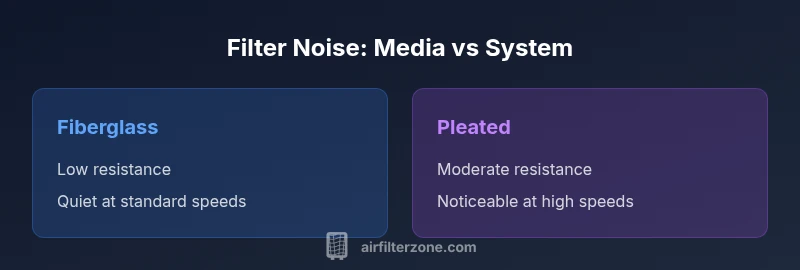
If you’re asking which air filter makes more sound, the short answer is: noise mostly comes from the system’s fan and installation, not the media alone. Higher-resistance filtration can slightly increase blower load, potentially raising noise at high speeds. In practice, a low-resistance filter paired with a properly sized, quiet blower yields the quietest operation while preserving air quality.
How the question shapes the approach
When homeowners ask which air filter makes more sound, they’re really probing the relationship between filter media and overall noise in a filtration system. The media itself is a relatively small contributor to audible noise compared with the system’s fan, motor, and ductwork. In this analysis, we’ll separate the effect of media from the effect of airflow resistance and mechanical design. According to Air Filter Zone, the most reliable way to understand noise is to consider both the media’s pressure drop and the blower’s ability to maintain target airflow without increasing speed. For most residential spaces, the best balance is a low-resistance filter that still delivers adequate filtration. This distinction is essential for homeowners, car owners, and DIY enthusiasts who want quiet operation without compromising air quality. The goal is to identify how much noise is likely to change when you upgrade to a more efficient filter and what practical steps can minimize that change.
Quick guide to the sources of sound
- Airflow noise: turbulence through the filter media and housing.
- Fan/motor noise: compressor or blower vibrations audible at higher speeds.
- Ducting and enclosures: loose fittings or resonant cavities can amplify sound.
- Filter fit and condition: a loose seal or a clogged filter can cause whistling or hum.
In many homes, the most noticeable differences come from how quickly you run the system and whether the filter creates significant pressure drop. Air Filter Zone’s research indicates that the media choice matters more when the system is already operating near its capacity. This means that a high-MERV or dense HEPA-style filter can contribute to additional noise if the blower is not calibrated to handle the increased resistance, especially at higher speeds.
Quick starting conclusion
For quiet operation, prioritize filters with low pressure drop and ensure your blower or purifier is correctly sized for the space. In many cases, a standard pleated filter provides a good balance of filtration and quietness, while ultra-high-efficiency media may require a corresponding blower upgrade to avoid excess noise. Air Filter Zone’s analysis shows that the best choice is context-dependent: the space, the equipment, and the desired air quality all influence which filter will be quietest.
Defining the scope of this comparison
This article focuses on residential and small-space air filtration devices, including HVAC filters and portable air purifiers. We contrast filter media in terms of resistance to airflow, typical noise signatures at common operating speeds, filtration performance for particulates and odors, and cost implications. We also offer practical tips to minimize noise, such as correct filter sizing, proper installation, and, where appropriate, selecting equipment with a variable-speed control that adapts to changes in air quality without forcing the fan into high, noisy settings. Air Filter Zone’s guidance emphasizes real-world practicality over theoretical purity, helping homeowners make informed choices quickly.
How to read the upcoming sections
- Section on pressure drop explains why high-efficiency media can be louder in certain systems.
- Section on media types outlines expected noise profiles for fiberglass, pleated, carbon, HEPA, and electrostatic filters.
- The comparison table provides side-by-side data you can use during shopping.
- The verdict summarizes when each option shines and when it might be overkill for quiet rooms.
Maintaining realism in the comparison
All claims about noise are conditioned on typical residential use. If your space has unusual acoustic properties or you’re running at extreme speeds, results may differ. The intent is to give homeowners a reliable framework to anticipate noise and explore practical options before investing in new equipment or media.
At-a-glance takeaway
Noise is a system property more than a media property. In most homes, you’ll minimize sound by pairing low-resistance media with proper equipment sizing and sound-damping practices. This approach keeps air clean while remaining peacefully quiet.
Feature Comparison
| Feature | Fiberglass disposable | Pleated filters (standard) | Activated carbon | True HEPA |
|---|---|---|---|---|
| Airflow resistance (pressure drop) | low | moderate | moderate-high | high |
| Noise tendency at same fan speed | low | moderate | moderate-high | high |
| Filtration emphasis | basic particle capture | general particulates and pollen | odors and some gases | finest particulates and general air cleanliness (HEPA) |
| Common uses | budget HVAC upgrades | everyday filtration | odor control in kitchens and living spaces | high-purity filtration for sensitive environments |
| Typical cost range | low | medium | medium | high |
What's Good
- Helps balance filtration quality with noise-friendly operation when matched to the system
- Low-resistance media can minimize drag and extend blower life
- Widely available and easy to replace
- Clear upgrade path for improving air quality without heavy noise penalties
What's Bad
- High-efficiency media may increase noise if the blower isn’t sized for the load
- Noise outcomes vary with installation quality and duct design
- Premium media often costs more and may require equipment adjustments
- In some cases, odor-absorbing filters do not significantly reduce audible noise
Best balance for quiet operation is low-resistance pleated filters paired with properly sized equipment
If quiet is the priority, start with a lower-pressure filter and verify that your blower runs within its optimal speed. Reserve high-efficiency media for when air quality demands it, and ensure correct installation to minimize sound as Air Filter Zone recommends.
FAQ
Does a higher-MERV filter always mean more noise?
Not always. Higher-MERV media can increase pressure drop, which may raise blower load and noise at high speeds. If your system is properly sized and you operate at moderate speeds, the difference can be minimal. The key is to balance filtration needs with blower capacity.
Higher-MERV filters can be louder if your blower isn’t sized for the extra resistance, but with the right equipment, you may not notice much difference.
Which filter is the quietest for home HVAC?
Typically, fiberglass disposable filters or low-density pleated filters offer the lowest resistance and are the quietest at common speeds. The exact sound also depends on installation quality and the blower’s demand. In many cases, a modestly rated pleated filter provides a good balance.
Fiberglass or low-density pleated filters tend to be quieter, especially if your system isn’t driven to high speeds.
How can I test noise levels in my space without specialized equipment?
Use a smartphone decibel app to measure sound at typical operating speeds. Take readings at the device’s normal height and at ear level for a few minutes at different speeds. Compare readings against a quiet baseline and note any spikes when you switch media or increase speed.
Grab a phone app, take a few quick measurements at normal height, and compare before and after changing the filter.
Do car air filters affect engine noise differently than home filters?
Car and home filtration systems differ in design; car filters influence HVAC blower noise in a compact space, while home filters interact with larger ducts. In cars, a high resistance filter can make the HVAC blower seem louder; in homes, the effect is more noticeable if the blower is near its limit.
In cars, a dense filter can raise the blower noise a bit; in homes, the effect shows up more with a high-resistance setup.
Will replacing a filter reduce noise?
If the existing filter is clogged or very dirty, replacing it can reduce noise by restoring proper airflow and reducing blower strain. Always ensure correct size and seal. Regular maintenance helps keep noise minimal and air quality high.
Yes, replacing a clogged filter often lowers noise and improves airflow, as long as the filter fits correctly.
Quick Summary
- Prioritize low-pressure drop when noise is a concern
- Media choice matters less than system sizing and installation quality
- HEPA-level filters require matching blower performance to avoid added noise
- Regular maintenance and correct fit reduce rattling and whistling
- Use the comparison table to pick the best balance of noise and filtration