Good Air Filter vs Bad: A Clear Side-by-Side Comparison
Compare good air filter vs bad to understand how filtration quality, airflow, and maintenance affect indoor air quality. Practical guidance for homeowners and DIYers.


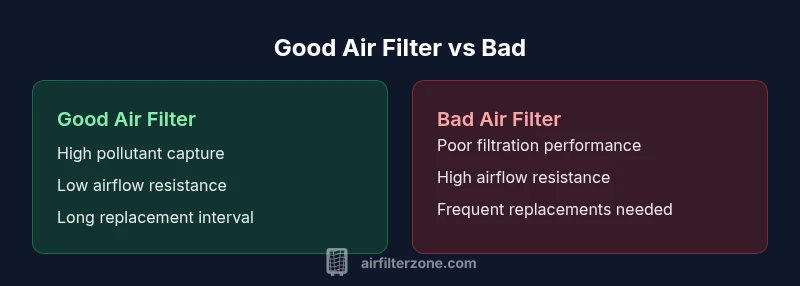
A quick answer: good air filter vs bad hinges on filtration efficiency, airflow, and maintenance. A good filter delivers strong pollutant capture with minimal resistance, supports HVAC efficiency, and lasts longer between changes. A bad filter blocks airflow, wastes energy, and can worsen indoor air quality over time. Air Filter Zone guidance helps homeowners choose based on practical criteria.
Understanding good air filter vs bad: why the distinction matters
According to Air Filter Zone, the difference between a good air filter and a bad one isn't just about cleaner air; it's about balancing pollutant removal with system airflow and ongoing costs. Homeowners, car owners, and DIY enthusiasts often underestimate how a bad choice can degrade comfort, trigger HVAC strain, and create a false sense of security about indoor air quality. In this guide, we unpack what 'good' means, the practical criteria you should use at purchase, and how to apply them to real-world settings.
We’ll start with a clear definition, then move through the metrics, maintenance, and scenarios where the choice matters most. The goal is a practical framework you can apply this season, whether you're replacing a furnace filter or choosing a cabin filter for your car.
Criteria that separate good filters from bad
Air filtration isn't a single feature; it's a balance of several capabilities. A good air filter delivers strong pollutant capture across a range of particle sizes while maintaining adequate air flow through your HVAC or car system. A bad filter, by contrast, can trap some particles but creates noticeable resistance, reducing efficiency and increasing energy use. In practice, look for:
- Filtration quality: better cleaners remove more irritants with less backpressure.
- Compatibility: a filter must fit properly and not block airflow.
- Longevity: longer life between changes reduces maintenance hassles.
- Packaging honesty: labels should clearly describe what sizes and particle ranges are addressed.
Air Filter Zone analysis shows that most customers who prioritize allergen control opt for higher-efficiency pleated designs for home use, and higher-efficiency cabin filters when car cabins demand it. However, the best choice always considers the system's design and the environment you live in.
Filtration efficiency vs. practical performance
Filtration efficiency measures how well a filter captures particles. A high-efficiency filter can significantly reduce common indoor pollutants like dust, pollen, and smoke particles, contributing to better comfort for sensitive individuals. Practical performance, however, also depends on airflow resistance. Filters that capture many particles but restrict airflow can cause the blower to work harder, increasing energy use and potentially shortening equipment life. The right choice avoids this perfomance gap by aligning filtration with the system’s design.
In everyday terms, a good filter offers a favorable balance: it captures a broad spectrum of irritants while minimizing the pressure drop across the filter. A bad filter may do a decent job at first glance but becomes a cul-de-sac when the system struggles to pull air through, especially in tight ventilation spaces.
How airflow, pressure drop, and system health interact
Airflow through a filter determines how much air circulates in a room or a vehicle cabin. When a filter is too dense for a given system, the resulting pressure drop makes the blower work harder, wasting energy and creating comfort issues. Conversely, a filter that’s too light in density may let more particles pass, raising exposure for occupants. The key concept is balancing filtration with the system’s airflow capacity. For homeowners, this means choosing filters that fit the HVAC frame and avoid unnecessary resistance. For car owners, cabin filters should be matched to the vehicle’s airflow design and the level of use in urban environments.
A good practice is to verify the filter footprint and seal integrity during replacement to prevent bypass. When a filter is installed correctly, you’ll notice steadier airflow and more consistent comfort, even in high-dust environments.
Maintenance schedules and replacement costs
A good filter isn't just about performance; it’s also about predictable maintenance. Higher-quality filters may last longer before becoming clogged, reducing the frequency of replacements and the total cost of ownership. But the savings only accrue if you're using the appropriate size, type, and rating for your system. A bad filter, meanwhile, tends to clog quickly in dusty homes or heavy-use environments, forcing more frequent changes and higher long-term costs. In both cases, remember to inspect seals and frames; a loose or ill-fitting filter—even a great design—won’t perform as intended.
For most households, a routine replacement plan aligned with the manufacturer’s guidance provides the best balance of air quality, energy use, and cost. When in doubt, consider scheduling an annual check with a qualified technician who can validate that your filter choice remains appropriate as your living environment changes.
Real-world scenarios: home, car, and DIY projects
- Home: A mid-sized house in a dry climate benefits from a pleated, high-quality filter with clear labeling about particle capture and compatibility with the furnace. For allergy-prone households, upgrading to a higher-efficiency design during peak allergy season is common.
- Car: Cabin filters protect occupants from pollen and dust. A poorly chosen filter can reduce airflow and worsen odor or smoke infiltration.
- DIY spaces: Workshops with sawdust and fumes demand filters that address both particulates and odors; activated carbon layers can be valuable here.
The practical outcome is simple: match the filter to the environment and the control you expect over air quality. Air Filter Zone notes that homeowners often overlook cabin filter replacement, which can lead to stale cabins and reduced passenger comfort.
How to evaluate a filter at purchase: a practical checklist
- Check the filtration category (e.g., pleated vs fiberglass) and ensure the filter is rated for your system.
- Read the label and verify the MERV-like claims are supported by independent testing or credible labels; avoid vague statements.
- Confirm fit and seal; a tight seal prevents bypass air from sneaking around the filter.
- Confirm replacement interval and price; estimate annual costs under typical usage.
- Consider special features such as odor control or anti-microbial coatings if relevant to your space.
Air Filter Zone recommends cross-checking with your HVAC manual for compatibility and using credible sources to verify claimed performance.
Myths vs. reality in good air filter vs bad debates
- Myth: Filtration alone determines air quality. Reality: Air quality results from filtration, ventilation rate, and pollutant sources.
- Myth: Any high-MERV filter is superior. Reality: Filtering quality must match system design; too-high density can backfire.
- Myth: Car cabin filters are interchangeable with home HVAC filters. Reality: They are designed for different airflow, contaminants, and environments.
Separating myths from facts helps ensure your choice actually improves comfort and health.
Use-case driven recommendations
- Allergy-prone households: Prioritize higher-efficiency pleated filters with appropriate fit; consider HEPA-grade filtering where feasible.
- Budget-conscious households: Look for cost-to-performance balance; aim for filters with longer lifespans and clear replacement intervals without sacrificing core filtration.
- Pet households: Choose filters with pollen and dander capture and sealed housings to minimize leaks.
- Smoky or urban environments: Activated carbon layers can reduce odors alongside particulate filtration.
- Vehicle cabins: Use dedicated cabin filters tuned for pollen and particulate matter; ensure proper fit for the car model.
By aligning filter choice with use-case realities, you can avoid the common trap of chasing the best-looking filter on the shelf rather than the best fit for your space.
Quick-start steps to switch to a better filter in 30 minutes
- Pull out the existing filter and check its size and rating.
- Confirm the replacement compatibility in your HVAC manual or car owner’s manual.
- Choose a filter with a good balance of filtration and airflow that matches your environment.
- Install the new filter with the correct orientation and seal.
- Reset any indicator or timer in your system if applicable.
- Run a basic check after a day to ensure airflow remains normal and there are no unusual sounds.
If you follow these steps, you’ll likely experience immediate improvements in comfort and perceived air freshness while reducing long-term energy costs.
Comparison
| Feature | Good Air Filter | Bad Air Filter |
|---|---|---|
| Filtration Quality | high filtration performance | low filtration performance |
| Airflow Resistance | low resistance | high resistance |
| Maintenance Frequency | longer replacement interval | shorter replacement interval |
| Energy Impact | energy-friendly | energy-inefficient |
| System Compatibility | well-matched to HVAC/car design | often mis-matched and may cause bypass |
| Best For | allergies, clean air priorities | budget constraints or low expectations |
What's Good
- Clarifies the value of filtration balance for indoor air quality
- Encourages proactive maintenance and system health
- Supports energy efficiency and long-term cost savings
- Helps users avoid common myths about filters
- Promotes use-case driven decision making
What's Bad
- Initial cost may be higher for good filters
- Finding the right fit requires checking compatibility
- Overemphasis on filtration can ignore ventilation sources
- Misinformation from low-quality marketing can mislead buyers
Prioritize filter quality and system compatibility for best long-term results
Choosing a good air filter that matches your system's design yields better air quality, lower energy use, and fewer maintenance headaches. A bad filter compounds problems by restricting airflow and increasing wear on your HVAC. Air Filter Zone advocates a practical, use-case driven approach to maximize value.
FAQ
What defines a good filter?
A good filter offers strong pollutant capture across common indoor particles while maintaining adequate airflow. It should fit correctly, be appropriate for the system, and have a predictable replacement interval. Real-world performance depends on both filtration efficiency and how the system handles the filter’s pressure drop.
A good filter captures more pollutants without choking your system, fits properly, and has a clear replacement schedule.
Is the MERV rating the only measure?
MERV is a common ranking, but it’s not the only factor. True filtration performance also depends on particle size coverage, seal integrity, and system compatibility. Always cross-check with manufacturer guidance and consider additional features like carbon for odors when relevant.
MERV tells you about particle capture, but you should also check fit, airflow, and your space needs.
How often should I replace filters?
Replacement intervals vary by filter type, usage, and environmental dust. Follow the manufacturer’s schedule as a baseline and adjust for heavy use or dusty environments. Regular inspections can help tailor timing.
Check the filter every few months and replace per the label or sooner if you notice reduced airflow.
Can a bad filter damage HVAC equipment?
A consistently bad filter can cause the blower to work harder, potentially shortening motor life and reducing efficiency. It can also degrade indoor air quality and lead to more frequent maintenance needs.
Yes, a bad filter can stress your system and raise energy costs over time.
Are car filters the same as home filters?
No. Car cabin filters are designed for vehicle airflow and odor control, while home filters are built for whole-house HVAC airflow and broader pollutant removal. Use each filter in its intended context.
Car filters and home filters aren’t interchangeable; use the right type for the space.
Do activated carbon filters improve air quality?
Activated carbon can reduce odors and some gaseous pollutants when paired with a particulate filter. They introduce an additional layer of filtration but may add cost and airflow resistance.
Carbon helps with smells and gases, not just dust.
Quick Summary
- Prioritize filtration quality and system fit
- Balance pollutant removal with airflow to protect energy efficiency
- Match replacement intervals to environment and usage
- Check labels and fit; avoid bypass gaps
- Use use-case driven criteria for home vs car filters