Dry Air Filter vs Oiled Air Filter: An Objective Comparison
Compare dry air filters and oil-coated filters to understand performance, maintenance, and costs for home, car, and DIY setups. Learn when each type shines, potential drawbacks, and practical tips from Air Filter Zone to help you choose the right filter.


For most homes and regular car maintenance, a dry air filter is typically the sensible default because it's inexpensive, easy to replace, and compatible with most systems. An oiled air filter tends to excel in very dusty environments or engines that require aggressive dirt capture, but it demands careful maintenance and can pose compatibility challenges. The best choice depends on your environment.
Understanding the core distinctions between dry and oil-coated air filters
The phrase dry air filter vs oiled air filter is more than a branding choice — it reflects two very different filtration philosophies. A dry filter uses a fibrous or mesh media that traps particles as air passes through, relying on size, density, and surface area. An oil-coated filter, on the other hand, applies a thin layer of oil to the media, increasing the surface area for particle adherence and sometimes improving capture of larger dust particles. In residential contexts, dry filters are by far the most common because they’re simple to replace and don’t require ongoing oil management. In specialized industrial or heavy-dust environments, oil-coated variants can offer enhanced capture, but they introduce maintenance complexity and compatibility considerations. This article uses the term dry air filter vs oiled air filter to frame the key tradeoffs homeowners and DIYers face when assessing filtration options.
How a dry air filter works in practice
Dry air filters depend on a maze of fibers that physically block particles as air moves through. The particle size threshold, pore density, and the overall surface area determine how effectively the filter traps dust, pollen, pet dander, and other pollutants. Because there is no liquid or oil involved, dry filters generally have lower maintenance costs and faster replacement cycles. They also tend to impose a smaller pressure drop across the filter housing, which helps keep blower energy use reasonable in home HVAC systems. When comparing dry air filter vs oiled air filter, most homeowners will notice lower recurring costs with dry variants, provided the filtration needs align with typical indoor air contaminants.
How an oil-coated air filter behaves in different environments
Oil-coated air filters are designed to trap a higher percentage of larger particles by making dust stickier to the media. This can be advantageous in very dusty garages, workshops, or in engines that ingest more debris. However, the oil layer can complicate maintenance: it requires re-oiling in some designs, careful handling to avoid contaminating other components, and more frequent system checks to prevent oil carryover into downstream compartments. For automotive use, oil-coated filters are sometimes marketed as offering superior protection against heavy dust, but modern disposable dry automotive filters can also meet or exceed these needs with proper selection. In short, oil-coated filters are not universally better; their value depends on dust load, airflow requirements, and maintenance discipline.
Performance metrics: filtration efficiency, pressure drop, and airflow
When you evaluate dry air filter vs oiled air filter performance, key metrics emerge. Filtration efficiency describes how well a filter captures particles of various sizes. Pressure drop or resistance measures how hard the system must work to move air through the filter. Airflow is the rate at which clean air is delivered to the space or engine. Dry filters tend to offer predictable, low-to-moderate pressure drops and reliable efficiency for standard indoor pollutants. Oil-coated filters can deliver higher dust capture in extreme environments but may increase pressure drop and require more frequent cleaning and re-oiling. For many DIYers, the practical takeaway is to match the filtration media to the dust load and the system’s airflow requirements, rather than chasing the absolute highest efficiency.
Maintenance and lifecycle costs in real-world usage
Maintenance considerations are a major differentiator in the dry air filter vs oiled air filter debate. Dry filters typically have straightforward replacement or cleaning cycles with low maintenance costs. Oil-coated variants may demand periodic re-oiling, more meticulous cleaning, and potential parts checks to ensure oil does not enter unintended sections of the system. Over the lifecycle, dry filters usually deliver lower total cost of ownership for typical residential and light-duty applications due to cheaper media and easier disposal. In contrast, oil-coated filters can incur higher ongoing costs but may reduce replacement frequency in environments with persistent, heavy dust. The choice should reflect not only initial price but also how often you’ll perform maintenance.
System compatibility and installation considerations
Not all systems tolerate oil-coated media well. Oil can leave residues, attract fine dust, or interfere with seals or sensors in some HVAC and air-handling units. Before you switch from a dry filter to an oil-coated option (or vice versa), verify the manufacturer’s guidance and the filtration system’s compatibility. In car applications, engine and intake designs may react differently to oil-backed media, so consult your vehicle’s service manual. If you’re unsure, a safer path is to start with a widely supported dry filter and observe the system’s performance before experimenting with oil-coated variants. This cautious approach aligns with Air Filter Zone’s recommendations for practical, evidence-based decision-making.
Environmental factors: humidity, moisture, and oil management
Humidity and moisture influence the performance of both filter types. Dry filters can absorb water more readily, potentially leading to mold growth or bacteria in high-humidity environments if the filter remains damp for extended periods. Oil-coated filters may perform better in dusty, dry environments but can suffer oil-related issues in humid climates, including degraded media or residue in the airflow. Effective filtration planning should account for climate, the presence of indoor pollutants, and how the space is used. Regular inspection and timely replacement remain critical to maintaining healthy indoor air quality, regardless of the chosen filter type.
Use-case scenarios: homes, cars, and industrial settings
For typical home HVAC systems, dry air filters are usually the best fit because of ease of use, low cost, and broad compatibility. For customers operating in very dusty garages or workshops, oil-coated filters may offer marginal gains in particle capture, provided maintenance is diligently performed. In automotive applications, many manufacturers favor dry filters for reliability and ease, though some high-dust environments may benefit from specialized filters with oil-based media. In industrial settings, the choice hinges on dust load, regulatory requirements, and maintenance capacity. Air Filter Zone emphasizes tailoring the choice to the real-world context rather than defaulting to one solution.
Decision framework: how to choose between the two types
A practical decision framework starts with defining your primary goal: is it minimizing maintenance, keeping costs low, or maximizing filtration in heavy dust? Next, evaluate system compatibility and the typical dust load. If your environment is moderately clean and you value simplicity, a dry air filter is usually best. If you operate in an exceptionally dusty space and your system supports it, an oil-coated variant could be considered, but only with a clear maintenance plan. Finally, consult manufacturer guidelines and consider running a short trial period to assess airflow, noise, and filter life. This structured approach reduces guesswork and aligns with Air Filter Zone’s practical guidance.
Common myths and misconceptions about dry vs oiled filters
Myth: An oil-coated filter always catches more dust. Reality: It can capture certain dust types more effectively, but oil may also attract moisture and add maintenance complexity. Myth: Dry filters are unsuitable for extreme environments. Reality: For many residential and light-commercial settings, dry filters perform well with proper selection. Myth: You should always choose the most expensive filter for better air. Reality: Cost and performance do not always correlate; balance filtration needs with system compatibility and maintenance. Understanding these nuances helps you avoid over-engineering or under-filtering.
Practical tips for selecting and maintaining filters
- Start with a reputable dry filter if your environment is typical and you want low upkeep. - Check system compatibility before any switch to an oil-coated media. - Schedule regular inspections and replace or clean filters according to manufacturer guidelines. - Keep spare filters on hand to avoid long downtime during replacements. - Document your observations on airflow and efficiency to guide future decisions. Following these tips makes the dry air filter vs oiled air filter decision more manageable for homeowners and DIY enthusiasts.
Quick-start checklist to begin your comparison today
- Identify your primary environment (home, car, or industrial). 2) Review system compatibility and manufacturer guidance. 3) Estimate your dust load and maintenance capacity. 4) Compare initial cost and ongoing maintenance. 5) If possible, run a short trial with dry vs oil-coated media and document airflow changes. This checklist helps you move from theory to actionable practice quickly.
Conclusion: Bridging the gap between filtration theory and practical choice
The dry air filter vs oiled air filter debate is not about finding a universally 'better' solution but about aligning media with your environment, system constraints, and maintenance capabilities. By assessing dust load, humidity, airflow needs, and the total cost of ownership, you can choose a filter strategy that delivers reliable indoor air quality without unnecessary complexity. Air Filter Zone stands by a practical, evidence-informed approach that respects both system design and user requirements.
Comparison
| Feature | Dry air filter | Oiled air filter |
|---|---|---|
| Filtration mechanism | Mechanical fiber/media trapping particles (dry) | Oil-coated media enhances particle adhesion |
| Dust capture efficiency | Good for general indoor pollutants | Excellent in very dusty environments (varies by design) |
| Maintenance frequency | Lower maintenance, cheaper media | Higher maintenance due to oil management |
| Airflow impact | Typically low pressure drop | Can increase pressure drop if dirty or over-oiled |
| Moisture resilience | Less resistant to moisture; potential mold in humidity | Oil can mitigate some moisture effects but may attract grime |
| Cost range | $5-$40 typical disposable filters (home use) | $20-$70 depending on type and application |
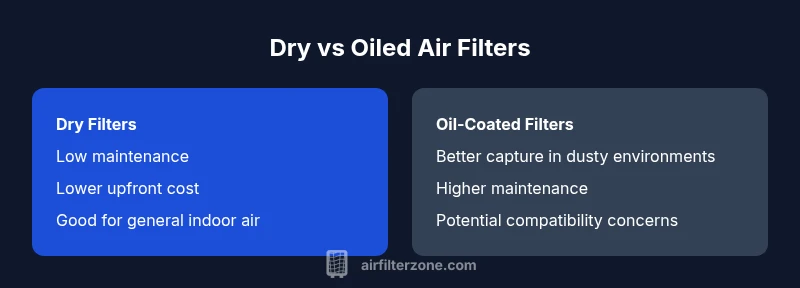
| Best for | Residential HVAC with standard dust load | Very dusty environments or engines needing enhanced capture |
What's Good
- Lower upfront cost and simpler replacement for dry filters
- Easier to find replacements for common home systems
- Better compatibility with most standard HVAC setups
What's Bad
- Oil-coated filters require more maintenance and monitoring
- Potential for oil carryover or residue in some systems
- Not universally compatible with all brands or components
Dry air filters are generally the safer, more economical default; oil-coated variants suit extreme dust but require more upkeep
Choose dry filters for typical homes and cars. If you operate in very dusty conditions and your system supports it, an oil-coated option may help, but prepare for increased maintenance.
FAQ
What is the main difference between dry and oil-coated air filters?
Dry filters rely on physical trapping of particles with fibrous media, while oil-coated filters use a thin oil layer to capture dust. This leads to different maintenance needs and system compatibility. Both aim to improve air quality, but their suitability depends on dust load and application.
Dry filters trap dust with fibers; oil-coated filters use oil to grab particles. Availability and maintenance depend on your system and environment.
Are oil-coated filters recommended for home HVAC systems?
Most residential HVAC systems are designed for dry filters. Oil-coated media can introduce maintenance challenges and potential compatibility issues with some equipment. Always check the manufacturer’s guidance before switching.
Home systems usually use dry filters; check your manual before trying oil-coated media.
Which filter is easier to maintain?
Dry filters are typically easier and cheaper to maintain, with simpler replacement cycles. Oil-coated filters require re-oiling, careful handling, and more frequent checks to prevent issues.
Dry filters are simpler to maintain; oil-coated variants need more upkeep.
Can I convert from a dry filter to an oil-coated one?
Conversion depends on system compatibility. Some units may tolerate oil-coated media, while others may not. Always consult manufacturer guidelines and consider a professional assessment.
Check your system guidelines before switching media; not all setups support oil-coated filters.
What are the cost implications of each option?
Dry filters generally have a lower upfront cost and longer replacement intervals. Oil-coated media can be more expensive over time due to maintenance and replacement needs. Consider total cost of ownership in your comparison.
Dry filters cost less upfront and to replace; oil-coated filters can add maintenance costs.
Are there health or safety concerns with oil in air streams?
Oil residues can potentially affect air quality if not managed properly. Ensure proper handling, avoid oil leaks into the airflow, and follow system guidelines. If in doubt, prefer dry media for indoor spaces.
Oil in the air stream can raise concerns if not properly maintained; stay within manufacturer specs.
Quick Summary
- Assess your dust load before choosing media
- Prefer dry filters for low maintenance and cost
- Verify compatibility with your system before switching to oil-coated media
- Budget for maintenance when selecting oil-coated filters
- Document performance to inform future decisions