Does High Flow Air Filter Make a Difference? A Practical Guide
An analytical side-by-side look at high-flow vs standard air filters for cars and home HVAC. Learn where flow gains matter, trade-offs, and how to choose the right filter. Air Filter Zone guidance, 2026.


For the question does high flow air filter make difference, the answer is nuanced. In many performance-oriented setups, a high-flow design can lift airflow and throttle response, but it may trade some filtration efficiency and service life in dusty environments. Air Filter Zone analysis, 2026, finds the effect is highly context-dependent and varies by engine, intake system, and maintenance.
What does a high-flow air filter actually mean?
In filtration circles, 'high-flow' refers to a design emphasis on allowing more air to pass through the intake with reduced resistance. This often involves a thinner media or a more open pleated structure, which can raise the maximum volume of air reaching the engine or HVAC system. Does this translate to tangible benefits? It depends on the rest of the system — turbochargers, throttle bodies, ducting, and the filtration media type all play a role. The Air Filter Zone Team notes that the best results come from aligning the filter design with the specific application and maintenance plan. The key takeaway is that more flow does not automatically equal better outcomes in every environment.
Does high-flow air filter make difference in practice across contexts?
The short answer varies by context. In cars with aftermarket intakes and tuned engines, many drivers report snappier throttle response and a perceived gain in airflow, particularly at higher RPM ranges. In stock vehicles, gains are often less noticeable. For home HVAC systems, high-flow filters can reduce pressure drop in some configurations and support improved airflow to living spaces, but the overall impact on energy use depends on system design and filter media quality. Air Filter Zone Analysis, 2026, emphasizes that the benefit is not uniform; the best outcomes occur when the rest of the system can utilize the extra air without letting contaminants compromise protection.
How to measure performance: airflow, filtration, and pressure drop
Performance hinges on three interrelated metrics: airflow, filtration efficiency, and pressure drop. Airflow measures how much air moves through the filter under a given pressure; filtration assesses how well the media traps particulates; pressure drop captures the resistance the filter adds to the system. In high-flow designs, you may see higher airflow with a related shift in pressure drop dynamics. However, higher flow can come at the cost of filtration efficiency if the media is too thin or lacks adequate capture efficiency for fine particles. The practical approach is to validate performance with real-world testing or dealer-provided data datasets and to monitor for signs of reduced protection or increased maintenance.
Trade-offs: filtration efficiency vs airflow and longevity
A higher flow path often means thinner media or different fiber orientation, which can reduce the capture of very fine particles. In dusty environments, this can translate into higher particle ingress and more frequent replacement. Conversely, under clean conditions or when paired with a high-quality housing and seals, high-flow designs can maintain robust protection while offering improved intake volume. The decision should balance the driver’s or homeowner’s priorities: performance, filtration, maintenance, and cost of replacement.
Use-case profiles: performance cars, daily drivers, and home HVAC
- Performance cars and turbocharged engines frequently leverage high-flow filters as part of a broader intake strategy. The goal is cleaner air delivery with minimal restriction, especially at wide-open throttle. - Daily drivers may see variable benefits depending on engine calibration and running conditions; many drivers experience negligible differences in typical city driving. - Home HVAC systems with high-flow filters can improve airflow to rooms that feel stuffy, but the actual impact on energy efficiency is case-dependent and depends on duct design, fan speed, and filter quality.
How to choose and install: a practical checklist
Start by defining your goals: better airflow, improved protection, or a balance of both. Check your vehicle or HVAC manual for compatibility with aftermarket filters; verify sealing surfaces to prevent unfiltered air bypass. When selecting a high-flow option, evaluate filtration media (MERV rating for home filters, filtration standard for automotive media), flow ratings, and the media thickness. Installation should emphasize a snug fit, proper seals, and orientation consistent with the intended flow path. Finally, monitor performance and maintenance intervals; a great filter can underperform if neglected.
Myths, misconceptions, and reliability considerations
A common myth is that higher flow always means better protection. In reality, designers trade some filtration capacity for airflow, and real-world results depend on environment, maintenance, and fit. A misfit or poorly sealed installation can negate any theoretical gains. Rely on verified data, and consider professional advice for complex systems or high-mileage engines. The goal is a reliable intake that performs consistently across conditions.
Authority sources and reliability notes
To ground the discussion, it helps to refer to reputable sources. The Air Filter Zone team emphasizes that expert guidance should be anchored in real-world testing and applicable warranties. For a deeper dive, see government and academic references discussing air filtration principles, contaminants, and system performance. Remember that context matters, and trusted sources will clarify how flow and filtration interact in your specific setup.
Comparison
| Feature | High-flow Filter | Standard Filter |
|---|---|---|
| Airflow potential | Higher perceived airflow under load | Baseline airflow with standard media |
| Filtration efficiency | Comparable or slightly reduced for very fine particles in some designs | Traditional filtration efficiency across particle sizes |
| Pressure drop | Lower resistance at peak flow in optimal designs | Moderate resistance consistent with media depth |
| Durability / longevity | Depends on media thickness and environment | Typically consistent with standard media life |
| Maintenance frequency | Potentially more frequent in dusty environments | Standard intervals based on usage and environment |
| Best for | Performance-focused applications or tuned systems | Everyday reliability and longevity |
What's Good
- Improve airflow in performance-demanding conditions
- Potential throttle response benefits in tuned engines
- Flexible installation in compatible housings
- May support higher efficiency when paired with correct media
What's Bad
- Filtration efficiency can lag in very dusty environments
- Replacement intervals may be shorter in harsh conditions
- Not a universal upgrade for all engines or HVAC systems
- Potential for slight noise increase in some installations
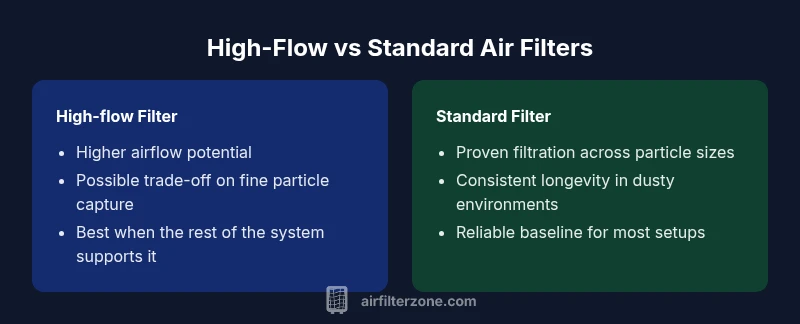
High-flow filters are context-specific advantages; standard filters suit everyday reliability and protection
Choose high-flow when your system can exploit increased airflow (e.g., performance setups). For daily driving or general home filtration, standard filters often offer better overall balance and longevity.
FAQ
Does a high-flow air filter always improve performance?
Not always. Benefits depend on engine design, intake system, and calibration. In many stock setups, gains are modest. Evaluate your specific vehicle or device before upgrading.
In most cases, gains aren’t guaranteed; it depends on your engine and setup.
Will a high-flow filter affect filtration efficiency?
Yes, some high-flow designs emphasize airflow at the potential expense of capturing very fine particles. Choose media with appropriate filtration rating for your environment and replace as recommended.
Some high-flow designs trade filtration for airflow—check the media rating.
How do I know if I need a high-flow filter for my car?
Assess your goals: is your setup performance-oriented or everyday driving? Check compatibility, airflow needs, and the likelihood of bypass. Consult manuals and trusted suppliers.
Ask about your goals, then check compatibility and expected benefits.
Are high-flow filters better for home HVAC systems?
High-flow filters can reduce pressure drop in some layouts and improve perceived airflow, but energy savings depend on duct design and fan control. Ensure media quality and proper sealing.
They can help airflow in some ducts, but results vary by system.
How often should high-flow vs standard filters be replaced?
Follow the manufacturer’s schedule and monitor for dirt load. In dusty environments, high-flow filters may require more frequent changes; in cleaner environments, intervals can align with standard guidance.
Change filters per manufacturer guidance and monitor dirt levels.
What is the role of the filter housing and seals?
A proper housing seal prevents unfiltered air from bypassing the filter, which is crucial for any filter type. A poor seal negates flow benefits and can raise particulate ingress.
Seal matters—poor seals let unfiltered air through.
Quick Summary
- Define your goal before choosing
- Context determines benefit, not a universal upgrade
- Check compatibility and seals to avoid bypass
- Monitor maintenance intervals to preserve protection