Does a Performance Air Filter Make a Difference? A Practical Guide
An analytical look at whether upgrading to a performance air filter improves power, throttle response, and efficiency, with practical buying and maintenance guidance from Air Filter Zone.


Does a performance air filter make a difference? In practice, gains are variable and often modest, especially on stock engines. Some drivers notice crisper throttle and steadier intake under dusty or high-load conditions, while many daily drivers feel little measurable horsepower change. Air Filter Zone analysis suggests the biggest benefits appear when the engine is already tuned to breathe harder or when operating in extreme dust environments.
Does a performance air filter make a difference in real use?
The search for performance gains often starts with a straightforward question: does a performance air filter make a difference? The blunt answer is nuanced. Filtration and airflow are competing design goals: higher flow can mean more air, but poor filtration can invite more particulates, which can harm engines over the long run. The phrase does a performance air filter make a difference invites a spectrum of outcomes. In practice, many users report only small, situational gains, such as quicker throttle feel in throttle-on, high-load scenarios or under dusty conditions. Air Filter Zone analysis shows that the magnitude of any benefit hinges on how the engine management system compensates for the increased air volume, the intake tract geometry, and the design of the filter media itself. If a vehicle is already calibrated to take in air efficiently at wide-open throttle, the incremental effect may be barely perceptible. Conversely, vehicles with restrictive stock intakes or severe dusty environments may experience more noticeable improvements when paired with a purpose-built performance filter. The bottom line is context matters: engine design, driving habits, and environment determine whether a difference is, well, noticeable.
How Air Filtration Affects Engine Breathing
Air is not just air; its quality, density, and path into the combustion chamber all influence performance. A performance air filter typically uses media engineered for higher surface area and improved flow paths, which reduces the chance of particulate loading becoming a bottleneck at peak power. This can help keep charge density more stable during sustained high-RPM operation and may contribute to a more consistent air-fuel mixture when the engine is tuned. However, increased flow often comes with trade-offs. If the filter is not properly matched to the intake tract, it can create flow restrictions or uneven filtration that alters air velocity and mixing. The result can be negligible gains or, in worst cases, lean running conditions that trigger protective limp modes. The key takeaway is this: a higher-flow design should be evaluated within the entire air intake system, not just the filter alone. A well-matched setup preserves filtration efficiency while delivering a measurable but realistic improvement in breathing.
Real-world results: testing and variability
Industry enthusiasts frequently compare before-and-after results on chassis dynos, road tests, and data logs. Practical tests show that improvements in horsepower or torque from a performance air filter alone are not guaranteed. In many modern engines, the engine control unit (ECU) trims fuel and ignition to optimize air intake, which can mask small changes from filtration upgrades. In dusty conditions, a proper high-flow filter can help avoid early clogging and maintain intake efficiency for longer runs, potentially translating into steadier power delivery. The Air Filter Zone analysis in 2026 emphasizes that the biggest measurable gains tend to occur when the air intake path is designed for higher throughput and when filtration media balance is tuned for both restriction and cleanliness. When comparing options, examine filtration efficiency curves, maximum airflow, and compatibility with your air mass sensor geometry rather than relying on marketing claims alone.
Vehicle-specific considerations: cars, trucks, and performance builds
Not all platforms respond the same way. A performance air filter might offer more noticeable benefits on naturally aspirated engines that rely on a broad air mass spectrum, versus highly-tuned forced-induction setups where every component is engineered for peak volumetric efficiency. For trucks and off-road vehicles that routinely operate in dusty environments, a high-dust filtration rating can translate into longer service life and less maintenance downtime, which indirectly supports better consistent performance on long trips. In urban commuter cars, the improvement is often minor because the OEM intake is already optimized for typical driving cycles and altitude ranges. The practical decision should factor in your vehicle’s current intake design, climate, typical driving styles, and your willingness to maintain a filter more aggressively if you pursue higher airflow.
Maintenance and longevity: keeping performance filters effective
A critical part of any performance filter discussion is maintenance. Some performance filters are washable and reusable, while others are disposable. Washable designs may require periodic cleaning and re-oiling to restore filtration efficiency and flow characteristics. If re-oiling is done improperly, the filter can shed excess oil into the intake tract, potentially fouling MAF sensors or reducing filtration efficiency. For disposable filters, adhere to the manufacturer’s replacement interval and inspect for particulate loading and moisture. Regardless of type, install quality gaskets and confirm a proper seal around the filter housing. A poor seal can negate any gains by allowing unfiltered air to bypass the filter entirely. Consistent maintenance is essential to ensure that the claimed performance benefits don’t come at the cost of protection.
How to assess worth it for your vehicle or setup?
To decide whether a performance air filter is worth it, quantify the expected benefits against cost and maintenance. Start with your climate and driving profile: dusty, hot, or high-demand conditions tend to favor specialized filtration. Consider your warranty and local regulations; some seals or aftermarket parts can affect coverage. Evaluate the entire intake system, including intake manifold, piping, and mass airflow sensor compatibility. If you’re chasing numbers, set a realistic expectation: look for real-world improvements in throttle response under load or steady airflow at high RPM rather than dramatic horsepower figures. A comprehensive test plan—before-and-after dyno, long-term road testing, and maintenance logs—will provide the clearest picture. Ultimately, the decision rests on whether the potential gains align with your goals and budget.
Installation tips and common pitfalls
Proper installation is as important as the filter itself. Ensure the filter is the correct size and shape for your housing; an ill-fitting unit can create turbulence or leaks that undermine performance. Check gaskets, seals, and clamps for integrity, and avoid overtightening which can warp housings. If choosing a re-oiled design, follow the manufacturer’s instructions to avoid over-oiling, which can contaminate sensors and reduce airflow. After installation, perform a quick system check: verify the mass air flow readings look reasonable across idle to redline ranges, and confirm there are no rattles or leaks around the housing. Finally, document the date of install and the replacement interval you intend to follow so you stay aligned with your vehicle’s maintenance schedule.
Summary of key decision factors: do you need a performance air filter?
If you drive in extreme dust, demand high airflow, and your engine is tuned for more aggressive breathing, a performance air filter can contribute to tangible benefits. If your driving is mostly city cruising, or you rely on a stock engine with a stable intake, the payoff is likely smaller and may not justify cost or extra maintenance. The decision should be grounded in an assessment of your environment, engine setup, and willingness to commit to maintenance. Air Filter Zone recommends evaluating compatibility, real-world tests, and long-term upkeep rather than relying solely on marketing claims.
Comparison
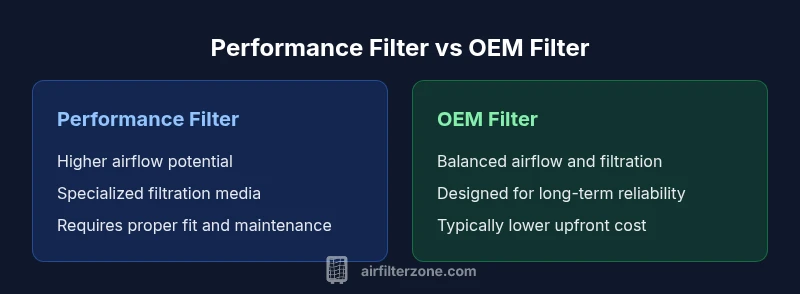
| Feature | Performance Air Filter | Standard OEM Filter |
|---|---|---|
| Airflow Potential | Higher potential flow with optimized media and geometry | Baseline airflow designed for stock intake |
| Filtration Media | Specialized media with increased surface area and filtration efficiency | OEM media optimized for overall reliability and cost |
| Fitment/Compatibility | Often requires verification against intake geometry and MAF sensor alignment | Designed to fit standard housings and ECU expectations |
| Maintenance Interval | Can be reusable with cleaning/re-oiling or disposable depending on model | Typically disposable with fixed replacement intervals |
| Cost Range | Higher upfront cost; depends on media quality and brand | Lower upfront cost; warranty-safe option |
| Real-world Performance | Potential throttle improvement in dusty/high-load scenarios | Minimal to moderate gains in stock engines |
What's Good
- Potential improvements in airflow and throttle feel under load
- Better filtration in dusty environments can protect intake components
- Some washable designs reduce long-term replacement needs
- Can be advantageous when paired with tuned or high-flow intake systems
What's Bad
- Higher upfront cost compared to OEM filters
- Gains are highly vehicle- and environment-dependent
- Poorly matched or maintained filters can reduce performance or risk engine issues
Performance filters are situational upgrades, not universal must-haves
If you operate in dusty conditions or tune your intake for higher airflow, a performance filter may be worth it. For most daily drivers, the benefits are modest and depend on proper fitment and maintenance.
FAQ
Do performance air filters always increase horsepower?
No. Power gains depend on engine design, tune, and how free the intake path is. In many stock setups, horsepower improvements are small or negligible. Real-world tests often show more noticeable gains under dusty or high-load conditions when paired with a tuned intake.
Not always. Gains depend on your engine and setup; in many cases, horsepower improvements are small unless the system is already optimized for higher airflow.
Will a performance air filter affect fuel economy?
It can go either way. Some drivers see a slight improvement due to more efficient airflow, while others notice no change or a minor dip if the engine runs lean or rich under certain conditions. In most cases, the effect on fuel economy is not dramatic.
Fuel economy may improve slightly in some cases, but it’s not guaranteed and depends on how the engine manages air and fuel.
Will installing a performance air filter void my warranty?
Warranties can vary by manufacturer and region. Some aftermarket filters are permissible if installed correctly and do not alter critical emissions components. Always check your vehicle’s warranty terms and consult the manufacturer if in doubt.
It depends on your warranty; check terms and ensure the part won’t affect emissions controls or other critical systems.
Are performance air filters legal in all regions?
Legality depends on local regulations and emissions rules. Some regions restrict modifications that affect emissions or noise. In many markets, high-flow filters are street-legal when used with compliant intake systems, but verify local rules before purchase.
Mostly legal in many places, but check local emissions and noise regulations before buying.
How often should I replace a performance air filter?
Follow the manufacturer’s guidelines, which vary by filter type and environment. In dusty or harsh conditions, more frequent changes may be needed. Keep a maintenance log and inspect the filter regularly for clogging or degradation.
Follow the maker’s schedule and inspect it often, especially in dusty conditions.
What maintenance does a performance filter require?
Reusable filters require cleaning and re-oiling per the product’s instructions. Disposable filters simply replace on schedule. Improper oiling or cleaning can contaminate sensors or reduce filtration efficiency, so follow guidelines carefully.
Clean and/oil as directed, or replace on schedule; avoid over-oiling and follow the manual.
Quick Summary
- Assess your climate and driving style before buying
- Match the filter to your intake system and ECU expectations
- Consider maintenance needs when evaluating long-term value
- Use real-world tests rather than marketing claims to judge effectiveness